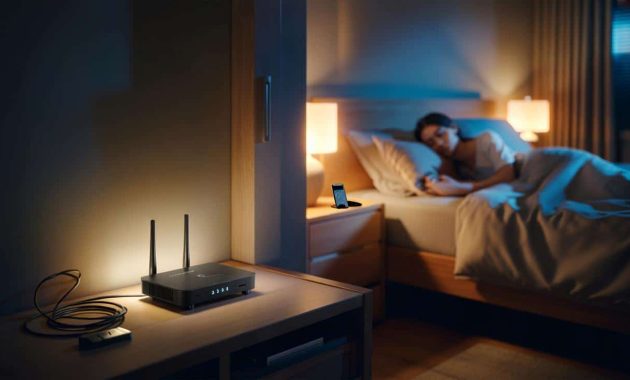
More people are starting to ask a simple question: if we are asleep and (supposedly) offline, why is the WiFi still on? Behind that tiny light on the box sit concerns about sleep quality, electricity bills and the way constant connectivity shapes our evenings.
Why some experts say night-time WiFi deserves a break
Modern life is built around the idea of being always connected. Phones, tablets, TVs and smart speakers keep chatting to the router, even when no one is actively using them. That permanent link has a cost that goes beyond money.
Sleep researchers and physicians increasingly encourage some form of “digital sunset” before bed. Blue light from screens is a major culprit, but the wireless environment itself is also being discussed. WiFi uses radiofrequency waves, a kind of non-ionising electromagnetic radiation, to move data between your devices and the internet box.
Several studies suggest that cutting unnecessary signals at night may support deeper, more stable sleep for some people.
Scientists do not agree on every detail. Large public health agencies currently say WiFi levels in homes sit well below regulatory limits. Yet a number of research teams have reported possible links between night-time exposure to wireless signals and changes in sleep patterns, brain activity and hormones such as melatonin, which helps regulate the circadian rhythm.
What circadian rhythm has to do with your router
The circadian rhythm is your internal body clock. It tells your brain when to feel sleepy, when to wake up and when to release certain hormones. This rhythm is finely tuned by light, temperature and behaviour.
Some laboratory studies indicate that radiofrequency exposure can slightly alter brain waves during sleep or shift hormone timing. These findings are not definitive, yet they fuel a simple question: if you do not need WiFi between midnight and 6am, why keep an extra signal active around your bedroom?
Cutting the WiFi at night becomes a low-effort precaution for households worried about sleep disturbance or long-term exposure.
For people who already struggle with insomnia, anxiety or light sleep, any measure that reduces stimulation can make a difference. Turning off WiFi often goes hand in hand with less scrolling in bed, fewer late-night emails and calmer evenings.
➡️ How a single houseplant in the bedroom increases deep sleep phases by 37%, nasa study
➡️ “I’m a machine operator and my annual income is now $54,700 with overtime included”
➡️ This “easy” plant is taking over French gardens – and it’s not always good news
➡️ India watches nervously as its main rival moves to buy 50 new warships
➡️ Africa’s deadliest snake may be the secret weapon to protect the continent’s agriculture
➡️ Goodbye hair dye : the new trend to cover gray hair and look younger
Sleep, screens and the subtle role of disconnection
When the router is on, the temptation to check one last notification rarely disappears. A phone on the bedside table, constantly refreshing over WiFi, keeps the mind half-alert. That mental agitation affects how quickly you fall asleep and how rested you feel in the morning.
Shutting down the signal sends a clear message: the digital day is finished. Some families even use it as an unofficial “lights out” for devices.
- Teenagers lose the ability to stay secretly online after midnight.
- Parents reduce the urge to work late from the sofa.
- Everyone gets a calmer, tech-free window before falling asleep.
Those changes in behaviour may matter more to sleep quality than the electromagnetic waves themselves. A quiet router often leads to a quieter mind.
What turning off WiFi does to your energy bill
Health questions draw the headlines, but the electricity angle is far clearer. A home router usually uses between 5 and 10 watts when it is on all the time. That looks tiny on paper, yet it runs 24 hours a day, 365 days a year.
If you switch the box off for eight hours each night, energy use drops. A typical household can avoid roughly 2.4 kilowatt-hours a month, depending on the model. At current tariffs in many European countries, that translates to a few pounds or euros a year.
The saving is modest for one device, but it adds up when combined with other nightly shut-offs.
The hidden cost of “phantom” devices
Energy analysts talk about “phantom” or standby consumption: the quiet trickle of power used by electronics when no one is actively using them. TVs, game consoles, streaming sticks, chargers and smart speakers often sit in this category.
In some European households, these invisible watts can reach around a tenth of the annual electricity bill. The router is only one item in a wider list of always-on devices that rarely need to run at full tilt around the clock.
| Device | Typical standby use | Simple fix at night |
|---|---|---|
| WiFi router | 5–10 W | Turn off or use a timer plug |
| TV and set-top box | 3–8 W | Switch off at the mains |
| Game console | 1–5 W | Disable instant-on mode |
| Smart speaker | 2–4 W | Unplug when not needed overnight |
Using power strips with simple on/off switches, or timer sockets programmed to cut power after a certain hour, makes these habits easier. One click before bed can silence several devices at once.
Building the habit of cutting WiFi at night
Turning off the WiFi does not require a lifestyle overhaul. The key is to attach the gesture to something you already do each evening, such as locking the front door or switching off the lights in the living room.
Some routers allow you to schedule WiFi hours directly in their settings. Others can be connected to smart plugs or cheap mechanical timers. For families, agreeing on a “WiFi bedtime” can quickly turn into a shared routine.
Framing the gesture as a household rule makes it easier for children and adults to accept a nightly offline window.
People who try it often report small but noticeable changes: fewer late-night arguments about screen time, shorter bedtimes for kids and a mild sense of relief for adults who feel they have permission to disconnect.
Who might not want to switch off completely?
Some homes rely on a constant internet connection for alarms, medical devices or remote work systems that need night-time access. In that case, cutting WiFi may not be realistic.
There are still options. You can:
- Turn off WiFi only in bedrooms by using wired connections elsewhere.
- Reduce router power output in settings when possible.
- Move the router further from sleeping areas.
These adjustments lower exposure in the spaces where the body is meant to rest, while keeping critical services connected.
Health, risk and what the science actually says
Public concern around WiFi and mobile signals has grown alongside the rise of smartphones and 5G. Large reviews from national and international health bodies generally state that exposure from routers and phones, at typical household levels, sits below official safety limits.
At the same time, some independent researchers argue that long-term, low-level exposure deserves closer study, especially for children and pregnant people. The evidence is mixed, often based on small studies or animal experiments.
Turning off WiFi at night is less about proven danger and more about applying a simple precaution when the connection is not needed.
People who are already sensitive to noise, light or stress sometimes report feeling better when they reduce wireless signals at home. Their experience may be tied to the broader calming effect of fewer alerts and less screen time, not only the radiation itself.
Practical scenarios: what a “WiFi curfew” looks like in real life
Imagine a flat where two parents and a teenager share the connection. The router is set on a timer to shut down at 11.30pm and restart at 6.30am. Phones lose WiFi access after that time, nudging everyone to stop scrolling in bed.
During the first week, there may be complaints. After a month, bedtime shifts earlier, and morning grogginess eases a little. Energy use drops slightly, but the bigger effect comes from fewer digital distractions at night.
Another household uses the router schedule only on weekdays. Weekends remain flexible, while school nights stay more structured. The routine becomes part of a wider effort: reading before sleep, dimmer lighting and charging phones outside the bedroom.
Extra context: a few terms worth unpacking
Radiofrequency waves are electromagnetic waves used by WiFi, mobile phones and Bluetooth. They are non-ionising, meaning they do not carry enough energy to break chemical bonds in cells, unlike X-rays or ultraviolet rays.
Circadian rhythm is the roughly 24-hour internal cycle that guides sleep, alertness, digestion and body temperature. Light is the main controller, but habits and possibly some environmental signals can nudge it.
When these rhythms are disrupted by late-night light, irregular bedtimes or constant stimulation, people often feel more tired, less focused and more irritable during the day. Cutting unnecessary signals and screens in the evening is one way to protect that rhythm.
Combining small steps for a bigger effect
Turning off WiFi at night rarely transforms life on its own. Its value grows when combined with other small choices: reading a physical book before bed, keeping the bedroom dark and cool, avoiding caffeine late in the day and leaving phones outside the room.
Each action removes one layer of stimulation from the night. Together, they create conditions where the brain can finally switch from constant alertness to genuine rest. For many households, flicking off the router light is a surprisingly simple place to start.