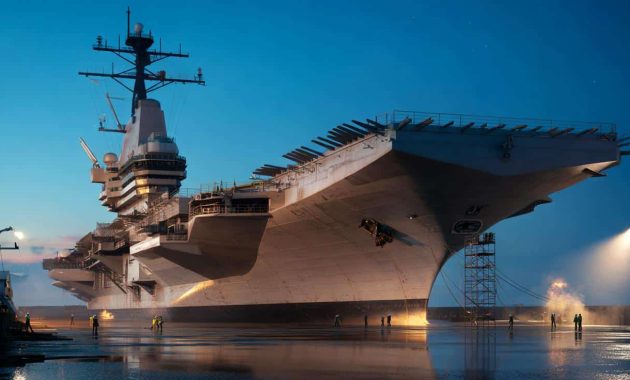
Just before dawn in Newport News, the shipyard feels half-asleep, half-electric. Floodlights throw long shadows across the dry dock, picking out welders’ sparks and the tiny silhouettes of workers moving along the flight deck of a ship so big it almost looks unreal. This is the U.S. Navy’s newest nuclear-powered aircraft carrier, the future USS John F. Kennedy (CVN-79), and up close it doesn’t look like a warship yet. It looks like a work in progress the size of a city block.
Down below, you hear the thud of tools, the crackle of radios, the low murmur of checklists being read out for the hundredth time. Somewhere deep inside the hull, systems are humming for the first time, feeding data to screens that, not long ago, were still wrapped in plastic. A $13‑billion machine is waking up, step by cautious step.
Sea trials are coming. And nobody wants any surprises.
The giant slowly comes alive
Stand near the bow of the John F. Kennedy and your brain needs a moment to catch up. The deck stretches away like an empty highway, the island rising above it with its forest of radar arrays, antennas and windows. Even for seasoned shipyard workers, watching a nuclear carrier reach this stage never seems routine. You feel the scale in your legs and in your neck as you tilt your head back.
Right now, the ship is in that strange in‑between moment: structurally complete, bristling with new tech, yet still ringed with scaffolding and temporary safety lines. Crews weave through narrow passageways that will soon be crowded with sailors on watch. Every hatch they dog shut, every cable they secure, is one more small step toward the day the ship leaves the pier under its own power and faces the Atlantic for the first time.
Walk through the shipyard and you hear the phrase “Kennedy’s getting close” more and more. Earlier this year, the Navy and Huntington Ingalls Industries started ticking off the big milestones: flooding the dry dock, powering up major systems, testing the twin nuclear reactors that will drive this floating airfield for half a century. Each successful test moves the ship toward builders’ sea trials, when shipyard and Navy teams take the carrier to sea and push every system hard.
There’s a ritual to it all. Old hands remember how it went with USS Gerald R. Ford, the first of this new class of carriers, with all its teething issues. The Kennedy team has those lessons taped to the walls, literally and mentally. Fewer surprises, smoother launches of aircraft, more reliable catapults and arresting gear. Everyone you talk to has slightly different dates in mind, but the mood is the same: the “what if” anxiety is slowly giving way to a quieter confidence.
The John F. Kennedy is only the second Ford‑class carrier, yet it already feels like a generational step. Compared to the aging Nimitz‑class ships, this hull hides electromagnetic catapults instead of steam pistons, advanced arresting gear, a redesigned island, and updated nuclear reactors meant to power ever more demanding sensors and weapons. That leap in complexity is exactly why these final months before sea trials are so intense.
You can’t just flip a master switch on a ship like this. Teams run through layer after layer of integration tests, checking that subsystems talk to each other, that the software behaves under stress, that sensors don’t interfere with each other’s signals. The closer sea trials come, the more those tests shift from “Does it work?” to “Does it work together, at sea, under pressure?” That’s the line everyone here is trying to cross.
Inside the quiet race toward sea trials
From the outside, “preparing for sea trials” sounds like a date on a briefing slide. On the deck plates, it’s a grind of rehearsals, simulations, and walk‑throughs where every mistake gets circled in red. A typical day starts before sunrise with coordination meetings: engineering officers, shipyard leads, nuclear specialists, combat systems crews. They go system by system. Power. Propulsion. Navigation. Aviation facilities. Damage control.
➡️ What if flu spreads less easily than we think?
➡️ This is what professional organizers focus on before cleaning starts
➡️ To Raise Honest Children, Here Are The 3 Sentences To Repeat Every Day
Then the ship becomes a maze of small tests. A valve is cycled 20 times in a row. A radar is powered on, then off, then on again. Fire doors are checked, re‑checked, and logged. Everyone moves with a checklist in hand. It doesn’t look glamorous. It looks like thousands of people trying to anticipate what the ocean will do to this ship, and what this ship might do in response.
One engineer tells the same story to every new hire on her team. She was a junior officer during an earlier carrier’s trials, when a seemingly minor software hiccup in a sensor system triggered an hours‑long troubleshooting drill at sea. No one got hurt, nothing broke. But a full test schedule had to be ripped up and rebuilt, costing days and a small fortune.
That single glitch changed how she approaches this phase. On Kennedy, her team has already rehearsed failure modes for key systems dozens of times before the ship even leaves the pier. “We play ‘what if’ on everything,” she says. “What if we lose that sensor? What if the backup doesn’t kick in? What if it happens when we’re launching aircraft?” We’ve all been there, that moment when one overlooked detail comes back at the worst possible time. On a nuclear carrier, you don’t get to shrug and try again tomorrow.
There’s a plain truth underneath the layers of engineering jargon: sea trials are about discovering what you missed. The Navy’s test community knows this and almost leans into it. The ocean is the harshest auditor around, and it never forgets shortcuts. So Kennedy’s pre‑trial prep is built around controlled stress. Systems are run at the edges of their envelopes, alarm conditions are simulated, power loads are swapped fast to see what cracks appear.
The emotional weight is real. For sailors who will live on this ship, this is about trust. They need to believe that when Kennedy steams into rough weather or an unpredictable crisis, the pipes won’t burst, the lights won’t flicker, the elevators won’t jam with an aircraft halfway up. *That trust doesn’t come from PowerPoint slides; it comes from watching the ship misbehave during trials and then watching teams fix it, fast and for good.*
What this new carrier changes for U.S. sea power
Beneath the hype around a “new supercarrier” is a more practical question: what does John F. Kennedy actually do differently? Start with the reactors. The Ford‑class power plant is designed not just to push this 100,000‑ton ship through the water, but to feed energy‑hungry systems that barely existed when older carriers were laid down. High‑power radars, advanced jammers, maybe even future directed‑energy weapons – they all need electrical headroom. Kennedy’s reactors were built with that in mind.
Then there’s the air wing. The electromagnetic catapults and improved flight deck layout are meant to boost the number of sorties the ship can generate in a day, with fewer people exposed to steam, shock, and heavy machinery. For the Navy, that means more aircraft in the air sooner during a crisis. For the crew, it means a slightly less punishing tempo on the deck, though nobody is pretending life on a carrier turns into a nine‑to‑five.
Let’s be honest: nobody really does this every single day. By “this,” sailors mean operating at the razor’s edge of capability, with every bell and whistle fired up. What the Navy aims for instead is a ship and crew that can surge there when needed, then throttle back without breaking anything. Kennedy’s automation is part of that bargain. Her designers trimmed the number of sailors needed to run key systems, betting that smarter software and better maintenance access can deliver the same punch with fewer people.
The potential upside is huge. Fewer sailors squeezed into berthing compartments, more space for mission systems and spare parts, lower long‑term manpower costs. The risk, of course, lies in over‑reliance on systems that can fail in weird, unplanned ways. That’s why, even as screens multiply, you still see sailors with grease‑stained manuals, practicing “what if everything goes dark?” drills in the lower decks.
“New ships always promise more than they deliver on day one,” a retired carrier captain told me bluntly. “The trick with Kennedy isn’t the promises. It’s whether she can grow into them over 50 years, through new wars, new politics, and tech we haven’t even named yet.”
- Strategic reach: Kennedy extends the U.S. ability to park a floating air base near tense regions without relying on local runways.
- Technological testbed: The ship will act as a live laboratory for integrating drones, new fighters, and advanced defenses.
- Signal to rivals: In an era of rising tensions with China and Russia, launching a new nuclear carrier sends a visible, steel‑plated message.
- Industrial backbone: Kennedy’s long build has kept thousands of high‑skill jobs alive in the U.S. shipbuilding base.
- Legacy factor: Bearing the name John F. Kennedy, the ship ties modern naval power to a familiar piece of American political history.
A ship built for a future nobody fully sees
Sea trials will come and go in a burst of headlines: first reactor run at sea, first high‑speed turn, first aircraft launched and trapped. Then the John F. Kennedy will fade into that strange background status carriers often hold, a constant gray presence moving quietly across satellite maps and shipping lanes. The world will only pay attention in sudden flashes – a deployment to a hotspot, a tense encounter in narrow waters, a humanitarian mission after a disaster.
What lingers from this moment in the shipyard is more subtle. It’s the sense that a country is still willing to pour time, money, and attention into a single, massive piece of national hardware whose payoff is measured not in days but in decades. At a time when drones and cyberattacks dominate the buzz, a nuclear carrier feels almost old‑fashioned in its visibility. Yet that visibility is exactly the point.
The sailors who will walk Kennedy’s passageways for the first time during sea trials won’t be thinking in grand strategy terms. They’ll be focused on tight hatches, clean readings, and the next watch rotation. Somewhere between their daily grind and the big geopolitical narratives, this ship will start earning its place in the fleet’s story. Whether you see that as reassuring, troubling, or simply fascinating says as much about you as it does about the steel giant easing toward the sea.
| Key point | Detail | Value for the reader |
|---|---|---|
| New nuclear carrier | John F. Kennedy (CVN-79) is the second Ford-class ship, with upgraded reactors and flight deck tech | Helps understand why this specific carrier is a big deal, not just “another ship” |
| Sea trials phase | Shipyard and Navy teams stress-test every major system at sea before full deployment | Gives context when you see future headlines about tests, delays, or milestones |
| Long-term impact | Designed to operate for around 50 years as a mobile air base and tech testbed | Shows how this carrier will shape U.S. power and global security for decades |
FAQ:
- Question 1What exactly are sea trials for an aircraft carrier like the John F. Kennedy?
Sea trials are the first major test trips at sea where the Navy and shipbuilder check propulsion, navigation, safety, and combat systems under real conditions before the ship is accepted into the fleet.- Question 2How is the John F. Kennedy different from older U.S. carriers?
It’s a Ford-class carrier, with more powerful reactors, electromagnetic catapults, advanced arresting gear, and a redesigned island that aims to launch more sorties with fewer crew.- Question 3Is the John F. Kennedy already in active service?
No, it’s still in the final stages of construction and testing. Sea trials are a key step before formal delivery and commissioning into active fleet service.- Question 4Why does the ship cost so much money?
The Kennedy bundles cutting-edge tech, nuclear propulsion, and the capacity to operate a full air wing for decades, which drives costs into the tens of billions over its life cycle.- Question 5What role will this carrier play once fully operational?
It will act as a mobile air base, able to project U.S. power, support allies, deter rivals, and respond to crises or disasters almost anywhere on the planet’s oceans.