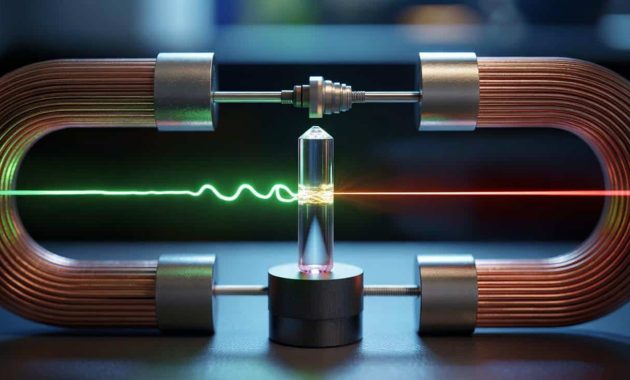
Fresh measurements from Jerusalem now suggest that light’s magnetic field, long treated like a sideshow, plays a starring role in how light twists through matter. The shift sounds subtle. The consequences reach from laser design to quantum memory.
What changed in a rule everyone thought was settled
Since 1845, physicists have relied on the Faraday effect to read a material’s magnetic fingerprint. Shine linearly polarised light through a magnetised crystal, and the plane of polarisation rotates. For generations, textbooks pinned that rotation mostly on light’s electric field interacting with charges in the material.
New work shows the magnetic field of light directly drives a large share of that rotation, and the share grows at longer wavelengths.
In November 2025, researchers Amir Capua and Benjamin Assouline at the Hebrew University of Jerusalem revisited the maths and the measurements. They focused on a workhorse crystal in photonics, terbium gallium garnet (TGG), widely used in optical isolators and magneto-optic sensors. By carefully separating contributions, they found that the oscillating magnetic field in the light beam couples to electron spins inside the crystal and alters the rotation in a big, measurable way.
| Wavelength range | Share of rotation from light’s magnetic field |
|---|---|
| Visible | ≈ 17% |
| Infrared | Up to ≈ 70% |
The team also derived an explicit equation that predicts the magnetic contribution for a given material and wavelength. They validated it against TGG data. The result reframes a classic phenomenon that underpins lasers, filters, and non-reciprocal optical components.
From Faraday to 2025: the half of light we ignored
Faraday’s original insight linked magnetism and light. But practical optics largely tracked the electric part of the electromagnetic wave. That bias made sense: charges respond strongly to electric fields. The magnetic field oscillates too, yet its effect seemed tiny and hard to extract from background noise.
Two things changed. First, measurement tools improved. Modern detectors, stable lasers and cleaner crystals cut noise floors. Second, new modelling made it possible to apportion the rotation between electric-dipole and magnetic-dipole channels in a consistent way. When the numbers settled, the magnetic channel was no longer a rounding error.
- Electric field: drives charge motion and classic optical transitions.
- Magnetic field: couples to electron spins and magnetic moments.
- Result: both channels rotate polarisation; the balance shifts with wavelength and material structure.
In the infrared, light’s magnetic field can dominate the Faraday rotation in common garnet crystals used every day in labs and factories.
Why it matters for photonics, sensing and quantum hardware
Designers now have a new knob to turn. If the magnetic field of light can be engineered to talk directly to spins, devices can be tuned for stronger rotation with lower power or at new wavelengths. That affects several busy frontiers.
➡️ Auto technicians explain how keeping the gas tank above half prevents fuel line freeze
➡️ Bad news a 135 fine will apply to gardeners using rainwater without authorization starting March 18
➡️ Preferring to stay home: what psychology reveals about your choice to avoid friends
➡️ The winter accessory no one remembers to wash, and it’s not clothes or sheets
- Optical isolators and circulators: materials can be optimised for magnetic-field coupling, boosting isolation in compact chips.
- Magnetometry: sensors can separate electric and magnetic channels, improving accuracy when fields are weak or fluctuating.
- Data storage: light-driven switching of spin states hints at optical control of magnetic bits without heavy electromagnets.
- Quantum interfaces: spin-photon coupling is a core need for linking qubits; magnetic-field resonances may open new routes.
- Energy efficiency: if magnetic coupling carries more of the load at longer wavelengths, devices could run cooler with less laser power.
What the experiment actually probed
The Faraday effect is simple to picture. Take a beam with a linear polarisation. Pass it through a magnetised medium. The polarisation angle rotates by an amount set by the material’s Verdet constant and the path length. That constant, it turns out, contains two intertwined parts.
- An electric-dipole term, linked to how charges move within the lattice.
- A magnetic-dipole term, linked to spin and orbital magnetism.
Capua and Assouline separated these terms by scanning wavelength and using a crystal where the relevant transitions are well mapped. The trends showed a clean rise in the magnetic-dipole weight toward the infrared. That trend fits the structure of rare-earth ions in TGG, which support spin-sensitive transitions at longer wavelengths.
Why this was missed for so long
The signal sits on top of other magneto-optical features. It also looks similar to effects that arise from crystal imperfections or strain. Without a proper model, researchers folded the pieces together and called the sum “the electric response.” The new framework gives each piece a budget line. The instruments of 2025 did the rest.
Practical takeaways for engineers
- Re-calc Verdet constants: split electric and magnetic terms in device simulations, especially beyond 700 nm.
- Material screening: check garnets, perovskites and chalcogenides for strong magnetic-dipole channels.
- Device layout: lengthen path or switch wavelength to exploit higher magnetic contribution, not just crank laser intensity.
- Calibration: magneto-optic sensors may need updated baselines to avoid bias from previously ignored magnetic coupling.
Caveats, open questions, and what comes next
The headline numbers come from TGG, a very specific crystal with rare-earth ions. Other materials will differ. Temperature, impurities and strain can shift the breakdown between electric and magnetic channels. Ultrafast pulses may behave differently from continuous beams. The model now needs stress testing across families of compounds, from iron garnets to two-dimensional magnets.
There is also a device-level question. How stable is the magnetic contribution under high optical power? Can integrated photonics harness it in silicon nitride or lithium niobate platforms? Data from thin films, where interfaces matter, will tell us how this scales on chips.
Key facts at a glance
- Where: Hebrew University of Jerusalem.
- When: November 2025 publication.
- Material: terbium gallium garnet (TGG).
- Findings: magnetic field of light accounts for ≈17% of Faraday rotation in the visible, up to ≈70% in the infrared.
- Deliverable: a predictive equation to calculate the magnetic share of rotation.
Extra context you can use
Glossary
- Faraday rotation: rotation of linear polarisation as light travels through a magnetised medium.
- Spin: an intrinsic magnetic moment of electrons that behaves like a tiny compass needle.
- Verdet constant: coefficient that links rotation angle to magnetic field strength and path length.
- TGG: a transparent garnet crystal prized for strong magneto-optical response and low optical loss.
A simple at-home demo
You can see a cousin of this physics with two cheap polarisers and a strong magnet. Align the polarisers to block light. Place a clear, magnetisable glass between them. Apply the magnet along the beam path. A slight brightening hints at rotation. It is crude, but it shows how magnetism can twist light’s angle.
Risks and advantages for industry
- Risks: device models may be off by double-digit percentages at longer wavelengths, leading to underperformance if left uncorrected.
- Advantages: designers gain a new control channel; optimised materials could shrink isolators and boost quantum readout fidelity.
- Compatibility: the effect lives in standard garnets already on many optical benches, so early adoption can piggyback on existing supply chains.
Light does not just pass through matter; it nudges magnetic order as it goes, and that nudge can be engineered.
For researchers, the next steps are clear. Map the magnetic share across materials, temperatures and film thicknesses. For product teams, the homework is practical: update models, revisit wavelength choices, and measure. The quiet half of light just found its voice.