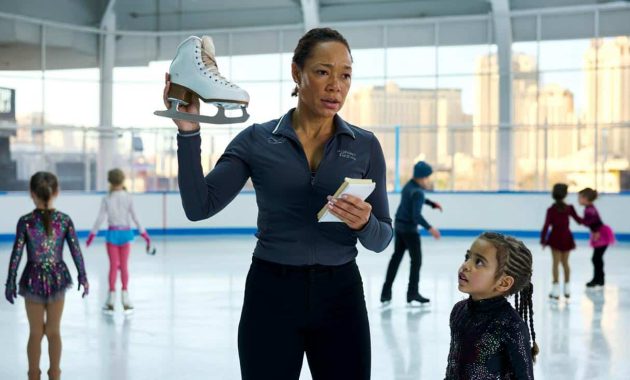
In Las Vegas, the air inside the rink is too cold for July, but Surya Bonaly doesn’t flinch. At 52, the former French figure skating prodigy moves between children in glittering costumes, correcting a knee here, adjusting a blade there, her famous power now channeled into calm authority. Outside, the Nevada sun beats down on a city that barely remembers the Winter Olympics exist. Inside, one of France’s most dazzling athletes of the 1990s quietly coaches in exile.
She laughs with the parents, switches effortlessly between French and English, and poses for a selfie with a young girl who has no idea what a backflip on ice means in the history of sport.
Then, in a low voice, she says a line she’s repeated more often lately: “I no longer had my place in France.”
And that sentence lands like a blade on fresh ice.
From French darling to uncomfortable icon
For a whole generation in France, the name Surya Bonaly is tied to Saturday afternoon broadcasts and living-room carpets turned into improvised ice rinks. She was the girl with the intense gaze, the explosive jumps, the muscular legs that shattered the delicate ballerina image of figure skating. She was also, unmistakably, the only Black skater at the very top in a very white, very codified sport.
As a teenager, she won five consecutive European titles. Three world silver medals. Nine French championships. A résumé that should have guaranteed a lifelong place in the country’s sporting pantheon.
Yet today, she’s teaching kids in the United States, far from the French system that once paraded her as a symbol of “diversity” before gently pushing her to the margins.
What changed is not just time, but the story that was told about her. In France, Surya was too often described as “powerful but not artistic”, praised for her physical strength, critiqued for her style, her hair, her costumes. Judges and commentators repeated the same phrases, sometimes with a thinly veiled condescension.
The image stuck. She was the athlete who jumped higher than everyone, yet was never quite “elegant enough” for the top spot. She became famous worldwide for that forbidden backflip landed on one blade at the 1998 Nagano Olympics, an act of defiance that thrilled viewers and scandalized officials.
In the US today, that same move is celebrated on TikTok compilations and nostalgic reels. In France, it still sits in a gray zone between legend and “indiscipline”.
➡️ The grossest part of your home you never clean: a cleaning expert’s trick
➡️ The little mysterious fruit to plant before winter for a bountiful spring surprise
➡️ This database reveals what English soldiers were really doing in the Middle Ages
Over time, the distance widened. While many former French champions were integrated into federations, TV commentary, or national training programs, Surya drifted away. No key role at the French federation. No central place on major broadcasts. Invitations to events became sparse.
She has said it bluntly in interviews: she didn’t feel wanted in the French system once her medals stopped coming. What hurt wasn’t just the professional sidelining, but the sense of being quietly erased from the official memory of the sport.
*That’s when the American door started to look less like an escape, and more like a real second chance.*
Rebuilding a life on American ice
Surya’s US story began almost like a cliché: a new country, a suitcase, and an old pair of skates. She settled first in Minnesota, then Nevada, choosing places where the rinks were full, the parents motivated, the kids hungry for strong role models. She found work quickly as a coach, because her name still carried weight with former skating fans and American coaches who remembered Nagano.
On the ice, she built something different from what she’d known in France. Less hierarchy, more direct contact with families, more freedom in the way she taught. She could bring her culture, her story, her personality, without having to fit into an old template.
One story she likes to tell is about a little girl who came to her first lesson with braids just like Surya’s in the 90s. The child’s mother had shown her old competition videos on YouTube. The girl looked at Surya and said simply: “I didn’t know someone who looks like me could skate like that.”
Moments like this have multiplied over the years. Black and brown families, mixed-race kids, or just parents looking for a tough but kind coach. In the US, her identity as a Black woman in ice skating is not a footnote, it’s **part of her strength**. She gets invited to speak at diversity workshops, to talk to young athletes about resilience and bias.
Back in France, those same topics still make some people uncomfortable. Here, they fill conference rooms.
Underneath the smiles, there is also a certain anger. Not the screaming kind, but a steady, lucid frustration. She has said it more than once: “If I had been fully supported in France, I would have stayed.” She talks about promises never kept, projects for academies that vanished, executive roles that went to familiar faces from the old boys’ club.
Let’s be honest: nobody really believes that talent alone decides who stays at the top once the cameras are gone. Networks, politics, unspoken biases often weigh just as much. Surya, with her atypical trajectory, her adoptive parents, her strong opinions, did not fit easily into the polite, closed world of French sports institutions.
So she built her own kingdom, thousands of miles away, on a rectangle of American ice.
What Surya’s rupture with France reveals about our blind spots
When she says “I no longer had my place there”, Surya is not just talking about titles or jobs. She’s talking about recognition. About who gets considered “legitimate” long after the applause. In France, she felt tokenised as a young champion, then subtly sidelined as an adult expert. In the US, she feels listened to when she talks about training methods, injuries, mental pressure.
Her story forces a question: how many champions does France quietly let slip away because they don’t tick the right social, racial or institutional boxes?
For ordinary readers, this hits closer to home than it seems. We’ve all been there, that moment when you realize your ideas are welcome only as long as they don’t disturb the established order. Surya just experienced it in a brutally public arena. Behind the glitter of medals, there’s a workplace story that looks strangely familiar: a woman, racialized, direct in her opinions, who stops being “practical” once people can’t use her image.
In the US, she’s been asked to mentor young coaches, to create programs for underrepresented kids, to speak honestly about the flaws of the skating world. In France, when she raised similar topics, she often hit a polite wall.
The plain-truth sentence is this: **France loves its icons young and obedient, and struggles with them once they become adult, complex, political**. Surya crossed that invisible line. Instead of softening her edges, she chose to leave. Her criticism of France is not a revenge speech; it’s the report of someone who tried, waited, then finally moved on.
“I gave everything to French skating,” she said in a recent interview. “I would have liked French skating to give a little more back.”
- Persistent racial and social biases in elite sports
- Closed networks that lock former athletes out of decision-making
- A gap between public celebration and long-term support
- The emotional cost of exile for high-level athletes
- The opportunity: learning from her path to avoid repeating the same pattern
A mirror held up to French sport – and to us
Surya Bonaly’s American exile is not just the personal journey of a former star; it’s a mirror held up to France. It shows how a country can adore a champion on TV while leaving her feeling disposable once the spotlights fade. It questions who gets to stay in the narrative and who is quietly written out.
Her words today sting, because they sound both bitter and terribly clear. “I no longer had my place there” is not a tantrum, it’s a diagnosis. A diagnosis of a system that celebrates diversity in posters but struggles to share real power.
For readers, her path opens a broader conversation. How do we treat those who disturb the norm? How do we react when someone who made us dream says: “I was not welcome anymore”? Some will accuse her of ingratitude. Others will hear, beneath the anger, a form of deep disappointment, almost a heartbreak with her own country.
What’s striking is that from her rink in Las Vegas, she still speaks about France in the present tense. As if a part of her never really left. As if she’s still hoping the message will finally get through.
Her story doesn’t offer ready-made answers. It invites us to look differently at the next young “phenomenon” we celebrate, to ask what their life will look like at 40, at 50. To wonder how many talents have already left silently, not just in sport, but in science, in culture, in everyday workplaces.
France likes to believe it is the land of meritocracy. Surya Bonaly’s voice, coming from across the Atlantic, gently cracks that certainty. And pushes each of us to ask: whose place are we protecting, and whose place are we quietly denying?
| Key point | Detail | Value for the reader |
|---|---|---|
| Exile as a choice of dignity | Surya left France when she felt symbolized but not respected as an expert | Helps readers recognize when a system no longer deserves their loyalty |
| From token to leader | In the US, her identity and experience are turned into leadership roles and mentoring | Shows how a change of environment can transform a perceived “problem” into an asset |
| Structural blind spots | Her criticism exposes how former champions can be sidelined by networks and bias | Encourages readers to question similar mechanisms in their own fields or companies |
FAQ:
- Why did Surya Bonaly leave France?She felt progressively excluded from the French skating ecosystem after her competitive career, with few real roles or projects offered, and a recurring sense that her voice and expertise were not fully welcome.
- What is she doing today in the United States?She works mainly as a coach, mentor and guest speaker, training young skaters, advising families, and taking part in programs around diversity and inclusion in sport.
- Does she still have ties with French skating?Yes, but they are distant and sporadic. She’s occasionally invited to events, yet she is not integrated into the strategic or institutional core of French figure skating.
- Is her criticism only about racism?Racism is part of the picture, especially in how her style and body were judged, but she also denounces closed networks, lack of support for ex-athletes, and a rigid culture resistant to outspoken figures.
- Could she return to a major role in France one day?Nothing is impossible, and she has never completely slammed the door, yet it would require a real shift: concrete responsibilities, genuine listening, and clear recognition of what she went through and what she brings.