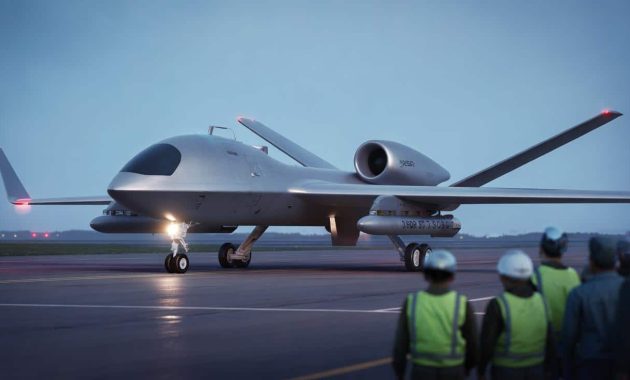
This first taxi outing for the MQ-25 Stingray marks a visible shift from development paperwork to hardware in motion, bringing the unmanned tanker closer to its delayed first flight and, eventually, full-time work aboard American aircraft carriers.
First production MQ-25 rolls into motion
The initial production-representative MQ-25A Stingray has completed its first low‑speed taxi test at Boeing’s facility at MidAmerica Airport, near St. Louis, Missouri.
Navy test crews from Air Test and Evaluation Squadron 23 (VX‑23) and the uncrewed‑systems-focused Air Test and Evaluation Squadron 24 (UX‑24) supported the event, which saw the drone taxi autonomously after commands from its remote operators.
The aircraft is now in the final stages of ground testing, with low‑speed taxi trials complete and first flight lined up once certification and weather allow.
Boeing and the US Navy confirmed that the first taxi test took place on 29 January. Engineers will now run more taxi sessions, finish systems-level checks and close out airworthiness documentation before clearing the aircraft to fly.
Why taxi tests matter for an unmanned tanker
Taxi trials look modest compared to a first flight, but for an uncrewed carrier aircraft they are a major technical hurdle.
- They confirm the engine, brakes and steering work as a system.
- They validate autonomy and remote control on the ground.
- They help refine safety procedures before higher‑risk flight trials.
During the test, the MQ‑25 responded to remote inputs from “air vehicle pilots” and conducted a planned series of ground manoeuvres. The drone moved under its own power, demonstrating that propulsion, software and control links are working together outside the lab.
Getting a large unmanned aircraft to obey precise taxi commands is a crucial stepping stone before attempting carrier deck operations.
From delayed promises to a new flight timeline
The taxi test arrives after the Navy missed its own ambition to fly the first production-representative MQ‑25 before the end of 2025.
➡️ Spraying vinegar on the front door : why people recommend it and what it’s really for
➡️ What it means when someone overexplains everything, according to psychology
➡️ Bad news : a new rule prohibits mowing lawns between noon and 4 p.m. in 23 departments
➡️ Archaeologists have uncovered a medieval tunnel dug into a 6,000‑year‑old burial site
➡️ The subtle impact of daily rhythms on emotional balance
➡️ This profession pays well because expertise takes years to master
Senior naval aviation leaders had publicly committed to that target. In early 2025, Vice Adm. Daniel Cheever famously said, “We will fly MQ‑25 in ’25,” tying the programme’s credibility to that date. The schedule has since slipped, pushing the first flight into 2026.
Cost growth and repeated delays have dogged the programme. The original plan envisaged early pre‑production deliveries in 2022 and an initial operational capability around 2024. The Navy now talks about 2027 as the new goal for bringing the Stingray into frontline service.
Key programme milestones so far
| Milestone | Planned | Current reality |
|---|---|---|
| Deliver first pre‑production aircraft | 2022 | Still in pre‑production ground and flight test |
| First flight of production‑representative MQ‑25 | By end of 2025 | Now targeted for early 2026 |
| Initial operational capability (IOC) | 2024 | Now aimed for 2027 |
| Total planned procurement | 76 aircraft | Programme still approved |
From UCLASS strike drone to dedicated tanker
The MQ‑25’s DNA stretches back to an earlier, more ambitious Navy plan: the Unmanned Carrier Launched Airborne Surveillance and Strike (UCLASS) programme. UCLASS was designed to give aircraft carriers a stealthy drone capable of long‑range surveillance and precision strikes.
Boeing says the Stingray’s design draws on its UCLASS work. That lineage shows in the MQ‑25’s sleek planform and subtle low‑observable features, even though the current requirement is focused on refuelling rather than deep strike.
The Navy scrapped its stealthy UCLASS combat drone vision and pivoted to a refuelling role, but much of that advanced design work survives in the MQ‑25.
Northrop Grumman’s X‑47B demonstrators previously proved that a large drone could safely launch, recover and operate on a carrier. Those aircraft did not go into service, but they paved the way for the Stingray by validating deck handling, arrestor landings and catapult launches for uncrewed jets.
What makes the MQ-25 stand out
New imagery from the taxi tests shows several distinctive features on the production‑representative MQ‑25.
Flush inlet and hidden exhaust
At the top of the fuselage sits a “flush” air inlet rather than a traditional gaping engine intake. This design smooths airflow while reducing the line-of-sight to engine blades, a common radar reflector.
The exhaust is recessed into the fuselage, helping to mask the engine’s hot stream and potentially reducing the aircraft’s infrared and radar signature from certain angles.
Sensor turret and refuelling gear
Under the nose, a retractable sensor turret will house electro‑optical and infrared cameras, and potentially laser devices. This gives the drone an intelligence, surveillance and reconnaissance (ISR) role alongside its primary tanker function.
Under a wing, images show a buddy refuelling store – effectively a hose‑and‑drogue unit carried like an external pod. This is how the MQ‑25 will dispense fuel to fighters and other aircraft in flight.
Although built as a tanker, the MQ‑25’s sensors and design leave the door open for future roles such as ISR or even limited strike missions.
Freeing up worn-out Super Hornets
Today, much of the US Navy’s carrier refuelling burden falls on F/A‑18F Super Hornets carrying external tanks and refuelling pods. This tanker duty consumes a large share of their flight hours without delivering any strike or air defence benefit.
Navy leaders repeatedly point to MQ‑25 as a way to:
- Extend the combat radius of carrier-based jets.
- Reduce wear and tear on ageing Super Hornets.
- Free crewed fighters for combat and patrol missions instead of support roles.
By stationing Stingrays further from the carrier, strike aircraft could reach targets at longer ranges or spend more time on station, a crucial edge against modern anti‑ship missiles and long‑range air defences.
Pathfinder for a more unmanned air wing
The Navy describes the MQ‑25 as a “pathfinder” for uncrewed operations at sea. Service leaders have publicly floated an eventual goal where more than 60% of carrier air wings could be unmanned.
Alongside the Stingray, the Navy is ramping up work on Collaborative Combat Aircraft (CCA) – a family of drones designed to fly alongside crewed fighters. Contracts for conceptual CCA designs have gone to Anduril, Boeing, General Atomics and Northrop Grumman, while Lockheed Martin is building a common control architecture.
The MQ‑25 is not just a tanker; it is a test case for how the Navy will control, maintain and fight with large uncrewed aircraft from crowded flight decks.
The Navy, Air Force and Marine Corps are coordinating CCA developments to ensure drones can pass between services and be controlled by different operators in joint operations.
Making drones work on a busy carrier deck
Getting the Stingray flying is only part of the challenge. It must also fit safely into the chaotic rhythm of a carrier flight deck, where space is scarce and aircraft, tractors and people move constantly.
Previous trials with the X‑47B used a glove‑like controller worn by deck crew to guide the drone around. The MQ‑25 T1 demonstrator has also been tested with its own portable control device. The latest video does not reveal the Navy’s final concept for deck handling, which will need to balance safety, speed and human workload.
Command‑and‑control networks, standard operating procedures and training pipelines are all being built out in parallel. Naval aviation units are learning how to blend unmanned systems into the same launch and recovery cycles as manned jets without choking the deck.
What “ground testing” really involves
Boeing says the MQ‑25A is now in the closing stages of a broad ground test campaign. That includes structural tests on a static airframe, engine runs, taxi trials and validation of flight‑certified software.
The team has also demonstrated control of the aircraft through the Navy’s Unmanned Carrier Aviation Mission Control System (UMCS), the digital brain that operators will use to task and monitor Stingrays.
Before the first flight, engineers still need to finish systems integration checks, sign off on safety analyses and obtain flight clearance documentation. A suitable weather window is another gating factor: the first flight will likely be conservative and closely monitored, so conditions need to be predictable.
Key terms and concepts behind the MQ-25
For readers less familiar with naval aviation, a few terms help frame what the MQ‑25 is being asked to do.
Buddy refuelling: This is when one tactical aircraft carries a refuelling pod to gas up others. Super Hornets have been doing this for years, but using frontline fighters as tankers reduces the number available for combat missions.
Initial operational capability (IOC): This is the point where a new system is judged ready to perform real missions with trained crews, even if some refinements are still pending. For MQ‑25, IOC around 2027 would mean a small number of Stingrays deployed with at least one carrier air wing.
Collaborative Combat Aircraft (CCA): These are future drones designed to team with human pilots, sharing tasks like sensing, jamming, or launching weapons while being controlled at a distance or semi‑autonomously.
Risks, benefits and what comes next
The MQ‑25 carries both operational promise and programme risk. Delays raise costs and postpone the relief that overworked Super Hornet fleets badly need. Technical challenges include deck handling, robust data links in a harsh electromagnetic environment, and keeping software cybersecure over its service life.
The benefits, though, are significant. A successful Stingray fleet would extend the reach of every carrier air wing, reduce pilot exposure on long tanker sorties, and create a template for future unmanned aircraft to follow. As the first production MQ‑25 edges from taxi runs towards take‑off, the Navy is not just testing a drone; it is rehearsing a new way of running air operations at sea.