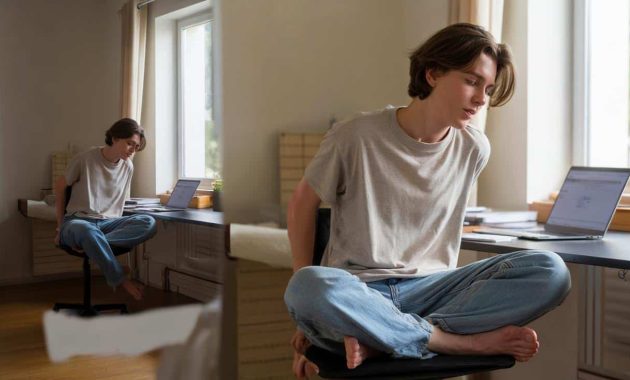
The first time I noticed it was on a Tuesday, around 3 p.m., when my lower back started doing that quiet, nagging burn. I hadn’t gone to the gym, hadn’t moved anything heavy, hadn’t done anything dramatic. I’d just… sat. At my laptop, on my phone, with one leg tucked under me like a pretzel, shoulders slowly climbing toward my ears. By evening my neck felt like I’d slept in a car seat, my hips ached, and I caught myself thinking, “So this is just… aging?”
Then I saw my reflection in a window: slumped, folded, almost half my real height.
Something about that image stayed with me.
The small change that quietly transforms your body
Spend a day simply watching people and you’ll see it: bodies collapsing into chairs, shoulders rolled forward, heads thrust toward screens like curious turtles. The world has turned into a village of sitters. We feel “tired” and blame work, stress, or lack of exercise, while our bodies are slowly molding to the shape of our chairs.
The simple change that starts to unlock physical ease? Not a workout plan. Not a gadget. It’s the way you sit, stand, and hold yourself during the thousands of quiet moments you don’t even notice.
Think of the friend who always looks strangely light on their feet, even when they swear they never exercise. There’s a good chance they don’t slump into chairs, don’t hang off one hip, don’t crane their neck over their phone for hours.
A 2023 study from a European ergonomics group followed office workers for six months. The group that only adjusted posture and sitting habits reported less back pain, fewer headaches, and more energy than the group that added a weekly workout but kept their old slouching ways. It wasn’t dramatic. It was just consistent. Their “exercise” was how they inhabited their own bodies, all day long.
This is the quiet math behind physical ease. Your workout might last 45 minutes. Your posture lasts the other 23 hours and 15 minutes. Muscles follow patterns: if your head lives forward, your neck tenses. If your pelvis tilts like a hammock, your lower back screams. The body is loyal; it reshapes itself around your habits.
*Change the habit, and over time the body has no choice but to respond.* That’s the hidden lever almost nobody talks about, because it’s not glamorous, not Instagrammable, and you can’t swipe a credit card to fix it.
The one habit: micro-adjusting how you sit and stand
The practical shift is almost suspiciously simple: start practicing “stacked” posture in small, repeatable moments. Think of your body like a column. Feet under knees. Knees under hips. Hips under ribs. Ribs under shoulders. Head gently floating over all of it.
➡️ When pumas return to Patagonia, penguins vanish by the thousands
➡️ She catches her 14-year-old daughter with a man
➡️ Scientists warn that this natural cycle is becoming increasingly unpredictable
➡️ Fresh foods that help cleanse the liver naturally and effectively in no time
➡️ Heavy snow confirmed to intensify overnight as meteorologists warn of whiteout risks
When you sit, let your sit bones actually touch the chair, not your tailbone curled under you. Place both feet on the floor for at least a few minutes each hour. Let your shoulders soften instead of bracing upward. When you stand in a queue, gently rock your weight so it’s shared by both legs, not dumped onto one hip. These tweaks look like nothing from the outside. Inside your body, they’re a quiet revolution.
You can sneak this into daily life without anyone noticing. Waiting for the kettle: stand with both feet planted, unlock your knees, lift your chest just a little. In a Zoom meeting: slide your bottom back in the chair, let your lower back lengthen instead of rounding, imagine a thread lifting the crown of your head. On public transport: instead of hanging off the pole with one shoulder, align your ribs over your pelvis and let the train do the balancing workout for your core.
One woman I interviewed started putting sticky notes with a simple word — “stack” — on her laptop and bathroom mirror. Three months later, her physiotherapist reduced her sessions. She hadn’t joined a gym. She’d changed the way she occupied space.
There’s a clear logic under it. When your skeleton is stacked, your muscles don’t need to hold on for dear life just to keep you upright. Your joints share the load. Your breath has room to move. Even digestion and circulation benefit when your torso isn’t folded like a closed book.
Let’s be honest: nobody really does this every single day, all day long. You’ll forget. You’ll slouch. You’ll fold yourself into the sofa like a croissant. The magic isn’t in perfect posture; it’s in returning, a few times a day, to something a bit more aligned, a bit more spacious. Those tiny corrections are like compound interest for your body.
How to bring ease into your body, one tiny cue at a time
Start with one anchor activity instead of trying to “fix your posture” everywhere. Pick something you already do daily: brushing your teeth, making coffee, waiting for your computer to start. During that one action, practice your stacked posture. Feet grounded. Knees soft. Pelvis neutral, not tucked. Chest gently open, not thrust. Neck long, gaze straight ahead.
Do this for one week. Don’t chase perfection, chase awareness. Notice when your shoulders sneak upward or when your weight drifts to one leg. Gently bring it back. It’s like teaching a shy dog to come when called: repetitive, calm, no drama. Over time, the body starts arriving on cue.
The biggest trap is turning this into a new way to be tense. Many people hear “posture” and immediately stiffen: chest out, back arched, jaw tight, like a soldier at inspection. That’s not ease, that’s armor. The goal is not to be rigid; the goal is to feel supported without effort.
Be kind when you catch yourself slumping over your phone at 11 p.m. You’re not failing at posture; you’re living. Adjust once. Maybe twice. Then let it go. These micro-moments are less about aesthetics and more about sending a quiet message to your nervous system: “You don’t have to work so hard just to exist.”
“People come to me asking for stretches and exercises,” a posture specialist told me. “Half the time, the real game-changer is teaching them how to sit like a person whose body matters to them.”
- Set one daily posture cue – Tie it to a habit you already have: coffee, emails, commuting.
- Use furniture that supports you – Adjust chair height so your hips are slightly above your knees.
- Uncross your legs sometimes – Let both feet find the ground for a few minutes each hour.
- Breathe into your ribs – A few slow breaths can naturally realign your spine.
- Move every 30–60 minutes – Stand, stretch, or just change position for 30 seconds.
The quiet ripple effect of changing nothing… and everything
Once you start playing with this small shift — this decision to inhabit your body a little differently — other things tend to rearrange themselves. You might notice your neck doesn’t bark at you by Thursday. Maybe your lower back doesn’t hijack your weekend plans. Maybe you get home from work and actually have enough energy to say yes to a walk, or to sit on the floor with your kids without feeling 40 years older than you are.
You haven’t become “sporty”. You haven’t magically found two free hours a day. You’ve just stopped leaking energy into constant, unnecessary muscle tension.
Some people report unexpected side effects. Feeling a bit more confident when they walk into a room. Breathing more deeply before a stressful conversation. Sleeping better because their body isn’t buzzing from eight hours of collapse in front of a screen. None of this looks heroic. From the outside, you simply seem more at ease in your own skin.
We’ve all been there, that moment when you stand up from a chair and realize your body hurts more than your mind thinks it should for your age. That moment can be a quiet turning point. Not into a fitness project, not into a punishment program, but into a gentle experiment: what happens if I treat posture as my everyday self-care, not a strict school rule from childhood?
You don’t have to announce it. You don’t need new clothes or a wearable device. You only need the willingness to notice how you’re sitting and standing, a few times a day, and the curiosity to try something a little kinder.
The next time you catch your reflection — hunched over your phone, folded into your desk, curled around a steering wheel — you could see it as criticism. Or you could see it as an invitation. Your body is whispering: “Stack me. Give me space. Let’s see what changes when I’m not fighting gravity alone.”
| Key point | Detail | Value for the reader |
|---|---|---|
| Micro-adjust posture daily | Use simple stacking cues during existing habits | Improves ease without adding workout time |
| Prioritize relaxation, not rigidity | Avoid “soldier posture” and focus on gentle alignment | Reduces pain and tension rather than creating more |
| Think of posture as self-care | View sitting and standing as ongoing body support | Builds long-term comfort, confidence, and energy |
FAQ:
- Question 1Can changing my posture really help even if I never exercise?Yes. Your body spends most of its time in “non-exercise” mode. Improving how you sit and stand reduces strain on muscles and joints, which often leads to less pain and more energy, even without formal workouts.
- Question 2How long before I feel a difference?Some people feel subtle relief in a few days, especially in the neck and lower back. Bigger changes usually show up after a few weeks of small, consistent adjustments during daily activities.
- Question 3Do I need special chairs or ergonomic gear?Not necessarily. Good furniture can help, but the main shift comes from how you use what you already have: feet grounded, hips supported, back tall but relaxed.
- Question 4What if I keep forgetting to adjust my posture?Pick one strong cue, like phone notifications or coffee breaks. Each time it happens, quickly “stack” your body. Over time, it becomes an almost automatic habit.
- Question 5Can better posture replace medical treatment?No. If you have strong or persistent pain, you still need professional advice. This simple change is a support, not a substitute, and often works best alongside medical or therapeutic care.