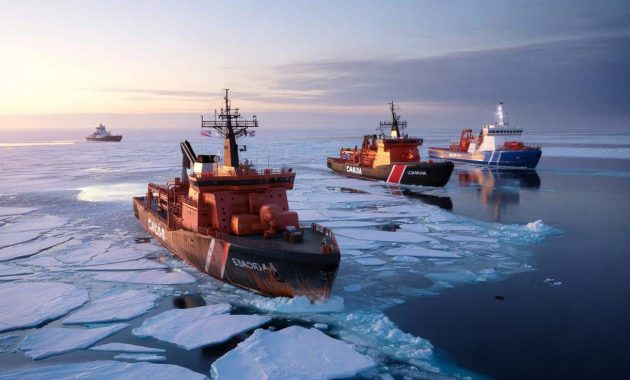
In the high Arctic, where melting ice opens new routes and new risks, Washington is quietly outsourcing a key symbol of power.
After years of delay, budget rows and technical dead ends, the United States has decided that catching up in the polar game matters more than building everything at home. The new plan leans heavily on Canadian design experience and Finnish shipbuilding muscle to rebuild an American icebreaker fleet that is now badly outgunned by Russia and increasingly challenged by China.
North American design, Nordic steel: a shared fix for a late start
The core of the strategy is simple: stop reinventing the wheel, and start producing ships fast.
Instead of launching a fully bespoke American vessel, the US Coast Guard has picked a Canadian icebreaker design from Seaspan Shipyards in Vancouver as the basis for its future Arctic Security Cutters (ASC). That design – known as the MPI – was originally developed with Finland’s Aker Arctic Technology for Canada’s own polar missions.
Under the current plan, up to six US Arctic Security Cutters could be built before the end of the decade. The first pair would be assembled in Europe at Rauma Marine Constructions in Finland, with deliveries targeted around 2028. From roughly 2029 onward, follow‑on hulls would shift to Bollinger Shipyards in Houma, Louisiana.
Washington is borrowing a ready-to-build Canadian design and Finnish production capacity to avoid losing another decade at sea.
This “build where you can, as soon as you can” approach is a sharp break with the traditional, slow, domestic-only model of big US naval programmes. It reflects a blunt calculation: polar access is turning into a race, and the United States is not keeping pace.
The ice pact: when Arctic politics turn into industrial policy
The deal rests on a broader political framework: the ICE Pact, signed in July 2024 between the US, Canada and Finland. Behind the diplomatic language sits a hard-edged idea: pool Arctic expertise instead of duplicating it three times.
How the ice pact changes the rules
- Canada brings a mature modern icebreaker design (MPI) and an existing supplier base.
- Finland contributes decades of know‑how in hull forms, propulsion in ice and efficient yards.
- The US offers the demand, the funding and part of the production capacity for serial builds.
Because the MPI design is already largely engineered and aligned with Lloyd’s Polar Class PC4 standards, the Coast Guard can skip years of paperwork and redesign. Key systems have been tested, equipment suppliers are lined up, and Canadian yards have already integrated lessons from their own polar projects.
Instead of starting from a blank page, the US is buying into an existing ecosystem of designers, suppliers and engineers.
➡️ “I felt overwhelmed by small tasks,” until I changed how I started them
➡️ Heavy snow confirmed to intensify tonight as visibility could collapse in minutes
➡️ If you want a happier life after 60 admit you are the problem and quit these 6 habits
➡️ The plant that improves indoor humidity naturally without sprays or devices
For Washington, the benefit is not just speed. A ship that several countries operate and support can be cheaper to maintain over its lifetime, from spare parts to upgrades, and offers more predictable through-life costs.
A workhorse icebreaker built for long, lonely patrols
The MPI was never conceived as a showpiece; it was drawn up for the grind of long Arctic patrols in harsh conditions. That suits the Coast Guard perfectly.
Capabilities of the future US Arctic Security Cutter
Based on current specifications, the Arctic Security Cutter derived from the MPI will be around 100 metres long and displace about 9,000 tonnes. Its hull is rated Polar Class PC4, meaning it is designed to operate year‑round in thick first‑year ice, including some older multi‑year floes.
| Key feature | Planned value |
| Length | 100 m |
| Beam | 20.4 m |
| Draught | 6.4 m |
| Displacement | ≈ 9,000 t |
| Ice class | Lloyd’s Polar Class PC4 |
| Installed power | 10.1 MW |
| Propulsion power | ≈ 7.2 MW |
| Speed in ice | 7 km/h in 1 m ice |
| Range | 22,000 km |
| Endurance | > 60 days |
| Crew | ≈ 85 people |
| Propulsion system | Diesel-electric with DC bus |
The ship’s diesel‑electric system allows flexible power management and better control at low speeds in broken ice. The endurance of more than 60 days at sea means crews can stay on station for long stretches without relying on scarce Arctic ports.
Beyond icebreaking, the design accommodates scientific laboratories, helicopter operations, medical facilities and command spaces. That combination lets the Coast Guard support research, enforce fishing regulations, respond to oil spills and assert sovereignty from the same hull.
A thin American polar fleet under growing pressure
The immediate reason for this sprint is the state of the current US fleet. As of 2026, the Coast Guard only has three polar-capable ships in real service: the ageing heavy icebreaker Polar Star (commissioned in the 1970s), the medium icebreaker Healy, and the Storis, a more recent addition.
Internal assessments have suggested a need for at least nine Arctic Security Cutters to handle annual missions to both the Arctic and Antarctic, along with search‑and‑rescue and escort duties. That leaves a wide gap between requirements and reality.
For a country with Alaska, Antarctic commitments and growing Arctic trade, three working polar ships is a strategic liability.
The MPI-based ASC provides what US planners see as a pragmatic jump in capacity: not experimental, not nuclear, but sturdy, repeatable and built for serial production. It does not solve every need – the US is still pursuing larger Polar Security Cutters – yet it reduces the risk of having no ship available when an ice‑choked route must be opened or a remote community needs urgent support.
The industrial stakes for Canada, Finland and the US
Seaspan’s payoff and the Gulf Coast’s bet
For Seaspan, the choice of the MPI as the template for the ASC is a strong endorsement. The company already has a backlog of 21 icebreakers, including a heavy PC2 vessel and as many as 16 MPI units for Canada. Roughly 5,700 people work at its Vancouver and Victoria yards, supported by hundreds of engineers who specialise in complex cold‑water ships.
Bollinger, on the Louisiana side, sees the ASC as a chance to stabilise and upgrade its facilities after difficult years with the Polar Security Cutter programme. If the transition from Finnish to American production goes well, it could turn the Gulf Coast into a more serious player in the global ice‑capable ship market.
Funding is not trivial: Washington has ring‑fenced an envelope in the billions of dollars for heavy, medium and light icebreakers, with the ASC forming one of the key pillars of that investment.
A crowded, uneven and suddenly strategic icebreaker market
The US story sits inside a wider trend. After a long lull, the icebreaker market is busy again, and capacity is tight.
Seasonal melting has not made icebreakers redundant. It has created more complex ice conditions and more traffic. Thinner but more mobile ice, unpredictable freeze‑up dates and higher commercial interest in the Northern Sea Route and Northwest Passage all increase demand for ships that can operate safely where normal hulls cannot.
Russia never stopped building icebreakers and currently operates the only civilian nuclear icebreaker fleet, with dozens of vessels and several nuclear units. That gives Moscow near‑permanent access to the Northern Sea Route along Siberia.
China, while not an Arctic coastal state, has steadily expanded its polar fleet since 2018, running more cargo voyages through the Russian Arctic each season and using research voyages to stake a long‑term interest.
Who actually has icebreakers in 2026?
| Rank | Country | Approx. icebreakers | Nuclear units | Notes |
| 1 | Russia | ~40–45 | ~7 | Largest nuclear fleet, year‑round Northern Sea Route operations |
| 2 | Canada | ~18–20 | 0 | Large civil fleet, Arctic patrols and resupply missions |
| 3 | Finland | ~8 | 0 | Strong engineering base, Baltic and Arctic expertise |
| 4 | Sweden | ~7 | 0 | Baltic ice management, mainly civil |
| 5 | China | ≥5 | 0 | Mixed fleet of research and support ice‑capable ships |
| 6 | United States | 3 | 0 | Recognised capability gap, new ASC and PSC programmes launched |
| 7 | Norway | 2–3 | 0 | Research and offshore support near Svalbard and Barents Sea |
| 8 | Japan | 2 | 0 | Antarctic research support |
| 9 | France | 1 | 0 | L’Astrolabe, logistical support to Antarctic territories |
Yards that can deliver modern icebreakers at pace are few. Finland and Canada dominate the high‑end segment, with some Asian yards active at the lighter end. That scarcity explains why Washington was willing to send work offshore in the first phase: waiting for domestic yards to climb a steep learning curve would mean more years with minimal Arctic presence.
What this means on the ice: scenarios and risks
A future Arctic patrol in practice
Imagine a summer in the late 2020s. Sea ice in the Chukchi Sea breaks up earlier than expected. A foreign research vessel, sailing close to the Alaskan coast, runs into thicker, drifting floes and issues a distress call. At the same time, commercial shipping along Russia’s Northern Sea Route surges thanks to a mild season, and a US scientific mission is waiting for an escort to reach a remote station.
With only one or two heavy icebreakers, the Coast Guard must choose who gets help and who waits. With a small series of Arctic Security Cutters in service, a different picture emerges: one cutter can peel off to assist the distressed vessel, a second can support science, and a third can keep a presence near strategic chokepoints.
This is what planners mean when they say “the number of hulls matters as much as performance”. Multiple medium icebreakers often bring more practical flexibility than a single, exceptionally powerful one.
Key terms: polar class and endurance
Two technical ideas sit behind much of the debate:
- Polar Class (PC) is a rating system that defines what sort of ice a ship can safely handle. A PC4 hull like the MPI‑based ASC is designed for year‑round use in thick first‑year ice, including some old ice, but it is not as extreme as the heaviest Russian nuclear vessels operating in very thick multi‑year ice.
- Endurance describes how long a ship can stay away from port with enough fuel, food and spare parts. For Arctic work, long endurance reduces dependence on distant bases and allows a vessel to ride out storms or unexpected ice patterns without withdrawal.
Those two elements interact. A well‑armoured hull without endurance is of limited use; a long‑range ship without ice capability risks getting stuck, as several commercial vessels have learned the hard way in recent winters.
For the United States, blending Canadian design, Finnish construction and American funding is not just about prestige ships. It is about regaining the basic ability to go north, stay there for weeks, and not have to ask anyone else for an escort out of the ice.