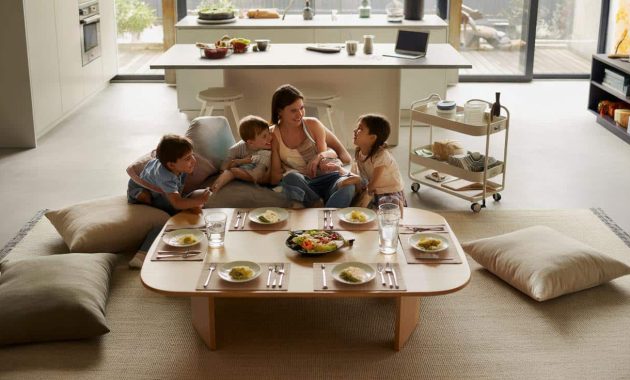
The first time I saw a family eat without a dining table, I thought it was a joke. Tuesday night, small apartment, kids in socks, pasta bowls perched on a low, wide coffee table that looked more like a soft island than furniture. The parents were half-sitting, half-leaning on floor cushions, laptops closed, TV off. Everyone was close, almost huddled, like a picnic that had simply moved indoors.
No one asked, “Pass the salt at the end of the table,” because there was no “end” anymore. Just one large surface in the middle of the living room, shared like a campfire.
The surprising part? It didn’t feel messy or temporary. It felt like the old dining room had simply… disappeared.
Why the dining table is quietly disappearing from homes
Walk through new apartments in big cities abroad and you’ll notice something unsettling at first glance. No heavy wooden table commanding the room, no six matching chairs waiting for a Sunday roast that rarely comes. The space that used to be “the dining room” is now a hybrid: half living room, half office, half play area.
The traditional table, once the star of family life, is slowly being pushed out of the script. In its place, low modular tables, XXL sofas with sideboards, kitchen islands that double as desks. The home is shrinking, but the way we live inside it is expanding.
In Tokyo, Berlin, Copenhagen, real-estate agents admit it openly: buyers ask more about plug sockets than about where to put a formal table. A Danish interior designer recently confessed that 70% of her clients are happy with “a generous coffee table and a good island” instead of a classic dining space.
She showed me photos from one of her projects. A family of four, two kids, one dog. Their dinner spot? A huge, low table on wheels in front of a corner sofa, with hidden storage underneath for placemats and board games. On Sunday nights they slide it aside to unroll a yoga mat. On weekdays, it’s a homework station. Only once a year do they borrow a folding table from the neighbors for Christmas.
The logic behind this is simple. We no longer live in our homes by “rooms”, we live by “moments”. Work call, snack, quick dinner, online class, movie, stretching, all in the same open space. A fixed, imposing dining table occupies precious square meters while serving a shrinking number of real meals.
*The new trend treats furniture as flexible equipment, not a static monument to family life.* When dinners last 20 minutes and everyone eats at different times, a softer, more adaptable surface suddenly feels like the honest answer to how we truly live.
What replaces the dining table: the new setups that actually work
The most common replacement abroad is surprisingly humble: a large, sturdy coffee table placed at the perfect “eating height” when you’re seated on a sofa or on cushions. Not those tiny decorative pieces where you can barely fit two magazines. We’re talking broad surfaces, often 100–120 cm long, sometimes adjustable in height, with rounded corners to move around them easily.
➡️ I tried this homemade version and stopped buying the ready-made one
➡️ This gentle pruning technique encourages long-lasting blooms
➡️ How routine supports physical comfort naturally
Designers pair them with floor cushions, poufs, and sofas with deep seats. Meals are more casual, plates closer, bodies more relaxed. Some families even keep a small rolling cart nearby with cutlery, napkins, and condiments that glides in and out like a mini sideboard on wheels.
There’s also the kitchen island revolution. In many Canadian and Dutch homes, the island has simply swallowed the dining table. It’s where breakfast happens, laptops open, vegetables are chopped, homework is corrected, wine is poured for friends at night. One block, multiple lives.
A couple in Montreal told me they sold their big table during a move and never bought a new one. They extended their island by 40 cm with a wooden panel and added three comfortable stools. When they have guests, they bring in two foldable chairs from the balcony closet. “We eat better, we talk more,” they say. “There’s no formal ‘take your places’, people just slide in.”
The deeper reason for this shift isn’t laziness or lack of taste. It’s a new hierarchy of needs. Storage beats ceremony. Comfort beats “proper posture”. Versatility beats tradition.
Many young households abroad mistrust furniture that has only one use. They’d rather invest in a sofa that can host a sleepover, a coffee table that turns into a dining deck, a bench that hides all the toys. The heroic, central table of our childhood memories becomes, in their eyes, a bit of an oversized relic.
There’s also one plain-truth sentence nobody dares to say out loud: **most families almost never sit all together at the dining table on regular weekdays**. The new setups simply stop pretending.
How to live without a dining table (without turning your home into chaos)
If you’re tempted to follow this trend, start small. Instead of throwing out your dining table overnight, test a “low living” zone first. Bring a large tray to your coffee table or ottoman and have one meal there per week. Notice how your body feels, how the conversation flows, how the room lives afterward.
Then, if the experience makes sense, upgrade the furniture. Choose a coffee table that’s large enough for at least four plates and a salad bowl. Look for rounded edges, easy-to-clean surfaces, and a height where you can eat without folding yourself in two. Think “informal but solid”, not “fragile design object”.
The biggest mistake is to confuse “no dining table” with “eating anywhere, anyhow”. That’s where crumbs in the bed, laptop keyboards full of sauce, and indigestion on the sofa start to creep in. Going table-free doesn’t mean losing all structure; it means inventing a new one that fits your rhythm.
Set a few simple rules. No plates on the couch cushions, always use a tray for snacks in front of the TV, and wipe the central table after every meal like you would a regular dining surface. Be gentle with yourself too: **you don’t need a Pinterest-perfect setup to have real moments around food**.
One interior architect I spoke to, who works between Paris and Stockholm, summed it up in one sentence:
“In 15 years, I’ve watched the classic dining room die quietly, replaced by a living room that finally dares to admit what we actually do in it: eat, work, rest, and live all mixed together.”
She advises her clients to think in zones rather than in rooms.
To keep things practical, many of them use a simple toolbox:
- One large, robust coffee table that can handle daily meals
- Two or three washable floor cushions for extra “seats”
- A discreet, foldable table stored behind a door for big dinners
- A rolling cart or sideboard for plates, glasses, and condiments
- A weekly “reset ritual” to clear and clean the living area
This mix lets them live free of a permanent dining altar, without sacrificing shared meals or a sense of care.
What this new trend says about the way we want to live
Behind the disappearance of the dining table hides a bigger question: what kind of life do we actually dream of between our four walls? A home organized like a showroom, or a flexible nest where the same square meter can change meaning three times a day.
Abroad, the answer seems to be tilting toward fluidity. Families accept that dinner might happen in front of a series, that friends might eat on the balcony ledge, that kids might do their homework on the same surface where tacos were served an hour before. Some will find this sad, others liberating. Both reactions are valid.
We’ve all been there, that moment when you realize your grand dining table mainly holds unopened mail and laundry waiting to be folded. Once you see it, it’s hard to unsee. Letting go of the table is maybe less about losing a ritual, and more about daring to rebuild one that matches your real daily life.
The question lingers: if you were designing your home today from scratch, would you still give an entire room to a piece of furniture you truly use only twice a month?
| Key point | Detail | Value for the reader |
|---|---|---|
| Flexible dining setups | Large coffee tables, islands, and modular furniture replace fixed tables | Gives ideas to adapt eating spaces to small or changing homes |
| Real-life usage | Most families don’t use formal dining tables daily for shared meals | Helps release guilt and design a home based on actual habits |
| Practical toolkit | Combination of low table, cushions, foldable table, and side cart | Offers a realistic method to live comfortably without a classic dining room |
FAQ:
- Do people really live without a dining table all year long?Yes. In many urban homes abroad, especially small apartments, families rely on a big coffee table, a kitchen island, or a foldable table brought out only when needed.
- Is eating on a low table bad for posture?It depends on height and support. A stable low table with good cushions or a deep sofa can be as comfortable as a chair, as long as you’re not twisted or hunched for hours.
- What if I host large dinners from time to time?You can keep a lightweight folding table and stacking chairs in a closet or hallway. They appear only for parties, weddings, or holidays, then disappear again.
- Will my living room look messy without a formal table?Not necessarily. Choose one strong central piece, add hidden storage, and set a quick daily reset ritual so the space doesn’t slowly turn into an open snack bar.
- Is this just a passing trend?Trends come and go, but the deeper shift—smaller homes, hybrid spaces, flexible furniture—looks set to stay. The key is to borrow what truly fits your own way of living.