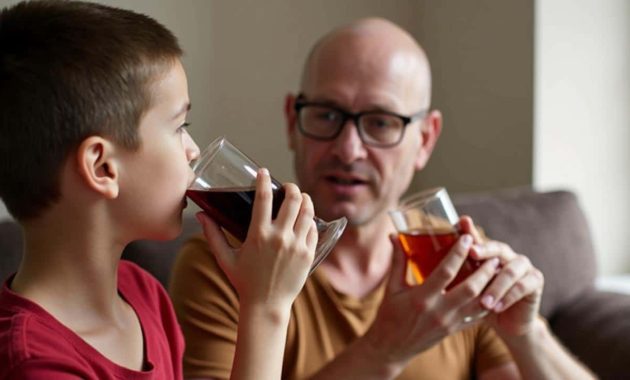
Her dad twists the cap off a bottle of cider, pours a little into a tumbler and slides it across the table like it’s no big deal. “Better you try it here than out there,” he says, nodding vaguely toward the dark garden and the world beyond. She laughs, sips, grimaces, then takes another sip. Somewhere in the house, her mum hesitates, listening but not intervening. Somewhere online, thousands of people are arguing about this exact moment.
On TikTok and Reddit threads, parents are confessing: yes, they let their kids drink at home. Some say it’s safer. Some say it’s insane. Experts keep posting grim statistics. The comment sections are full of rage, guilt and a quiet fear no one quite names.
One question keeps coming back, stubborn as a hangover.
“Better at home than in the street?” A comforting myth collides with reality
Scroll through parenting forums for five minutes and you’ll see the same phrase over and over: **“At least if they drink, I want it to be at home.”** It sounds caring. It sounds modern. It lets parents feel like they’re not the strict, out-of-touch ones. After all, alcohol is everywhere – in series, memes, family barbecues. Pretending teens will just ignore it feels naive.
So the kitchen table becomes the “safe lab” where alcohol is introduced. A small glass of wine at Sunday lunch. Half a beer during a football match. A sip of prosecco on New Year’s Eve that, slowly, becomes a whole flute. Many parents describe it as harm reduction. A way to teach moderation instead of fostering rebellion.
Yet as pediatricians quietly point out, what feels like control might actually be the beginning of something else entirely.
In one widely shared UK TikTok, a mother proudly explains that her 13-year-old is allowed “a couple of alcopops” during family parties. Comments explode instantly. Some call her “responsible” and “realistic”. Others accuse her of neglect. Under the viral noise, a different conversation is happening in medical journals and policy reports.
Research from Australia, the US and Europe keeps landing on the same uncomfortable pattern. Teens who drink with parental permission are more likely to drink more heavily later. A 2018 study from the University of New South Wales, for example, followed nearly 2,000 teens for six years. Those who were given alcohol by their parents were more likely to binge drink and report alcohol-related harms than those who got nothing at all.
Another US study found something similar: early “supervised” alcohol use was linked with more frequent and heavier drinking in high school. Parents imagine they are building a fence. The data suggests they might be building a ramp.
The logic seems simple at first: demystify alcohol, and kids won’t go crazy with it when they’re out with friends. In reality, what children internalise is not just the taste of wine or beer. They absorb the message that alcohol is a normal, almost necessary, ingredient of grown-up life. A reward, a relaxant, a social glue.
➡️ France helps Greece challenge Turkey with €800 million high-tech warship: the FDI frigate
➡️ “I blamed productivity”: when the real cost was my well-being
➡️ The price shock in supermarkets: this basic food becomes a luxury and gets people talking
When that message shows up at age 12 or 13, the developing brain is still wiring itself. Alcohol hits harder and rewires faster. Neurologists remind us that the adolescent brain is especially sensitive to substances that trigger reward pathways. That means a teenager doesn’t just “try” alcohol. Their brain learns from it, stores it, craves it more intensely.
Parents often assume their child will copy their moderation. The science suggests teens are more likely to copy their frequency. If you drink often, even “just a glass”, it sets a baseline. And when that baseline starts early, the slope is slippery.
How to handle alcohol with your kids without normalising it
So what do you do if your teen is already asking for a sip, or if you grew up in a family where wine on the table was just part of the furniture? One practical approach experts suggest is separating alcohol from everyday family life as clearly as possible. That doesn’t necessarily mean hiding every bottle. It means not letting it become casual background noise.
Concrete example: family meals can be alcohol-free as a rule, with drinks reserved for rare adult occasions. You can explain it plainly: “This is something for adult bodies and adult brains, and even then we’re careful.” Teens understand boundaries more easily when the rule is consistent, not negotiated at every birthday.
When they ask to taste, some addiction specialists advise delaying that first sip as long as you realistically can. Not with panic, but with calm repetition. *“You’ll have your whole adult life to experiment. Right now your brain is still under construction.”* It’s not a magic phrase. Yet hearing it ten times matters.
Still, saying “no” isn’t a strategy on its own. Kids watch how you drink far more than they listen to what you say about it. If your teenager sees you reaching for wine every stressful evening, any speech about “responsible use” rings hollow. This isn’t about perfection. It’s about coherence.
Soyons honnêtes : personne ne fait vraiment ça tous les jours. No parent gets communication and modelling right every time. You might have nights where you drink more than you intended, or where you laugh off being tipsy as a joke. The key is what you do with those moments later. Name them. “Yesterday I drank more than I wanted. That’s not what I’m aiming for.” Teens are far more likely to trust a parent who can admit missteps than a parent who pretends to be a walking brochure.
And when your kid comes home smelling like beer for the first time, that’s not the moment for a lecture. It’s the moment for questions, water, and maybe some honest sharing of your own teenage disasters.
“Parents often think that supervised drinking will teach control,” says one addiction psychiatrist I spoke to. “What it really teaches is that alcohol is acceptable, available, and part of how we relate to each other. That’s a powerful lesson for a 13-year-old brain.”
Here are some small, realistic moves families use to de-dramatise alcohol without normalising it:
- Set a clear family rule: no alcohol for under-18s at home, even on “special occasions”.
- Talk in advance about parties: how to say no, how to leave, who to call.
- Offer a no-questions-asked “get me home” deal if they ever feel unsafe.
- Keep adult-only drinks stored out of reach and out of daily sight.
- Use TV scenes and social media posts as openings: “What do you think about that?”
The internet is split – and so are many parents’ hearts
Spend an evening reading comments under a viral video about kids drinking at home and you’ll feel it: this isn’t just a policy debate. It’s about fear, culture, and memories people don’t always voice. Some echo Mediterranean childhoods where wine was diluted with water and no one ended up in rehab. Others recall parents who drank heavily and say they swore never to repeat that story.
One emotional thread runs through both camps: the terror of something happening to your child when you’re not there. Letting them drink “under your roof” can feel like a charm against worst-case scenarios. You can look them in the eye, count the bottles, check they’re in bed. Handing that control over to the outside world feels unbearable.
On a more personal level, many adults are still untangling their own relationship with alcohol. On a Friday night, it’s easier to pour your kid half a cider and call it “continental” than to face your own discomfort. One mother in a Facebook group wrote, “If I ban it, I’m a hypocrite. If I allow it, I’m scared I’ll regret it later. I honestly don’t know which fear to choose.”
We don’t often admit it out loud, but a lot of parenting decisions are exactly like that.
Experts, for their part, are rarely absolute. Most don’t think a stolen sip at 16 will ruin a life. What they worry about is pattern and message. **Repeated, relaxed access at home teaches a habit.** Silence teaches shame. Screaming teaches hiding. Somewhere in the middle, there’s room for calm, slightly clumsy conversations where everyone feels a bit awkward and still shows up.
On a quiet Tuesday evening, with dishes piled in the sink and phones lighting up the table, that might look like this: “You’re going to see a lot of alcohol in your life. Some people use it without much drama. Some people get hurt. I’m not scared of you having your own experiences when you’re older. I’m scared of you feeling you can’t talk to me about them.”
On a human level, that’s what all the arguments online are really circling around: not just booze, but whether our kids will keep talking to us when things get messy.
The next time you see a clip of a teenager holding a beer in a family kitchen and thousands of strangers judging their parents, hold the image a little longer. There’s the easy reaction – “reckless” or “relaxed”, depending on your instinct. Then there’s the quieter layer: an adult trying to make the least-bad choice in a culture soaked in alcohol, algorithms, and anxiety.
We all carry our own ghosts into that decision. The cousin who crashed a car. The grandparent who drank in secret. The sunny holidays where wine really was just… there. On a screen, those stories flatten into hot takes. At home, they live in the tiny pause before you say yes or no.
Maybe the real shift starts less with “Do I let my kid drink at home?” and more with “What story about alcohol do I want them to grow up with?” Not the polished, Instagrammable one. The honest one that includes stress, pleasure, regret and recovery.
On a certain level, this isn’t a debate about bottles at all. It’s about trust, control and how much risk we’re willing to admit exists in our children’s lives. That’s why the internet is split, and why it probably always will be. The data can guide us, yet it can’t fully answer the question that keeps parents awake at 2 a.m.: where is the line between protection and overconfidence?
Each family will draw that line in a slightly different place. What matters is drawing it with eyes open, knowing what the research actually says, and leaving enough space for your child to tell you when they’re lost. On a bright screen, the debate feels abstract. On a dim kitchen night, it’s just you, your kid, and the choice in front of you.
| Point clé | Détail | Intérêt pour le lecteur |
|---|---|---|
| Parental supply isn’t protective | Studies link supervised drinking with higher rates of later binge drinking | Helps parents question the “better at home” instinct |
| Modelling beats lecturing | Teens copy how often you drink more than what you say about it | Invites readers to look at their own habits, not just their rules |
| Connection is the safety net | Open, non-judgmental conversations reduce secretive, risky behaviour | Gives a realistic focus point in a messy, polarised debate |
FAQ :
- Is it ever “safe” to let a teen drink at home?There’s no risk-free level for underage drinking, especially for brain development. A rare sip is unlikely to cause harm, but regular access at home increases risks over time.
- What if my culture always includes kids at the table with wine?You can honour cultural traditions while adapting them. Many families keep children’s drinks non-alcoholic and focus on food, conversation and rituals instead.
- My teen has already been drunk. Is it “too late” to change things?No. You can reset boundaries, talk about what happened, and seek support if patterns repeat. One bad night doesn’t define their future.
- Should I tell my kids about my own drinking past?Selective honesty works best. Share enough to be real and relatable, without glamorising risky behaviour or oversharing adult details.
- How do I respond if my teen says “Everyone else’s parents let them”?Stay calm and grounded: “Every family has different rules. I’m making this choice because I care about your health and safety, not because I don’t trust you.” Then keep listening.