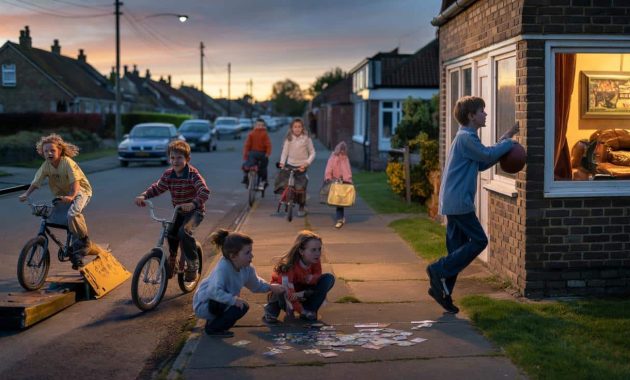
For kids who grew up in the 1980s and 1990s, freedom began when the school bell rang and ended when the streetlights flicked on. No smartphones, no location sharing, and very few adults hovering nearby. That everyday liberty has quietly vanished, reshaped by technology, safety fears and changing parenting norms.
Vanishing for hours with no check‑in
In many 80s and 90s households, one sentence unlocked the outside world: “I’m going out.” No follow‑up questions, no tracking apps, no constant pinging.
Once a child stepped out the front door, they were effectively off‑grid until dinner time.
Parents often had no idea whether their kids were at the park, in a friend’s garden, or three streets away investigating a building site they had been told to avoid. The unofficial rules were simple: stay with someone roughly your own age, avoid obvious danger, and be back before dark or before the snack you’d been promised.
Today, the idea of a 10‑year‑old wandering “somewhere in the neighbourhood” for an entire afternoon would alarm many families. Technology has raised expectations: if you can reach a child at any moment, failing to do so starts to look negligent.
Yet that era of inaccessibility forced children to assess risk in real time. A broken bike, a wrong turn, a shortcut that went too far – every problem had to be solved on the spot, often by a group of kids barely tall enough to see over garden fences.
Going almost everywhere alone
Walking to school without adults was once a rite of passage, not a headline. In early primary years, children formed loose walking buses of their own, picking each other up house by house.
Historical data from the UK shows how dramatically that has changed. In the early 1970s, most seven‑ and eight‑year‑olds regularly walked to school unaccompanied. By around 1990, that proportion had collapsed to under 10%. Comparable French data suggests autonomy now arrives years later than it once did.
What used to be a normal walk has, in many places, turned into a managed logistics operation.
➡️ After 60, social energy is managed differently by the brain
➡️ China turned contested reefs into permanent military bases using millions of tons of concrete
➡️ Legendary rock band retires after 50 years “the hit everyone knows”
➡️ Is eating meat-free actually healthy? A centuries-old diet debate returns
➡️ How to remove moss from your lawn naturally and effectively ?
Parents today often juggle school runs by car, supervised bike rides, and carefully chosen routes. Concerns range from road safety and traffic to stranger danger and air pollution. The result is that many children know the inside of a car far better than the back alleys and cut‑throughs near their homes.
For kids of the 80s and 90s, bikes were both transport and ticket to independence. Helmets existed, but were loosely enforced. A Saturday might include a cross‑town cycle to a video rental shop, a friend’s house, and the corner shop, all without adult oversight.
Knocking on doors to see who’s out
Before messaging apps, the social network was a row of doorbells. Childhood plans were not scheduled; they were improvised.
You walked over to a friend’s house, rang the bell and asked, “Can you come out?” The answer was immediate and unfiltered: yes, no, or “he’s at his grandma’s”. No coordinating parents over WhatsApp, no Google Calendar invites for playdates three weeks ahead.
Spontaneity, and a bit of rejection, were built into everyday friendship.
If one friend was busy, you tried another. Eventually a group formed organically and the day took shape on its own: a kickabout in the park, a homemade ramp for bikes, or an elaborate game that lasted until someone was called in for tea.
Today, many children’s social lives are more curated. Parents coordinate timings, vet locations, and manage group chats. The upside is safety and inclusion; the cost is that children get fewer chances to handle awkward moments face to face: the knock‑back, the argument on the doorstep, the brave decision to ring the bell again tomorrow.
Watching whatever was on television – and nothing else
Entertainment choice in the 80s and early 90s was narrow. A handful of channels meant that if you missed your favourite cartoon, that was it until the next broadcast. No replay. No on‑demand. No algorithm whispering “next episode?”
Saturday morning cartoons were an event. After school, children’s programmes filled a short slot before the evening news took over. When those shows ended, many kids simply turned off the TV and went outside.
Limited content created a strange kind of abundance: more time for everything that wasn’t on a screen.
That scarcity also produced a shared culture. On Monday morning, the playground buzzed with the same episode of the same show, because almost everyone had watched it. Today’s children have far more choice but far fewer common reference points, scattered across streaming platforms, YouTube channels and games.
Playing outside until the streetlights came on
Unstructured outdoor play dominated many childhoods. Pavements became football pitches, with school jumpers as goalposts. Small patches of grass hosted marble tournaments and improvised versions of tag, stuck in the mud or British bulldog.
There were no organised coaches, no Saturday leagues with matching kit, and certainly no participation trophies. Older children made the rules, often in their own favour, and younger ones learned quickly how to negotiate or push back.
Weather rarely stopped anything. Rain meant sliding in the mud. Cold meant running harder. The end of playtime wasn’t a scheduled pick‑up; it was the glow of streetlights or the distant shout of a parent’s voice echoing down the road.
Creating games and worlds from almost nothing
With limited toys and no constant stream of digital content, many games were invented on the spot. A ball and a wall could fill an afternoon. A piece of chalk could turn tarmac into a hopscotch grid, a racetrack, or an imaginary kingdom.
Boredom, far from being a crisis, was the raw material for invention.
Kids built dens out of scraps of wood, attempted dubious engineering feats like makeshift rafts, and launched complex trading economies based on stickers, marbles or trading cards. Rules were written, tested and rewritten in real time, usually without a single adult knowing or caring.
- One street had its own version of hide‑and‑seek with secret “bases”.
- Another specialised in bike races over bumps and makeshift ramps.
- Blocks of flats hid legendary spots for swapping football stickers.
Those local variations created tiny cultures: in one area, a certain game might be famous; three streets away, no one had heard of it.
Handling conflicts without adult referees
Fights, fallouts and hurt feelings were inevitable. What was different was the expectation that children handled most of them themselves.
A controversial goal, a suspected cheat, a harsh insult – all could end in tears, sulking or someone storming off with the ball. But by the next day, the same group usually gathered again, having stitched things back together without mediation from teachers or parents.
Children learnt early that friendships survive imperfect apologies and that being right can still mean playing alone.
This did not erase bullying or serious harm, which existed then as they do now. Yet day‑to‑day disagreements gave children practice in negotiation, compromise and forgiveness at a raw, unscripted level that is rarer when adults step in early and often.
Why those freedoms faded
The 80s and 90s were not a golden age of safety; traffic accidents, crime and neglect were real. What changed was awareness and perception.
| Factor | Then | Now |
|---|---|---|
| Technology | Landlines, no tracking, no mobiles | Smartphones, GPS, constant messaging |
| Parental expectations | “Be back by dark” | Regular check‑ins, supervised activities |
| Traffic & urban design | More quiet streets, fewer cars per household | Heavier traffic, larger vehicles |
| Social norms | Unaccompanied kids seen as normal | Can trigger concern or official reports |
Media coverage amplifies rare but shocking events, feeding a sense that unsupervised childhood equals danger, even when crime statistics do not always support that feeling. At the same time, indoor digital entertainment has become so attractive that many children need persuading to go outside at all.
What could a modern middle ground look like?
Parents who grew up in those freer decades often feel torn. They remember the thrill of roaming, but they see roads busier, lives busier, and screens more persuasive than anything they knew.
Some families experiment with “graduated freedom”: small, local responsibilities that grow over time. That might start with a child walking one block alone, or going to the corner shop with a sibling, or playing in a nearby park while a parent stays within calling distance rather than constant line of sight.
Terms such as “free‑range parenting” describe this approach. The idea is not to recreate the 1980s but to give children age‑appropriate chances to make decisions, take minor risks and handle the boredom that leads to creativity, without abandoning safeguards entirely.
There are also modern equivalents to old freedoms. Online games and group chats, for example, give children spaces to form their own rules and alliances, even if adults sometimes struggle to understand those worlds. These digital zones come with different risks – from screen overuse to online bullying – yet they also build skills in communication, collaboration and digital literacy that earlier generations lacked.
A useful question for any parent or carer is not just “Is this safe?” but “What skill is my child building here?” Roaming the streets once taught navigation, courage and social judgment. Navigating today’s digital life teaches other abilities, from information filtering to managing constant communication. The challenge is to combine both, allowing space for scraped knees and awkward chats at front doors, without ignoring the genuine risks that did not always worry adults in the 80s and 90s.