On some future afternoon, the light will start to feel… wrong.
Not darker, exactly. Thinner. Colors turn metallic, birds fall strangely quiet, and people who were scrolling their phones will slowly look up, one by one, as if pulled by a silent alarm.
Street lamps may flicker on in the middle of the day. Shadows grow razor sharp, then melt. A faint chill runs through the air, out of sync with the season.
And then, for several long, impossible minutes, day will simply vanish.
Scientists already know when this will happen.
What they didn’t expect is how long the Sun will disappear.
The day the Sun goes “offline” for an impossible length of time
Astronomers have already circled the date in red: August 2, 2027.
On that day, the Moon’s shadow will sweep across Earth and trigger one of the most astonishing celestial shows of our century, a total solar eclipse stretching across the Mediterranean, North Africa, and the Middle East.
What has researchers buzzing isn’t just the path.
It’s the duration.
At the very center of the Moon’s shadow, close to Luxor in Egypt, totality is expected to last around 6 minutes and 23 seconds.
In an era when many eclipses barely give us three minutes of darkness, those extra heartbeats of night feel almost extravagant.
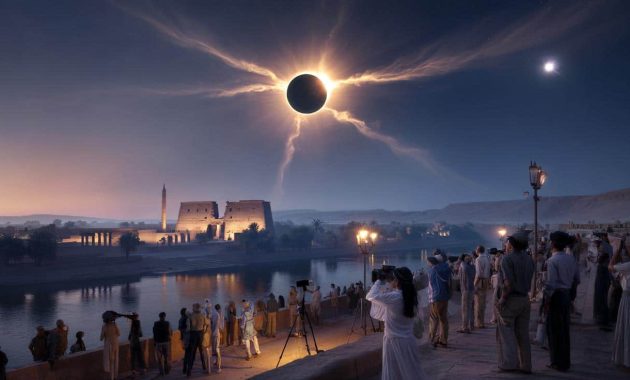
Picture this: you’re standing near the ruins of the ancient temples of Luxor, the Nile sliding by like a strip of metal.
The midday Sun is high, the air heavy, tourists fanning themselves. Then the light shifts, turning eerie and sideways, as if someone has changed the bulbs in the sky.
The Moon starts to bite into the Sun.
Locals drift out of shops, guides stop mid-speech, and people raise their eclipse glasses in near-silence.
Then the last bead of sunlight snaps off and the corona unfurls, a white ghostly crown around a black hole in the sky.
Three minutes pass.
Four.
➡️ For every dessert, its apple! The ultimate guide to finding the right apple to use
➡️ Meteorologists warn February begins with a rare Arctic breakdown
➡️ The creamy potato and onion bake that works well as a main or side
You feel the drop in temperature on your skin. Venus and Jupiter pop out. People gasp, laugh, swear, cry.
And the darkness just keeps going.
This unusually long blackout isn’t random drama.
It’s geometry.
Total eclipse duration depends on several moving parts: how close the Moon is to Earth, how close Earth is to the Sun, and where you stand along the eclipse path. When the Moon is near perigee (its closest point to us) and Earth is near aphelion (its farthest point from the Sun), the Moon appears larger and the Sun slightly smaller in our sky.
That combo stretches totality.
The 2027 eclipse hits that sweet spot, with the Moon’s apparent disk big enough to cover the Sun completely and for longer than usual.
It won’t beat the absolute record of the 21st century (set for 2009 at over 6 minutes 39 seconds), but for modern observers with better instruments and global networks, this will be one of the most scientifically and emotionally loaded sky events in living memory.
Why scientists are quietly thrilled — and what they plan to do with those minutes
For eclipse scientists, an extra minute isn’t just “more wow.”
It’s more data.
The corona, that delicate halo of super-hot plasma around the Sun, remains stubbornly mysterious. We still don’t fully understand how it reaches temperatures of over a million degrees while the Sun’s surface “only” simmers around 5,500°C. During totality, when the bright photosphere is blocked, telescopes and cameras can finally study the corona’s intricate streamers and loops in detail.
Longer totality means more time to switch filters, capture sequences, and track how those structures evolve second by second.
Six-plus minutes is almost leisurely, by eclipse standards.
Space weather teams are also sharpening their pencils.
Solar activity should be high in the late 2020s, which means a corona bristling with loops, flares, and magnetic tangles.
Teams in Egypt, Spain, and Saudi Arabia are already mapping vantage points with clear horizons, stable air, and reliable infrastructure. Portable observatories will sprout on rooftops and desert plateaus. Drones may monitor light and temperature changes while stations measure how the sudden “night” affects local winds and animal behavior.
It’s not just about the Sun.
Biologists want to watch how birds, insects, and even livestock react during six minutes of fake night. Local power grids and traffic systems will be under subtle observation too: how does a city respond when day blinks off like a switch?
Behind the scientific excitement lies a more personal truth: eclipses change people.
Ask anyone who has stood in the path of totality and you’ll notice a shift in their voice.
Psychologists studying past events have noted a weird cocktail of emotions — awe, fear, joy, a sense of smallness and connection all at once. Many describe it as a kind of “cosmic reset,” a shock that rearranges priorities for a while.
Six full minutes of that is a long time to sit inside your own head, with the universe visibly rearranging itself above you.
*Most of our days blur into each other; eclipses slice through that blur like a knife.*
And that’s part of why this one, with its extraordinary duration, is already bending travel plans, research budgets, and life decisions years in advance.
How to live this eclipse like you’ll never forget it
If you’re even mildly eclipse-curious, this is the one you quietly design your life around.
That doesn’t mean selling everything and moving to Luxor, but it does mean starting earlier than you think.
Step one: pick your zone.
The path of totality will slide over parts of Spain, North Africa (including Morocco, Algeria, Tunisia, Libya, Egypt), Saudi Arabia, and Yemen. Inside that narrow band, some spots will get barely a couple of minutes, while others, especially near Luxor, will flirt with those 6+ glorious minutes.
Step two: treat this as both a trip and a time-sensitive appointment with the sky.
Book accommodation early, check historical weather data, and plan one backup location within a few hours’ travel. Clouds are ruthless.
Everyone talks about protective glasses and camera gear, but the emotional logistics matter just as much.
Who do you actually want standing next to you when the world goes dark at noon?
We’ve all been there, that moment when a “big” event becomes stressful because we’ve tried to cram in too much.
Don’t turn the eclipse into an endurance test of flights, missed connections, and panicked last-minute drives.
Let’s be honest: nobody really does this every single day.
Traveling for an eclipse is weird and intense, and it’s OK to admit you might feel overwhelmed.
Keep your gear simple: eclipse glasses, maybe binoculars with filters, a tripod if you love photography — and that’s it.
Many veteran eclipse chasers will tell you they regretted spending totality fiddling with lenses while missing the sky.
One thing seasoned observers repeat endlessly is: prepare your mind as much as your suitcase.
This sounds mystical, but it’s actually practical.
“During my first total eclipse, I spent three minutes shouting instructions at my camera,” recalls French astrophotographer Laure C. “I looked up for maybe 15 seconds. Never again. For my second eclipse, I took only one camera, pressed record, and then just… watched. Those two minutes are tattooed on my memory.”
Use the days before the eclipse to scout your spot at the same hour of day.
Notice where the Sun will be, where you can sit, where the horizon is open.
Then write down, on an actual piece of paper, the small things you don’t want to forget in the moment.
- Look around at people’s faces when totality starts.
- Listen to birds and city sounds just before and after.
- Take 10 seconds to breathe and feel the temperature change.
- Spend at least half of totality with your devices down.
- Right after, record a quick voice note of how you feel.
A long shadow, a long memory
Years from now, people will say, “Where were you during the great eclipse?”
Some will talk about the traffic jams and airport chaos. Others will remember standing on a dusty rooftop, or a riverbank, or a crowded town square as the Sun vanished into a perfectly black hole.
The duration of this event matters because humans don’t just witness eclipses; we inhabit them.
Six minutes is enough time for your thoughts to wander from gear and logistics to family, to climate, to history, to the simple fact that you’re standing on a spinning rock, watching clockwork shadows slide across it.
There’s a quiet power in that.
A kind of shared, global breath.
This century will bring faster phones, smarter cars, more screens.
But very few moments will rival the raw, naked strangeness of the day that turned into night — slowly, impossibly — while an entire strip of the planet looked up together and felt, if only briefly, like citizens of the same small world.
| Key point | Detail | Value for the reader |
|---|---|---|
| When and where | Total solar eclipse on August 2, 2027, with longest totality near Luxor, Egypt (around 6m23s) | Helps you decide early if this is an event you want to travel for and where to target |
| Why it’s special | Unusually long totality due to orbital geometry, happening during a period of high solar activity | Shows why scientists are so engaged and why this eclipse will likely produce spectacular views |
| How to experience it | Plan simple travel, protect your eyes, prioritize presence over complex gear and photos | Gives you a realistic way to turn a rare celestial event into a vivid personal memory |
FAQ:
- How long will the 2027 solar eclipse last at its maximum?The longest duration of totality is expected to be around 6 minutes and 23 seconds near Luxor, Egypt, with shorter totality along other parts of the path.
- Is this really the longest eclipse of the century?It’s among the longest, especially for widely observable eclipses with good infrastructure. A 2009 eclipse slightly beats it in raw duration, but 2027 offers exceptional conditions for both science and public viewing.
- Is it safe to look at a total solar eclipse?You must use proper eclipse glasses or certified solar filters during all partial phases. Only during the brief full totality, when the Sun is completely covered, is it safe to look with the naked eye — and you need to stop the moment any bright sliver reappears.
- Do I really need to travel into the path of totality?If you stay outside the path, you’ll only see a partial eclipse, which feels like a dimmer switch on the Sun. Totality is a completely different experience, with sudden darkness, visible corona, stars, and a strong emotional impact.
- What’s the simplest way to prepare without going overboard?Pick a spot in the path of totality with historically good weather, book accommodation early, pack eclipse glasses and minimal gear, and give yourself a backup viewing location within a few hours’ drive in case of clouds.