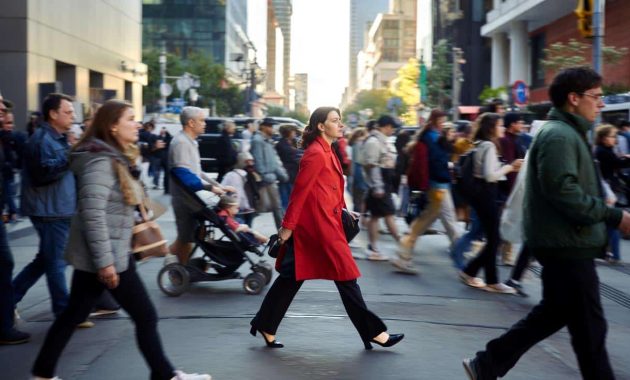
You’ve probably noticed them on the sidewalk or in the subway corridor. The people who don’t just walk, they slice through the crowd. Their feet seem to know exactly where to land, shoulders angling at the last second, bag tucked close, eyes already on the next gap. They’re not running, not really. Just… decisively faster than the rest of us clutching coffee cups and vague directions.
One morning, I watched a woman in a red coat cross three city blocks, weaving between tourists and kids on scooters, never once breaking stride. She wasn’t late. She wasn’t stressed. She just moved like someone with a silent internal deadline.
Behavioral scientists say that walk says far more about her than we think.
The hidden personality test playing out on the sidewalk
Stand on any busy street corner for five minutes and you’ll spot it. The quiet divide between people who drift and people who move. The stroller-pushers, the window-gazers… and the ones who glide past like they’re already living twenty seconds in the future.
Across cultures and cities, researchers keep finding the same thing. People who naturally walk faster than average tend to share a cluster of traits. Not only are they described as more driven, more focused, often more impatient, they also report seeing time itself differently.
To them, a minute is not a vague unit. It’s something you either spend well or waste.
In one well-known study from the 1990s, psychologist Robert Levine timed pedestrians in 31 cities by quietly clocking how long it took them to walk 60 feet. Cities where the average walking speed was higher tended to rank higher on economic productivity.
More recent personality research goes even deeper. When scientists compare walking speed with Big Five personality traits, fast walkers score higher on extraversion and conscientiousness, and lower on neuroticism. They’re more likely to describe themselves as “goal-oriented” and “efficient”.
One UK study even found that people who walk at a brisk pace have a lower perceived age. In other words, they move like they feel younger inside.
Why does walking pace hook so tightly into personality? Part of it is simple physics. People who are comfortable taking up space, literally and socially, tend to move with fewer hesitations.
➡️ Hygiene after 65 : not daily, not weekly, here’s the ideal shower frequency for staying healthy
➡️ Ozempic and other weight-loss drugs linked to sudden vision loss, two studies suggest
➡️ This cousin of the dodo defies extinction on the lost islands of the Pacific
Part of it is pace of life. If your brain fires quickly, your calendar is packed, and your decisions come fast, your body often syncs up with that tempo. Your nervous system becomes a metronome.
And there’s something deeper: fast walkers usually hold a clear internal map. They walk like people who have already decided where they’re going in more ways than one.
What your walking speed quietly says about you
Behavioral scientists often talk about “time urgency”. Not the stressy kind that sends your heart racing, but the steady internal drumbeat that whispers, “Let’s go.” People who walk faster than average usually score high on this trait.
They don’t just respect deadlines. They almost experience life as a timeline they’re constantly moving along, not a room they’re aimlessly wandering through. That’s why you’ll see them instinctively find the shorter security line, pick the escalator over the stairs when they’re late, and adjust their route in seconds when a crowd blocks their way.
Their bodies broadcast a simple signal: forward is the only direction that counts.
Think of a colleague who always seems half a step ahead. The one who arrives at meetings with their notebook open, laptop already connected, questions ready. Watch them leave the building at lunch. They’re the person already several meters down the street while others are still deciding where to go.
One manager I spoke with joked that she could predict her team’s style by how they moved in the hallway. Her fastest walker? Always early, hates small talk, loves ticking things off a list. Her slowest? Brilliant strategist, loves to reflect, can get lost in ideas and lose track of time.
Neither style is “better”. Yet the fast walker’s stride tends to mirror a mind that treats life like a series of tasks to be met head-on.
From a behavioral point of view, fast walking bundles together several indicators: **higher conscientiousness**, stronger sense of personal agency, and a bias toward action over rumination. These are the people who volunteer first, answer emails quickly, and mentally organize errands into the most efficient route.
They’re also more likely to see themselves as responsible for their own trajectory. If something isn’t working, they change direction rather than lingering. That same forward tilt in their body shows up in their decision-making.
The flip side? Many fast walkers admit they struggle to “do nothing”. Stillness can feel like a stalled engine. *Their feet are honest about what their minds rarely admit: they’re more comfortable in motion than in pause.*
Can you change your walking speed—and what happens if you do?
You can’t rewrite your whole personality overnight, but you can play gently with your tempo. One simple experiment behavioral scientists suggest is a “conscious pace swap”. For three days, try walking 10–15% faster than you usually do whenever you’re moving with a purpose. Not racing, not power-walking. Just slightly more decisive.
Notice what changes. Your route choices. The way you dodge people. The fact that you arrive two minutes earlier than usual and suddenly have a small, unexpected pocket of time. Those tiny wins send quiet signals back to your brain: you’re capable of moving more actively through your day.
It’s less about burning calories and more about testing a new self-image: the version of you who doesn’t drift, but directs.
Of course, this is where guilt loves to sneak in. You might think, “If I walk slowly, does that mean I’m lazy or unmotivated?” Not at all. Some people are naturally reflective, or live in bodies that move differently, or have learned to guard their energy after burnout. Speed isn’t morality.
The mistake many of us make is treating walking as just a way to get from A to B, instead of a daily micro-habit that shapes how we feel about ourselves. We shuffle when we’re tired, dawdle when we’re scrolling our phones, then complain we “never have time”.
Let’s be honest: nobody really does this every single day. But playing with your pace a few times a week can be a surprisingly kind way to tint the rest of your life with a bit more intention.
Behavioral psychologist friends often remind me that the body is the easiest place to tweak the mind. One of them put it like this:
“Change how you move, and your brain quietly updates who you are allowed to be.”
If you want to experiment, you can borrow a few cues that fast walkers naturally use:
- Set a clear micro-destination (the door, the corner, the café) before you start moving.
- Keep your hands relatively free so your arms can swing and your body feels ready.
- Look where you’re going, not at your feet or your phone.
- Walk with one continuous intention, instead of starting and stopping.
- Notice how your inner dialogue shifts when your feet commit to a direction.
These tiny adjustments don’t turn you into someone you’re not. They simply let you borrow, for a few minutes, the psychological frame that fast walkers live in all day.
When a simple walk turns into a mirror
Once you start paying attention to walking speed, the world looks slightly different. Streets become quiet personality maps. That couple walking out of sync. The teenager dragging their feet behind their parents. The nurse in uniform moving like every second already belongs to someone else.
You might catch yourself adjusting too. Slowing down on purpose when you’re with a friend who needs to vent. Speeding up on a solo errand because it feels oddly good to cut through the noise and just go. There’s no single “right” tempo. There’s only the one that matches what your day, and your nervous system, can honestly carry.
What behavioral science keeps hinting at is simple: the way we move is rarely random. Fast walkers often carry a mindset of **direction, urgency, and ownership** without even naming it. Slow walkers often protect space for reflection, detail, or recovery.
The quiet question underneath isn’t “Am I fast or slow?” but “Does the way I move through the world fit the life I say I want?” Some people will read this and feel an itch to pick up the pace a little. Others might realize they’ve been sprinting through a life that actually needs a pause.
Either way, the next time you find yourself walking down a busy street, try this tiny experiment. Match your natural pace for a block. Then nudge it—up or down—by just a notch. Notice which version of you feels more honest. That’s the one worth listening to.
| Key point | Detail | Value for the reader |
|---|---|---|
| Walking speed tracks personality | Fast walkers score higher on conscientiousness, extraversion, and time urgency | Helps you read your own default traits in an everyday behavior |
| Body tempo shapes mindset | Small changes in pace can subtly shift focus, confidence, and sense of agency | Gives a low-pressure way to experiment with a more intentional self-image |
| No “right” speed for everyone | Fast and slow walking styles both carry strengths and trade-offs | Encourages you to align your pace with your real needs, not social pressure |
FAQ:
- Does walking fast mean I’m more successful?Not automatically. Fast walkers often show traits linked to achievement, like drive and time awareness, but success also depends on strategy, support, timing, and luck.
- Can I train myself to become a fast walker?You can gently increase your pace over time, especially on short, purposeful walks. That might nudge your mindset, but your baseline personality will still be yours.
- What if I walk slowly because of health reasons?Then walking speed says more about your body than your personality. The research mainly applies to people moving at a pace that feels physically comfortable for them.
- Is walking speed linked to mental health?Some studies suggest very slowed walking can appear in depression or fatigue, while brisk walking can boost mood. The direction also works both ways: how you feel affects how you move.
- Should I worry if my partner and I have different walking speeds?Not at all. Different paces can reflect different temperaments. What matters is whether you can occasionally meet in the middle—literally slowing down or speeding up for each other.