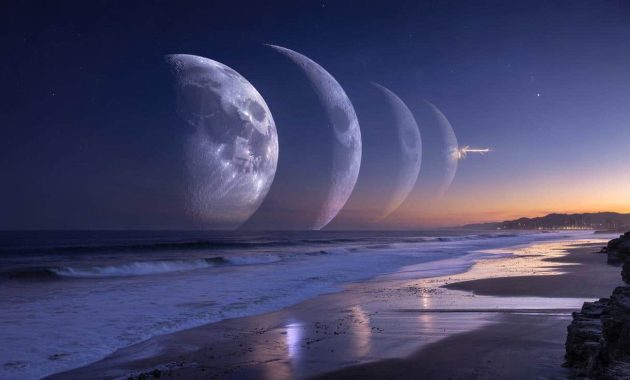
For billions of people, the Moon is a familiar presence that rises, sets, and pulls the oceans with dependable regularity. Behind that reassuring routine, though, lies a subtle cosmic reshaping: the Moon is drifting away, Earth’s spin is slowing, and both our days and our tides are changing in ways that matter on geological and, one day, biological timescales.
A moving partner in Earth’s cosmic dance
From a human perspective, the Earth–Moon system feels permanent. Calendars, tide tables and eclipse predictions treat it like clockwork. Yet measurements show the distance between Earth and the Moon increases by about 3.8 centimetres every year. That shift sounds trivial, smaller than the width of a finger, but carried over millions of years it reshapes the length of our day and the character of our oceans.
Geologists and astronomers now see this slow drift as a key part of Earth’s story. It helps explain why days were shorter in the age of the dinosaurs and why fossils record a different number of days in a year than we see now.
Each year, the Moon moves a few centimetres farther away, and Earth pays for that distance with slightly longer days.
When dinosaurs walked under a bigger Moon
Roll the clock back around 70 million years to the late Cretaceous, when Tyrannosaurus rex roamed and flowering plants had just spread across the continents. Earth spun a little faster then. One full rotation took about 23.5 hours, not the 24 hours we live by today.
This isn’t just an educated guess. Researchers have studied ancient shells from fossil bivalves that grew in warm Cretaceous seas. These marine creatures laid down fine daily growth lines, a bit like tree rings. Under a microscope, those lines act as a natural calendar.
An influential study on the bivalve Torreites sanchezi found roughly 372 daily lines stacked within what was clearly a single year of growth. That means an ancient year still lasted about the same number of hours as now, but those hours were divided into more, shorter days. Earth was spinning faster; the Moon was closer and tugging more strongly on the oceans.
Born from a violent collision
The deeper origin of this slow drift reaches back 4.5 billion years. Models suggest a Mars-sized object, often called Theia, smashed into the young Earth. The impact threw a ring of molten rock into orbit. That debris clumped together and cooled to form the Moon, initially far closer than it is now.
In those early days, the Moon would have loomed enormous in the sky. Tides would have been far more extreme. Over time, tidal friction began to transfer energy from Earth’s spin into the Moon’s orbit, launching the long process that still continues: a gradually retreating Moon and an ever-slowing Earth.
➡️ China turned contested reefs into permanent military bases using millions of tons of concrete
➡️ Chefs explain why seasoning cast iron at low heat lasts much longer
➡️ Storm Harry is coming : there will be heavy snow and rain until
➡️ This ex‑Google and Amazon engineer warns AI is about to replace half of human developers
How tides are pushing the Moon away
The engine behind the Moon’s escape is surprisingly familiar: the tides. As the Moon’s gravity pulls on our planet, it raises bulges in the oceans on the side facing the Moon and the opposite side. If Earth didn’t spin, these tidal bulges would line up neatly with the Moon.
But Earth rotates once every 24 hours, much faster than the Moon completes an orbit in about 27 days. That rapid spin drags the tidal bulges slightly ahead of the Moon’s position in the sky. Gravity between the off-centre bulges and the Moon produces a forward tug on the Moon, almost like giving it a tiny, constant push.
Because Earth spins faster than the Moon orbits, the tidal bulges race ahead and effectively “tow” the Moon into a higher orbit.
This push increases the Moon’s orbital energy. As its energy rises, so does its average distance from Earth. The price is paid by Earth’s rotation, which loses a little angular momentum. Over long periods, that loss shows up as longer days.
Laser checks from Apollo’s mirrors
The 3.8-centimetre figure isn’t theoretical. During the Apollo missions, astronauts placed special mirrors, called retroreflectors, on the lunar surface. On Earth, observatories fire laser pulses at these mirrors and measure the time it takes for the light to return.
By timing that round-trip journey to a fraction of a nanosecond, scientists can track tiny shifts in the distance between Earth and the Moon. Decades of measurements reveal a clear trend: the gap between us grows each year, confirming the tidal theory worked out on paper.
Longer days ahead, but not for us
Earth’s rotation continues to slow as energy drains into the Moon’s orbit. Right now, the length of a day increases by roughly 1.7 milliseconds per century. That is far too small to notice in daily life, but over hundreds of millions of years it adds up.
- 70 million years ago: day length around 23.5 hours
- Today: 24 hours (by definition), with small adjustments such as leap seconds
- Hundreds of millions of years from now: days lasting several minutes longer than today
For humans, the immediate effects show up mostly in precise timekeeping. Atomic clocks are so accurate that the tiny irregularities in Earth’s spin require occasional “leap seconds” to keep Coordinated Universal Time aligned with the planet’s actual rotation. Over the very long term, future calendars and satellite navigation systems would have to account for a gradually lengthening day.
What happens to our tides
As the Moon recedes, its gravitational pull weakens slightly. That means tides will gradually become less extreme. Today’s coastal ecosystems, from salt marshes to mangrove forests, depend on the timing and height of the tides. On a scale of tens to hundreds of millions of years, those habitats will experience slower, gentler tidal cycles.
Storm surges and local geography will still matter far more for coastal flooding over the next few centuries. Climate-driven sea-level rise, for instance, dwarfs the tidal changes caused by the Moon’s current drift. Yet the underlying trend toward milder tides remains part of Earth’s long-term environmental background.
The future: weaker eclipses and a stalled tide machine
If nothing else changed and the process ran for long enough, Earth and the Moon would eventually reach a state called tidal locking. Earth’s rotation would slow until it matched the Moon’s orbital period. A day on Earth would last as long as one lunar month. One side of our planet would always face the Moon, just as one side of the Moon always faces us now.
In a fully locked Earth–Moon system, every point on the planet would keep the same view of the Moon, and ocean tides would almost freeze into place.
In that distant configuration, tides would no longer surge in and out; they would barely slosh, stuck in a near-static pattern. Yet the cosmos rarely grants such neat endings. Long before full tidal locking, changes in the Sun will likely override everything.
Within about a billion years, the Sun is expected to brighten enough to evaporate Earth’s oceans. Without large oceans, the tide machine would shut down. The Moon’s outward drift would slow dramatically or stop. Billions of years later, as the Sun swells into a red giant, both Earth and the Moon may be scorched or engulfed entirely.
Smaller Moon, weaker eclipses
On a much shorter timescale, another visible change will come from the shrinking apparent size of the Moon in the sky. Because it is moving away, it will gradually cover a smaller fraction of the Sun’s disc during an eclipse.
Today, total solar eclipses occur when the Moon perfectly covers the Sun as seen from parts of Earth, producing a dramatic midday twilight. In the distant future, the same alignments will yield only annular or partial eclipses, where a ring or crescent of sunlight remains visible around the Moon.
Why this matters for Earth science today
The slow dance between Earth and the Moon is not just a curiosity for astronomers. It helps geophysicists and climate scientists piece together the history of our planet. Fossil growth lines, sediment layers and tidal patterns in ancient rocks all carry imprints of past day lengths and lunar distances.
By comparing those records with modern laser ranging data and computer models, researchers refine their understanding of how Earth’s rotation, climate and even continental positions have changed through time. The Moon’s drift acts like a built-in clock, quietly recording the deep history of our planet’s spin.
Key terms worth knowing
| Term | Meaning |
|---|---|
| Tidal friction | Energy lost as tides move across ocean basins and sea floors, gradually slowing Earth’s rotation. |
| Tidal locking | A state where one body always shows the same face to another, as the Moon already does to Earth. |
| Orbital energy | The energy linked to how fast and how far a body orbits around another, which increases as the Moon moves outward. |
| Leap second | An occasional one-second adjustment added to keep atomic time aligned with Earth’s slightly irregular rotation. |
Simulating Earth without the Moon’s pull
Researchers sometimes model what Earth would look like with a very different Moon. One scenario asks what our climate and oceans would be like if the Moon had never formed or if it were already much farther away.
Simulations suggest that without a strong lunar pull, Earth’s axial tilt might wander more chaotically. That tilt, currently about 23.5 degrees, gives us seasons. Unstable tilt could lead to wilder swings between ice ages and warm periods. The Moon’s presence, and its slow retreat, appears to help steady that tilt and keep long-term climate variations somewhat restrained.
Another modelling line looks at coastal ecosystems millions of years from now. Gentler tides could favour different species of plants and animals, change how nutrients cycle through estuaries, and affect where humans can build ports and coastal cities. These are remote considerations, yet they show that the Moon’s tiny yearly step away from Earth has cumulative effects far beyond mere astronomy.