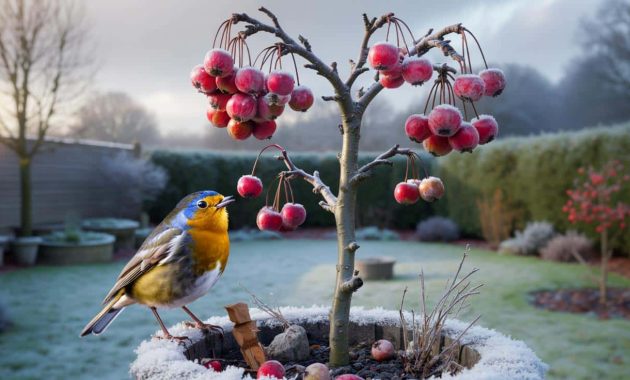
The first time you notice it, you’re probably just washing up after dinner. Outside, the garden looks flat and grey, breath hanging in the air, soil crusted with frost. Then a sudden movement near the back fence. A flick of orange-red. You pause, hands still in the sink, and there he is: a robin, perched like a tiny ember against the winter branches.
He isn’t hopping around the feeder with the pushy tits and finches. He’s somewhere else entirely, leaning towards a small tree or shrub that still carries one stubborn splash of colour. Red berries, glossy in the dull light, like someone forgot to tell them winter had started.
He knows exactly why he’s there.
The winter berry robins simply can’t resist
Ask any backyard birdwatcher and you’ll hear the same thing: if you want robins in winter, think berries, not seeds. They’ll visit a feeder out of curiosity, sure, but their winter love affair is with a very specific fruit. Again and again, people mention the same plant: **the humble crabapple**. While the rest of the garden is stripped bare, those small, marble-sized fruits cling stubbornly to the branches, softening with each frost.
Stand at your window on a cold January morning, and you’ll see the routine. Robin arrives, surveys the scene, then dives into the crabapple tree. He’ll test a few fruits, pick the softest ones, swallow them whole in three quick jerks of his head. Then he’ll vanish into the hedge, only to be back an hour later. Like clockwork.
One birdwatcher in Kent told me she counts winter not in weeks, but in how many crabapples are left on her favourite tree. “By Christmas there’s still plenty,” she said, pulling on her garden gloves. “By late January, the tree is practically stripped. And every missing fruit means another robin visit.” Her neighbours have the usual feeders: sunflower hearts, peanuts, fat balls. She has that as well, but the real traffic flows through the crabapple branches.
She started noticing a pattern during the Beast from the East cold snap. While most birds crowded the feeders, the robins kept returning to the small crabapple by the shed. It was like a private canteen. One day she counted four different robins taking turns, each one fiercely guarding their patch of fruit. The berries kept them coming back when everything else was frozen solid.
There’s a simple reason for this quiet obsession. Robins are “facultative frugivores”, which is the fancy way of saying they switch to fruit when insects vanish. Crabapples, especially the smaller ornamental varieties, hang on the tree for months. As the frost hits, the fruits break down, the starch turning to sugar. For a robin, that softened, sugar-rich berry is pure winter fuel.
*Seeds in hanging feeders are fine, but they’re not what a robin’s body is built around.* On the ground, a robin is a hunter, tuned to worms and bugs. When the soil locks up, fruit is the next best thing. **Crabapples bridge that gap**, keeping energy levels up until the first spring thaw wakes up the worms again.
How to turn one small tree into a winter robin magnet
If you’re tempted to try this, you don’t need an orchard. One ornamental crabapple tree or even a large potted specimen can change the whole feel of your winter garden. The key is choosing varieties that hold their fruit late into the season. Bird-friendly gardeners often mention cultivars like ‘Golden Hornet’, ‘Red Sentinel’ and ‘Evereste’ for their persistent, pea- to cherry-sized fruits.
➡️ The career pivot strategy that helps professionals change industries without starting over
➡️ Nivea cream under fire experts say your skin may be paying the hidden price
➡️ Hairdresser reveals hard truth about short hair for women over 50 that many won’t want to hear
➡️ In Pompeii, victims wore woollen clothes in midsummer, shaking up the eruption timeline
Plant your crabapple somewhere you can actually see from your house. That sounds obvious, but a lot of people tuck it at the far end of the garden. Place it near a hedge, fence or dense shrub so robins have a bolt-hole if a cat appears. Once established, don’t rush to tidy it. Leave the fruit on. Let the weather do its slow work.
There’s a trap many of us fall into: hyper-tidiness. We rake, clip, prune, sweep, and then wonder why the garden looks lifeless in January. Robins don’t care if your borders are Instagram-ready. They care about cover, food and a bit of quiet. If you prune your crabapple hard every autumn, or strip off the “rotting” fruit, you’re basically removing their winter buffet.
Let’s be honest: nobody really does this every single day. You won’t stand outside checking berry softness or counting visitors. You’ll have busy mornings, school runs, late trains, long emails. That’s exactly why crabapples work so well. Plant once, then let them get on with it. They’re almost a set-and-forget way of caring for wildlife.
“I used to think robins only cared about mealworms,” admits Mark, a birdwatcher from Derbyshire. “Then one harsh winter I noticed my robin ignoring the feeder and going repeatedly to this scruffy crabapple sapling at the side. That’s when it clicked: the tree was doing more for him than my expensive seed mix.”
- Pick a small-fruited crabapple variety with persistent berries.
- Position it near cover, but within sight of your window.
- Avoid heavy pruning in autumn so the fruit stays accessible.
- Resist the urge to ‘tidy’ fallen or shrivelled fruits too early.
- Combine the tree with shallow water and a quiet corner for maximum visits.
Why this tiny change feels bigger than just feeding birds
Once you notice the pattern, it changes how you see winter. That tree isn’t just a decorative puff of blossom in April. It’s a quiet agreement between you and a wild creature: I’ll grow this, you keep coming back. There’s something oddly grounding about watching the same robin return again and again, checking the branches, claiming the space as part of his cold-season territory.
We’ve all been there, that moment when the garden feels like one more thing you’re failing to “keep up with”. Plants unpruned, grass muddy, feeders empty. And yet, through all of that, a crabapple tree heavy with old fruit quietly does its job. **The robin doesn’t care if you forgot to refill the fat balls last night**. He cares that those small, softened fruits are still clinging on, bright against the bare sky.
You may start to notice neighbours’ gardens differently too. That front garden with a lone berry tree buzzing with birds. The scrubby verge where an untidy hedgerow holds onto its last fruits. Little pockets of survival stitched through the cold months. You might find yourself talking about it, comparing notes, swapping cuttings of crabapple rootstock like some secret winter club. And when that flash of red breast appears in your tree on the coldest morning of the year, you’ll know: you did one small, concrete thing that mattered.
| Key point | Detail | Value for the reader |
|---|---|---|
| Crabapples feed robins when insects vanish | Fruits soften and sweeten after frost, offering easy energy | Helps readers support robins through the harshest winter weeks |
| One small tree is enough | Compact ornamental varieties work in modest gardens or even large pots | Makes the strategy accessible, even in small urban spaces |
| Low-maintenance, long-term solution | Plant once, avoid over-pruning, leave fruit on branches | Provides wildlife benefits without daily effort or expensive feed |
FAQ:
- Question 1Which crabapple varieties are best for robins?
- Question 2Will crabapples attract other birds too, not just robins?
- Question 3Can I grow a crabapple in a small garden or container?
- Question 4Do I still need feeders if I plant a crabapple tree?
- Question 5How long will it take before robins start using the tree?