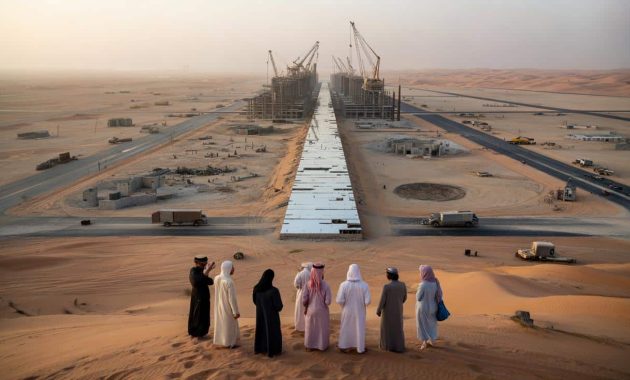
On a hazy morning in Tabuk province, the desert air feels strangely quiet. The billboards that once screamed “THE LINE – A MIRACLE IN THE MAKING” are sun-faded now, their futuristic renders peeling under the sun. Workers who once arrived by the busload trickle in slowly, or not at all. The convoy of VIP SUVs that used to kick up dust clouds is gone. What’s left are half-built foundations, steel skeletons, and a nagging question nobody is answering out loud.
For years, Saudis were told that a 170-kilometer mirrored megacity would redefine their future. Now, the project has been quietly shrunk, delayed, shelved – pick your euphemism – after billions of dollars burned. Online, the anger is sharpening. People want names, not slogans.
And a kingdom used to controlling the narrative suddenly faces a story that refuses to behave.
From sci‑fi fantasy to awkward silence in the sand
The first time Saudis saw the promo video for The Line, many watched it like a Super Bowl ad. A city with no cars, no streets, all run by AI, stretching across the desert in a razor‑straight slab? It felt insane and brilliant at the same time. Dazzling drone shots, synth music, soft‑focus families walking under vertical gardens.
That 100‑mile desert megacity wasn’t sold as just a project. It was sold as proof that Saudi Arabia had finally broken free from oil, from boredom, from the weight of its own past. A moonshot you could live in.
Fast forward to early 2024, and the tone changed. International reports began whispering what locals had already sensed: the 170‑kilometer dream was being quietly chopped down to a tiny fraction. Where officials once talked about 1.5 million residents by 2030, they now floated much smaller numbers. Construction slowed. Suppliers complained of unpaid contracts. Engineers were quietly reassigned.
On Saudi social media, a new kind of post started trending. Screenshots of old headlines boasting about “the world’s most ambitious project” side‑by‑side with satellite images showing a short stub of construction in the middle of nowhere. Young Saudis added sarcastic captions. Older ones added something sharper: “Who will be held accountable for this?”
The official line stayed vague: “phasing”, “prioritizing”, “optimizing resources”. On paper it sounded like strategic fine‑tuning. On the ground it felt like retreat. The gap between the hyper-polished promotional videos and the reality of half-built segments in the desert became impossible to hide. And when that gap gets too wide, people stop calling it ambition and start calling it a national embarrassment.
In a country where public criticism used to be rare, that shift matters. It’s not only about a failed megaproject. It’s about trust.
The cost of chasing a mirage
For years, The Line was the poster child of Vision 2030. Ministries, banks, universities – everyone learned to fold the megacity into their PowerPoints. If you were a young Saudi engineer or designer, getting hired by NEOM looked like a golden ticket. Families boasted when their kids landed a contract in “the future city”.
➡️ A €700,000 treasure: a Rhône resident finds gold bars and coins while digging a swimming pool
➡️ Are microwave ovens dangerous for your health?
➡️ Meteorologists confirm that the jet stream will realign unusually early this February
➡️ How to fall asleep – Science-backed tips for better rest
➡️ “High-functioning codependence”: the exhausting syndrome of the partner who always copes
Now many of those same people are doing quiet damage control. Some talk about “pauses” or “rephasing” to keep their CVs shiny. Others admit what they feel: a mix of pride in the ambition and deep frustration at the way it was managed. *Nobody wants to say out loud that their country fell for its own myth.*
The numbers alone sting. Estimates put early spending on NEOM, and especially The Line, in the tens of billions of dollars – on land clearance, imported expertise, elaborate marketing, and rushed infrastructure in an empty desert. This in a country where young graduates still struggle for stable jobs and some regions lack basic services once you step away from the big cities.
We’ve all been there, that moment when you realize the flashy new thing swallowed money that could have fixed something simpler and more urgent. For many Saudis, The Line feels exactly like that, just on a terrifyingly massive scale. The phrase “burning billions” isn’t just social-media drama. It’s the bitter shorthand for missed priorities.
The political problem is even deeper than the financial one. The Line was never marketed as a normal project that could hit bumps. It was tethered tightly to the image of Crown Prince Mohammed bin Salman as a fearless modernizer who bends reality by sheer will. When a leader’s personal brand fuses with a concrete project, every delay feels like a personal embarrassment.
Now, officials walk a tightrope: defend the vision without admitting the failure, reduce the scope without calling it a retreat, promise accountability without naming any high‑level names. Let’s be honest: nobody really does this every single day. It’s the kind of once‑in‑a-generation PR nightmare that forces a system to show what it’s really made of.
Angry citizens, quiet palaces, and the question nobody likes
Inside Saudi homes, the conversation sounds blunt. People ask: who signed off on this scale? Who questioned the feasibility? Who said, “Maybe start with 10 kilometers, not 170”? That’s the small, practical voice that often goes missing when power, ego and global headlines get into the room.
A more modest, experimental version of The Line – a test strip, a living lab – could have inspired pride and realistic hope. Instead, the country shot straight for the poster on the wall of every tech conference, and only later remembered the messy part: people have to live there, work there, love there. You can’t blueprint that on a keynote slide.
The anger online isn’t all the same shade. Some Saudis are furious about the displaced tribes in the NEOM area, families pushed off ancestral land so that a shiny mirrored wall could slice through their desert. Others focus on the sheer environmental irony: a “green” city that demanded massive concrete, steel, and energy in the middle of fragile ecosystems.
Plenty of people are just tired. Tired of watching grand announcements while their daily life crawls forward in slow motion. Tired of feeling that criticism equals betrayal. Tired of seeing foreign consultants live in luxury camps while locals worry whether the whole thing will vanish and leave them with nothing but dust and debts. The Line was sold as belonging to “all Saudis.” That ownership cuts both ways.
One Saudi analyst who requested anonymity put it plainly:
“People are asking the same question again and again: if this project was so obviously unrealistic, why was there no one brave enough in the system to say ‘stop’? This is not about hating the vision. It’s about protecting the country from vanity.”
The demands that flow from that question are starting to sound familiar. Citizens want:
- Transparency on how much was really spent
- Clarity on which parts of The Line are cancelled, scaled back, or quietly frozen
- Clear responsibility for the displacement of local communities
- A public accounting of who approved what, and when
- Reassurance that future “giga‑projects” will be tested, not just announced
They’re not all revolutionaries. Many still support Vision 2030. They just don’t want to be treated like extras in someone else’s sci‑fi trailer.
What this megacity mirage says about the future
The quiet retreat from a 100‑mile desert megacity is more than one country’s planning disaster. It’s a mirror held up to our age of spectacle, where leaders race to out‑build, out‑glitz, and out‑trend each other for global attention. Saudi Arabia isn’t alone in chasing record‑breaking projects that look incredible from space and feel hollow on the ground. But the scale of The Line – and the speed of its partial collapse – makes it a case study the world won’t forget soon.
There’s a different future on the table now. One where Saudi ambition shifts from “biggest in the world” to “works in real life”. Where young Saudis get to help design neighborhoods that actually breathe, not digital render fantasies bathed in lens flare. Where accountability isn’t treated as an insult, but as the grown‑up price of power.
For anyone watching from afar, the story carries a simple question: who pays for our collective dreams when they crash? Citizens? Workers? Landscapes? Or the people whose names were printed on the glossy brochures. A country that dared to imagine a city in a line now has to navigate something less cinematic and more human: admitting that some dreams were bad bets, and finding the courage to say “never like this again”.
The unfinished concrete in the desert will stand there for a while, catching dust and awkward glances on satellite maps. What really matters is whether the people who paid for it – with taxes, with land, with belief – get real answers, or just another video with epic music and no one to blame when the screen fades to black.
| Key point | Detail | Value for the reader |
|---|---|---|
| Saudi Arabia scaled back The Line | The 170‑km megacity has been quietly reduced and slowed after burning billions | Helps readers understand why the global “city of the future” hype suddenly went silent |
| Public anger is real, not just online noise | Citizens are demanding accountability for spending, displacement, and broken promises | Shows how prestige projects can backfire politically when trust is stretched too far |
| Megaprojects need reality checks | Lack of internal challenge and feasibility testing turned vision into a costly mirage | Offers a cautionary lens for assessing future “world’s biggest” urban and tech projects |
FAQ:
- Question 1Did Saudi Arabia officially cancel The Line?
- Answer 1The Line has not been officially declared dead, but reporting and on‑the‑ground evidence show it has been radically scaled back, slowed, and quietly “rephased”. In practice, the original 170‑km, 1.5‑million‑resident vision is no longer credible.
- Question 2How much money has already been spent?
- Answer 2Exact figures are tightly controlled, but analysts estimate tens of billions of dollars have gone into NEOM and The Line’s early stages, including land works, infrastructure, consultants, and marketing. The true cost may only emerge if a detailed audit is ever published.
- Question 3Why are Saudis so angry about this project now?
- Answer 3Because many feel the original plan was unrealistic from the start, yet pushed aggressively as unavoidable destiny. People see massive funds burned, local communities displaced, and little transparency on who approved what and who will answer for the miscalculations.
- Question 4What happens to the people who were displaced for NEOM?
- Answer 4Tribal communities in the NEOM area report forced relocations, contested compensation, and arrests of those who resisted. Their situation has become a symbol of the human cost behind the glossy megaproject branding, and a key point in calls for accountability.
- Question 5Could The Line ever be revived at full scale?
- Answer 5Technically, anything is possible if oil prices soar and political will hardens. But the combination of financial strain, logistical challenges, and public skepticism makes the original full‑scale version extremely unlikely. A smaller, more realistic urban experiment is far more plausible.