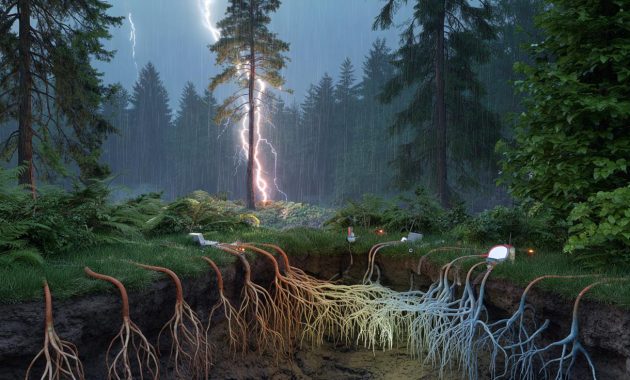
It sets off a chain of whispers underground. Across a web of fungi fine as lace, researchers say trees send chemical distress signals that rally neighbors in minutes, reshaping how a forest survives a storm.
The first flash was white enough to bleach the ferns, a rip that felt like it cut through bone. A pine took part of it, bark blistered and smoking, while a field team hunched behind a log watched laptop lines jump as rain stitched the canopy shut. We’ve all had that moment when the air goes metallic before a storm and every hair stands up. One of the researchers, cheeks slick with rain, tapped a graph showing a sharp wave rolling through the soil sensors toward trees that hadn’t been touched, a ripple passing from root to root through fungal threads most of us will never see. *The forest was not silent; it was wired.* Something was talking.
When the sky strikes, the ground responds
In the minutes after a nearby strike, the team watched a pattern repeat: a spike in compounds linked to plant defense showed up in the fungal network, then a bump in the sap chemistry of neighboring trees. It looked less like panic and more like triage. The hit trees exuded sugars and amino acids; the fungi ferried signals faster than any slow seep in soil should travel. A beech fifty feet away slid its stomata toward closed, as if bracing for a second blow, while a hemlock shunted carbon downward. The storm had turned the underground into an emergency room.
On one July afternoon, a bolt punched a cedar ridge and knocked out a sensor. The other units kept recording, and a curious thing unfolded. Untouched maples started building tannins in their leaves, subtle but measurable, while the fungi beneath them brightened on the electrodes like a city at night. You could see the wave peak, dip, and then settle. Some trees even pushed a trickle of sugars toward the struck pine’s root zone, a behavior the team has tracked after insect attacks as well. None of this was visible from the trail. It happened in quiet, in the mud, in networks most hikers step over without a thought.
To make sense of it, the researchers leaned into what ecologists call common mycorrhizal networks, or CMNs. Think of these fungal cables as both pipes and phones, ferrying carbon from one tree to another and pulsing information in the form of chemicals that plants read like traffic alerts. Lightning superheats air and soil pockets, creates pressure pulses, scars roots, and floods the zone with ions. Plants react—calcium waves, redox bursts, glutamate signals—then push cues and resources outward through their fungal partners. **Trees do send chemical distress signals.** The fungi don’t just carry them; they interpret them, changing their own metabolism in ways that nudge the entire web into a guarded state.
How scientists eavesdrop on a forest’s private line
Peeking into the wood‑wide web takes patience and odd tools. Teams slide hair‑thin microdialysis probes into soil next to living roots to sip the fluid around fungal hyphae. They tape leaf cuvettes onto branches to track gas exchange, then weld tiny electrodes to measure redox flickers underground. In some plots, they pulse a canopy with safe, labeled carbon dioxide and watch that 13C label slip through fungi to another tree. **It’s fieldwork that looks like sci‑fi, but it’s really just careful listening.** The trick is timing: storms are messy, and the signals fade fast, so the crew must be there when the sky decides to speak.
Reading those signals is part science, part humility. Rain dilutes soil chemistry and wind shakes leaves, so not every twitch means a message. The team filters out artifacts—like a squirrel stepping on a sensor, or a sudden cold gust that makes stomata behave—before calling any spike a “call.” And they’re wary of big words. No one is saying the forest is a brain, or that trees plot. What emerges is coordination, not conversation as we know it. Let’s be honest: nobody really does that every day. That’s fine. The point is simple and a bit beautiful: under stress, trees and fungi act together in ways that raise everyone’s odds.
“A lightning strike is the forest’s siren,” one ecologist told me, wiping rain off a rough notebook. “Through the fungi, that siren travels. Neighbors brace, conserve, and sometimes give.”
Here’s the cheat sheet people keep asking for when they hear this story:
- Fungal networks connect different tree species and ages, forming shared chemical highways.
- After a strike, researchers see quick pulses in defense‑related compounds along those highways.
- Neighboring trees respond within an hour or two by tightening water loss and boosting leaf defenses.
- Energy and nutrients sometimes flow toward the injured, a kind of ecological first aid.
- No mystical minds here. Just living systems tuned to survive a chaotic world.
What this changes in the way we see and care for forests
If trees mobilize through fungi after lightning, then a forest isn’t a crowd. It’s a network with rhythm. Managers who rush in with saws the morning after a storm can disrupt more than they save. There’s a pulse to ride. In some forests, leaving fungal “hubs”—old trees with rich mycorrhizae—can keep that emergency line open, helping young trees dodge secondary stress like heat, pests, or drought. **Fungi are not just bystanders; they’re the lines.** And if you’re a backyard naturalist, there’s room for wonder here. You can’t see the signals. You can still leave the duff, skip deep tilling, and let the quiet cables do their work.
➡️ Officials urge caution: Heavy snow expected tonight as authorities urge drivers to stay home
➡️ People who feel mentally overstimulated often carry unprocessed emotional energy
➡️ The small port on the back of your TV? It can do things you’d never expect
➡️ Planned caesarean births linked to higher childhood leukaemia risk, study warns
| Point clé | Détail | Intérêt pour le lecteur |
|---|---|---|
| Lightning triggers coordinated responses | Nearby trees show rapid changes in defense chemistry and water use after strikes | Explains why some trees survive storm clusters better than others |
| Fungal networks carry distress cues | CMNs act as pathways for chemical signals and resource sharing | Shifts the mental model from isolated trees to a connected community |
| Management can support the web | Protecting soil, duff, and old fungal hubs preserves the “emergency line” | Offers practical steps for gardeners, foresters, and park stewards |
FAQ :
- Do trees really communicate after lightning?They send chemical signals through fungal networks and adjust physiology in ways that help neighbors brace and sometimes share resources. It’s coordination, not language.
- Is it all about fungi?Fungi are major players, but trees also use airborne volatiles, root grafts, and electrical waves inside their own tissues. The fungal web stitches those threads together.
- Can I detect this at home?Not easily. Researchers use microdialysis probes, isotopic tracers, and sensitive electrodes. You can still foster the network by keeping soil covered and undisturbed.
- Does lightning help or harm forests?Both. It kills and opens gaps, but it also kickstarts regeneration. The networked response seems to reduce collateral stress for survivors.
- What does this mean in a warming world?Stronger storms and heat will test forests. Connected mycorrhizal webs could buffer stress in some places and break in others, which makes protecting soil and fungal diversity matter more.