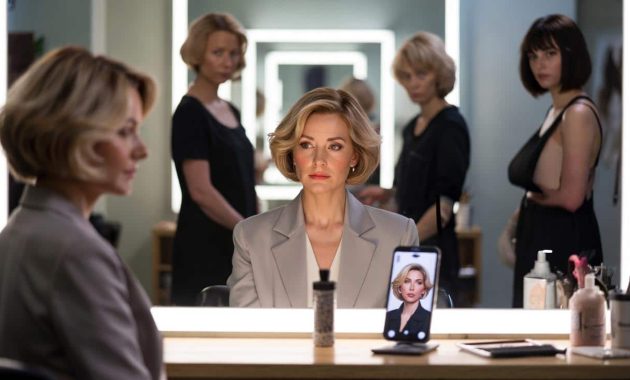
Saturday morning, 9:42 a.m., in a small neighborhood salon. A woman in her late forties drops into the chair, blazer still on, phone buzzing in her handbag. “I want a bob,” she says, pointing at a photo of a celebrity twenty years younger, jawline sharp enough to slice glass. The hairdresser smiles, tilts her head, and gently asks: “Do you want the haircut in the photo… or the feeling it gives you?”
The room quiets for half a second. You can feel that tiny, almost invisible tension between what we think a bob will do for us and what it actually does once we walk out of the salon.
Because a bob can be a miracle after 40.
It can also age you in a single snip.
The 5 bob haircuts that betray your face after 40
The professional hairdresser I spoke to, Sarah*, has been cutting bobs for 23 years. She loves them, she respects them, she also fears them a little. Some bobs, she says, “have no mercy” on a face that’s changing with age. They harden the features, drag the expression down, or spotlight every little thing we’d like to keep discreet.
Her observation is simple: past 40, the face softens, the contours shift, the texture of the hair changes. So the wrong bob doesn’t just “not suit you”. It actively creates shadows, harsh lines, and visual weight where there was none. Especially when we copy a cut seen on a 25-year-old with a ring light in front of her.
The first enemy, according to her? The ultra-straight, jaw-length bob that ends exactly where the face is starting to slacken. “The ‘helmet bob’,” she calls it. On a round or square face, it slices right at the jaw and makes the lower face look heavier. Then comes the too-short, extremely blunt bob at mid-ear height. Great on a teenager. On a mature face, it can highlight neck lines and ears while flattening the top of the head.
She also points to the razor-thin, hyper-thinned bob that clings to the neck. On fine or aging hair, it collapses at the roots and separates into sad little strands. The floating, too-long bob with no structure adds years, dragging everything down visually. And the last one? The perfectly symmetrical bob that doesn’t respect natural asymmetry or cowlicks and ends up looking like a wig.
Underneath these “least flattering” bobs lies the same problem: geometry vs reality. A bob is pure geometry on a moving, living face that’s not filtered or Photoshopped. Past 40, the game changes. The cut has to lift, soften, and give air, not emphasize every fold and hollow.
Sarah explains that the most unforgiving bobs are those that draw a line exactly where gravity is already working: jaw, corners of the mouth, neck. Once that straight, heavy line meets those zones, the eye is pulled directly there. That’s why the wrong bob can make you feel like you’ve aged five years overnight, even if you slept well and drank your water.
➡️ 2026 could be a decisive year for the financial future of these zodiac signs, according to astrology
➡️ An ‘ingenious’ Ukrainian idea so good China patented it for its next high?tech battle tank
➡️ How to clean dirty tile grout without ripping it all out: the quick trick to try at home
The problem isn’t the bob. It’s the wrong bob on the wrong face.
How a pro actually chooses a flattering bob after 40
Sarah has a ritual. Before even wetting the hair, she makes the client sit up straight, looks at her from the front, then from the side. She studies three points: the jawline, the cheekbones, and the neck. “I draw invisible diagonals with my eyes,” she says. “I look where I can create lift instead of weight.”
For a face with a softer jaw, she avoids a blunt finish at jaw level and prefers a bob that ends just above or just below. On longer faces, she adds volume on the sides instead of flattening everything near the cheeks. On shorter necks, she subtly opens the nape to lengthen the silhouette. The scissors follow the bone structure, not the Pinterest board.
What she sees repeatedly are women who arrive with a screenshot of a bob that has nothing to do with their hair. Thick hair vs fine hair. Wavy vs perfectly straight. Receding hairline vs full fringe. The mismatch is huge, and the disappointment is brutal. And of course, that little guilt that creeps in: “Maybe it’s just that I’m too old for this cut.”
Her tone softens when she says it: age isn’t the problem. The problem is copying someone else’s proportions without translating them into your own reality. *Let’s be honest: nobody really does this every single day.* We don’t walk around with contouring, a ring light, and a stylist adjusting every strand before a photo. The real-life bob has to work in the bathroom mirror at 7:03 a.m.
She also insists on texture. Those five “least flattering” bobs all ignore one thing: movement. On hair that’s drier, more fragile, sometimes slightly frizzier after 40, a straight, rigid line rarely does any favors. It fights against the natural bend instead of working with it.
“A good bob past 40 doesn’t try to freeze the face,” Sarah tells me. “It moves with your expression, your smile, your way of turning your head.” “When a cut looks beautiful only when you’re perfectly still, that’s a red flag.”
To help her clients avoid the worst traps, she keeps a mental blacklist:
- Jaw-level, ultra-straight “helmet” bobs on soft jawlines
- Super-short, blunt bobs that cut right at the ear on faces with stronger features
- Over-thinned neck-hugging bobs on already fine or fragile hair
- Long, shapeless “non-bobs” that drag the face down
- Perfectly symmetrical, rigid bobs on asymmetric or cowlick-prone hairlines
Finding “your” bob: not younger, just more yourself
What strikes me watching her work is that she never talks about “taking ten years off”. She talks about light, softness, balance. She sometimes suggests a slightly longer bob that brushes the collarbones to free the face without exposing the neck too much. Other times, a bob that’s shorter at the back and a touch longer at the front, so the eye follows a gentle diagonal that visually lifts the features.
She also plays with micro-details: a more diffused line instead of a sharp, ruler-straight edge; a few strands around the face that break the severity; a discreet gradient that gives air without screaming “layers”. These small gestures are invisible to the untrained eye, yet they’re exactly what stop a bob from hardening the face.
Behind the technical talk, there’s something more tender. Past 40, many women arrive at the salon after a breakup, burnout, children leaving home, a body that no longer reacts the way it used to. They don’t just want a bob. They want a new way to see themselves in the mirror.
The harsh bobs, the “least flattering” ones, often come from a kind of urgency: cut everything, reset, erase. Sarah’s job is to slow this impulse down and redirect it. She asks, “What do you want to feel when you run your hands through your hair in the morning?” The conversation shifts from years and wrinkles to comfort, femininity, movement. *The bob stops being an anti-aging weapon and becomes a tool for alignment.*
The real question, in the end, isn’t “Which bob makes me look younger?” It’s closer to: “Which bob lets my face live, instead of locking it in?”
The next time you sit in a salon chair with that screenshot of the perfect bob, there’s a quiet experiment you can try. Instead of saying “I want exactly this,” you can say: “Here’s what I like about this photo. How would you adapt it to my face and my hair today?” This single sentence flips the dynamic. Your hairdresser becomes an ally, not a service provider asked to photocopy an image.
| Key point | Detail | Value for the reader |
|---|---|---|
| Avoid the 5 harsh bobs | Helmet bob, ultra-short blunt, over-thinned neck bob, long shapeless bob, rigid symmetrical bob | Prevents cuts that age the face and highlight features you’d rather soften |
| Follow bone structure, not trends | Length adapted to jaw, diagonals that lift, movement that respects natural texture | Increases chances of walking out with a flattering, easy-to-live-with bob |
| Talk feeling, not just photos | Describe what you want to feel (lighter, softer, bolder) instead of copying a celebrity | Helps your hairdresser create a personalized bob that looks good in everyday life |
FAQ:
- Is a bob really a good idea after 40?Yes, as long as it’s tailored. A slightly softened, textured bob that respects your jawline and hair texture can bring light to the face and modernize your look without hardening your features.
- How short can I go without aging myself?Avoid cuts that stop exactly at your widest or softest point (jaw, ear) with a dead-straight line. Often, going just a centimeter above or below that zone changes everything and keeps the look fresh, not strict.
- My hair is fine and thinning. Can I still wear a bob?Yes, but skip ultra-thinned, neck-hugging bobs. A fuller, slightly blunt bob at or just above the shoulders, with subtle layers for movement, usually gives more body and density.
- What styling routine works for a flattering bob after 40?A light volumizing product at the roots, a round brush or simple blow-dry with the head down, then a touch of texture spray in the lengths. Nothing too heavy that weighs the line down or separates the strands.
- How often should I trim my bob to keep it flattering?Every 6 to 8 weeks for a structured bob, 8 to 10 weeks for a longer, softer one. Beyond that, the line often drops to the “danger zones” (jaw, neck) and starts to drag the face down again.