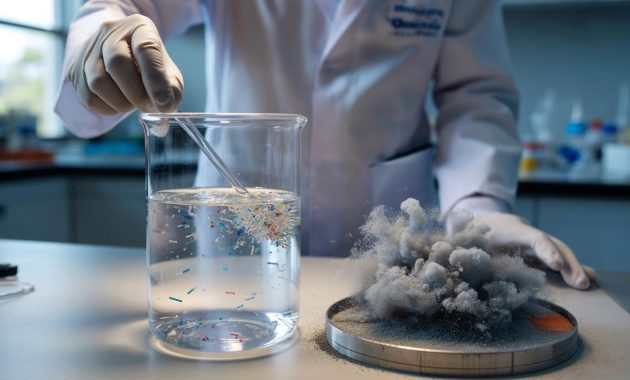
Then the tiny specks reveal themselves, like glitter you never asked for. Now comes a surprising twist: a substance derived from volcanic ash is being tested to grab those microplastics on contact — and make them disappear from view in seconds.
I first saw it in a lab that smelled faintly of wet stone. A technician poured a spoonful of a fine, grey mineral into a beaker of city water seeded with microplastics. The particles hung there like stubborn snow in a globe. She stirred once, gently, and the water clouded for a heartbeat. Then the grey swirled into soft clumps, dragging the plastic specks into little rafts. A magnet slid up the glass. The rafts leapt toward it as if they knew the way home. The water turned calm, almost shy. It looked like a magic trick.
The quiet power inside ancient ash
The mineral at the center of this story isn’t exotic. It forms when volcanic ash meets alkaline water over long stretches of time. The result is a honeycomb-like rock called a zeolite, rich in tiny pores and surface charges that love to catch things. Researchers are refining that natural structure and giving it a light magnetic touch. **They want a powder that clumps microplastics instantly, then leaves the party without a trace.**
In early lab runs, jar tests that water engineers use every day, beakers cleared in well under a minute. That’s not a metaphor. Stir, wait a few beats, pull a magnet or strain through a simple mesh, and the plastic-laden flocs come along for the ride. One team logged removal rates above nine in ten across common culprits like polyethylene, polypropylene, and PET, from sand-sized bits to barely visible fragments. Your eyes catch it first. The data follows.
What’s going on is mostly surface chemistry and geometry. Zeolite-like minerals carry a mosaic of charges that coax plastic bits to stick. Add micro-iron particles into or onto the ash, and those flocs become magnet-friendly “rafts.” Hydrophobic patches help gather polymers that hate water. The pores are not trying to swallow each plastic grain like a sponge; they’re creating contact, then cooperation. Think of it as polite crowd control, then a clean exit. *Simple doesn’t mean easy, but it can feel that way in the glass.*
How the test actually works, step by step
The process looks almost domestic. A measured pinch of the ash-derived powder, a swirl, and a quick pull with a magnet or a fine sieve. In the lab, technicians use jar testers and paddles, but the core action is the same. **The idea is disarmingly simple.** A teaspoon per liter was enough in small trials to start clumping plastics fast, though real-life dosing will shift with water quality. The captured flocs settle or stick to the magnet, ready to be lifted away.
If you try to imagine this at home, breathe. Overdoing the dose just makes more sludge. Stirring like you’re whisking eggs will break up the rafts and slow the cleanup. Short, steady mixing works better than a frenzy. Rinse your magnet or mesh between pulls if it clogs. And remember: the cleanest wins come when the water isn’t full of big grit to begin with. We’ve all had that moment where a quick fix turns into a mess on the counter. Let this be the calm version. Let’s be honest: nobody does that every day.
Behind the tidy demo sit real questions and real people pushing it forward.
“Speed matters when you’re treating millions of liters,” said one engineer involved in pilot tests. “If the plastic sticks in seconds, plants can slide it into routines they already understand.”
- What’s proven: fast clumping in lab beakers, high removal of common plastics, easy magnetic separation.
- What’s promising: low-cost sourcing from abundant volcanic ash, compatibility with existing plant equipment.
- What’s unknown: performance with nanoplastics, long-term sludge handling, full lifecycle impacts at scale.
- What to watch: pilot data from small utilities, dosing guides for different water chemistries, independent audits.
Why this matters beyond the lab
Microplastics are not some distant ocean tale anymore. They ride our taps, slip past filters, and show up in places that feel uncomfortably personal. The ash-derived purifier changes the story because it leans on geology, not exotic chemistry. A rock-born scaffold, a nudge of iron, and a knack for grabbing the wrong kind of dust. If that holds up under the stress of real plants and real pipes, the payoff is practical: faster treatment, fewer specialized membranes, lower bills for smaller towns that can’t afford high-end gear.
➡️ Satellite Images Reveal the Reality of Saudi Arabia’s $2 Trillion Megacity in the Desert
➡️ A Pool Noodle Will Change Your Life in Your Kitchen: Here’s Why It Will Make Everything Revolut
➡️ State Pension Cut Approved : $ 140 Monthly Reduction Starting February
➡️ 3.2 Billion Years Ago, An Asteroid Twice The Size Of Paris Threw Earth Into Chaos
It also asks a better question. Instead of chasing every last particle with ever-finer sieves, could we make the plastics want to leave? This mineral behaves like a host who knows when to close the night down. It gathers stragglers, turns the lights low, and points to the door. The scale-up will decide whether the trick plays outside the glass. But the idea has a rare blend of old and new — ancient ash, modern urgency. That mix tends to move.
| Point clé | Détail | Intérêt pour le lecteur |
|---|---|---|
| Volcanic ash to zeolite-like purifier | Refined mineral with charged pores that attract microplastics | Natural origin, fewer chemical additives, grounded in geology |
| Instant clumping and magnetic lift | Plastics form flocs within seconds and are removed with a magnet or sieve | Fast, visible results; compatible with simple tools and existing plants |
| Early promise, real-world questions | High lab removal rates, pilots underway, open questions on nanoplastics and sludge | Know what’s real now and what to look for next before hype takes over |
FAQ :
- What exactly is the substance?A mineral refined from volcanic ash, similar to natural zeolites, with added magnetic properties to help pull it out after it binds microplastics.
- Is it safe to add to drinking water?It’s used during treatment, not as a flavoring. The mineral is removed along with the plastics; safety checks focus on residues and byproducts.
- Does it work on nanoplastics too?Early signs are mixed. It can help cluster the tiniest particles, but performance varies and needs more independent testing.
- Can I use this at home today?Not yet. The current tests are in labs and pilot plants. Home kits may follow if dosing and removal can be made foolproof.
- What happens to the captured microplastics?They end up in sludge that can be dewatered and handled like other treatment waste, with options being studied for safer disposal or reuse.