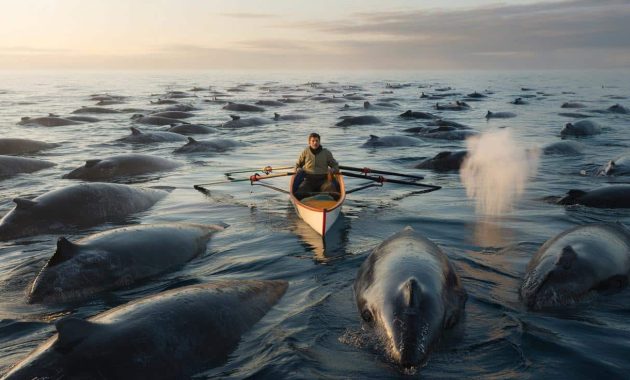
The first thing he heard was the breathing. Not his own, ragged from hours at the oars, but a deep, animal exhale rolling over the water like a slow drumbeat. The ocean around his tiny rowing boat, a lonely pinprick of color on steel-blue water, suddenly felt crowded. Under the dawn haze, backs like dark moving islands broke the surface, rose, and slipped away again. The air filled with the hiss of vapor and the faint smell of salt and life.
He was alone. They were hundreds.
For a moment, the oarsman froze, hands hovering mid-air, watching the water bulge and shift as if something enormous was turning under his hull. The GPS, the safety protocols, the months of preparation shrank to trivia in the face of these silent giants. His world narrowed to two questions.
Am I safe — and what on earth are they doing here?
When a rowing boat becomes a front-row seat to a whale migration
Imagine you’ve already been on the oars for eight hours, muscles shot, the horizon an endless flat line. That was the scene when the solitary rower, mid-ocean and days from land, found his boat gliding straight into a slow-motion traffic jam of whales. Dark shapes circled at a distance first, then came closer, surfacing in pairs, trios, whole clusters that seemed to move with a quiet, shared intention.
Their blows rose in white plumes, hanging for a second in the pale light before dissolving. The rower could hear the splash of massive tails, the slide of barnacled skin against water. His boat, barely seven meters long, suddenly felt like a toy drifting through a living, breathing metropolis. One curious individual surfaced so close he could see its eye tracking him. It looked, for a heartbeat, like the ocean itself was watching.
Another solo rower who crossed the North Atlantic a few years earlier described a similar moment south of the Azores. He had been dozing between strokes when the entire sea around him began to pulse — dozens of humpbacks surfacing in staggered rows. He later estimated more than 100 whales passed within a few hundred meters of his hull. One surfaced just underneath his oarlock, leaving him shaking and laughing in disbelief, hands trembling too much to film more than a few seconds.
Videos from kayakers off Mexico’s Baja coast show the same surreal perspective. Tiny human craft swallowed visually by a moving patchwork of gray and blue bodies, each whale the size of a bus, each exhale a heavy, wet sigh. In one clip, a paddleboarder drops to his knees as a blue whale surfaces beside him, its mottled back stretching longer than his entire board and vanishing into deep cobalt.
These rare clips are catnip for social media and science at the same time. One frame shows our scale against theirs with brutal honesty.
Behind the drama of these encounters lies a bigger story of migration. Many large whale species follow ancient “motorways” of the sea, traveling thousands of kilometers between feeding and breeding grounds. When one solitary human drifts into their path, it’s rarely about curiosity alone. It’s timing. Seasons. Deep-water currents rushing with food. Quiet routes far from noisy shipping lanes.
➡️ If your towels smell clean but feel stiff, this laundry step is likely missing
➡️ What walking with your hands behind your back means, according to psychology.
➡️ Goodbye kitchen cabinets : the cheaper new trend that doesn’t warp or go mouldy
➡️ This 15-year-old researcher earns a PhD using quantum physics to extend human life
Scientists tracking humpbacks and fin whales with satellite tags see the same narrow corridors lighting up year after year. What looks like random magic on the surface is often a crowd of animals right on schedule, following a map printed in memory and instinct. The rower, unknowingly, had parked his fragile shell right on the shoulder of that blue highway. *From the whales’ point of view, he was just another piece of floating debris that suddenly started staring back.*
And that’s where the questions about safety start to get real.
How close is too close when 40-ton animals fill the horizon?
Facing a wall of moving whales, the rower did the only logical thing his tired brain could manage: he stopped. Oars flat on the water, life jacket zipped, his hands hovering, just listening. Marine safety experts often give a surprisingly simple first rule for encounters like this: slow everything down. Speed is what turns proximity into danger, both for people and for whales.
On that morning, the ocean itself seemed to steady with him. The whales kept their loose formation, surfacing rhythmically, shifting direction in a way that looked random but never felt chaotic. He let the boat drift, resisting the urge to grab his camera every two seconds. For a moment, he treated the entire scene as if he’d stumbled into someone else’s home and didn’t want to knock anything over.
Only when the nearest blows began to fade did he dip his blades back into the water.
When people talk about dangerous whale encounters, they often picture horror-movie breaches onto small boats. The reality is more nuanced. The biggest risks for small craft — rowboats, kayaks, paddleboards — often come from surprise. A whale surfaces directly under a hull. A tail comes up fast during a deep dive. A playful slap sends a wave over a low cockpit rim. These are clumsy collisions, not attacks.
We’ve all been there, that moment when curiosity pulls us a bit too close to wild animals because the shot looks incredible through the lens. On wildlife trips, guides quietly sweat when a group leans over the rail, phones out, as a mother and calf surface underneath. The common mistake is assuming that calm equals harmless. A 30-ton animal turning without seeing you is more than enough to flip a tiny craft or crack a rib.
Let’s be honest: nobody really follows every guideline in the heat of a once-in-a-lifetime moment. The key is to know the lines before you cross them.
One open-ocean safety trainer put it bluntly:
“Whales are huge, mostly gentle, and utterly uninterested in your drama. Respect that, and you’ll usually leave with a story — not an accident report.”
From seasoned rowers and sailors, a few simple habits keep coming up:
- Row or sail in neutral when whales approach, rather than trying to weave between them.
- Keep a respectful buffer — many guidelines suggest 100 meters or more — even when they seem relaxed.
- Stay quiet and low, avoiding sudden splashes or banging on the hull.
- Resist chasing whales for a better angle; let them choose the distance.
- Have a basic plan: PFD on, gear stowed, and someone on shore who knows your route.
These are small gestures of humility on a vast, indifferent stage. They don’t remove the wildness from the encounter, they just give everyone — human and whale — a better margin for error.
What these rare meetings really tell us about whales — and about us
What lingers after such an encounter isn’t only the fear or the footage. It’s the sense that you’ve accidentally stepped into a bigger pattern, one that has been repeating under human radar for longer than cities have existed. The rower in the middle of the congregation wasn’t just “lucky”. He was intersecting with a migration that had flowed long before GPS tracks or satellite maps, guided by cues we still only half understand.
When you strip the story down, it becomes strangely intimate. One tired human, one tiny boat, and a highway of giants moving past with no interest in stopping. Some people come away from that contrast feeling fragile. Others feel oddly reassured, relieved even, that so much life is still happening entirely without our permission.
For anyone reading this on a crowded commute or from a noisy city, that gap between our over-managed days and their effortless journeys can sting a bit. It can also be a quiet invitation — to pay more attention, to listen for the slow breathing just beneath the surface of our own routines, and to accept that not every powerful moment needs a plan, a script, or a perfect shot to count.
| Key point | Detail | Value for the reader |
|---|---|---|
| Safety in close encounters | Slow down, keep distance, avoid chasing whales, treat their space like a moving home | Reduces risk while still allowing meaningful, awe-filled experiences on the water |
| Whale migration “highways” | Whales follow long-standing seasonal routes shaped by food, temperature, and memory | Helps explain why intense encounters cluster in specific regions and seasons |
| Human perspective shift | Feeling tiny next to whales can be unsettling but also grounding and strangely comforting | Offers emotional resonance and a deeper sense of connection to wild oceans |
FAQ:
- Are whales dangerous for solo rowers or kayakers?Direct aggression toward small craft is extremely rare. The main risks come from accidental collisions if a whale surfaces under a boat or swings a tail nearby. Keeping distance and slowing down sharply lower the danger.
- Why do whales sometimes gather in such large groups?Congregations often form along migration routes where food is abundant or near breeding grounds. These gatherings can look chaotic from the surface, yet often follow deep patterns of behavior and ocean conditions.
- What should I do if whales suddenly appear around my small boat?Stop or move very slowly, stay quiet, and avoid sudden changes of direction. Let the whales pass or choose their distance. If you feel unsafe, calmly angle away once there’s clear space.
- Is it legal to approach whales closely for photos or videos?Many countries have strict minimum-distance rules for approaching whales by boat, drone, or even swimming. Breaking them can lead to fines and stresses the animals, especially mothers with calves.
- Can these encounters help scientists understand whale behavior?Yes, especially when paired with location data and responsible citizen science reporting. Photos, videos, and logged sightings can complement satellite tags and acoustic studies to map migrations more precisely.