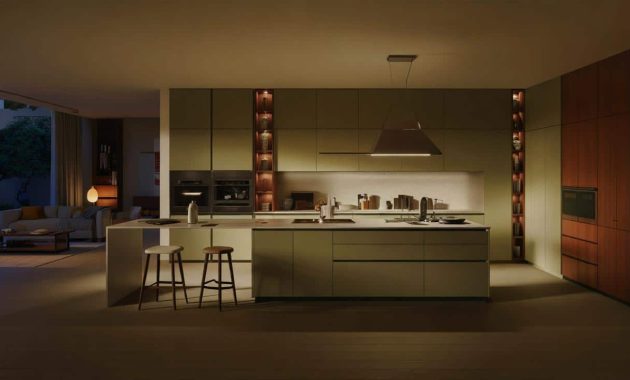
Friday night, 7:42 p.m., somewhere in a freshly renovated suburban kitchen.
The pasta water is boiling, the kids are circling like hungry satellites, and the famous quartz kitchen island is buried under… everything. Groceries, homework, a half-assembled Lego spaceship, the dog’s leash, three chargers, and someone’s unopened mail from last week.
You can’t chop an onion without moving a whole life’s worth of stuff to one corner.
The island was supposed to be “the heart of the home”. Right now, it feels more like a traffic jam with a marble countertop.
More and more designers are quietly confessing the same thing: the kitchen island is past its peak.
Something leaner, smarter, and far more elegant is taking its place.
And once you’ve seen it, the old island suddenly looks… clumsy.
Why Kitchen Islands Are Losing Their Shine
Walk into any new-build from the early 2010s and you can almost guess the layout with your eyes closed.
Big fat island in the middle, four bar stools, pendant lights like in every Pinterest board from the era.
The problem is that real life doesn’t move in a neat square.
We cook, we cross, we carry laundry, we let kids zoom through on scooters. A big fixed block in the middle of the room breaks that natural flow.
Designers talk about “circulation paths”, but you don’t need the jargon. You just feel it when you bump your hip for the third time in one evening.
Ask estate agents quietly and they’ll tell you: some buyers have started to sigh when they see yet another oversized island.
Especially in apartments and smaller houses, that huge slab often eats half the room, turning the kitchen into a narrow racetrack.
One London architect told me about a client who literally removed a pristine, barely used island a year after installation.
She’d imagined cocktail nights; what she got was a permanent obstacle between the fridge and the sink.
Once the island was gone, she gained almost a meter of circulation space and, surprisingly, less visual clutter.
The shift is also cultural. We cook differently from our parents.
We snack more, we work on laptops at the table, we order in as often as we simmer sauces for hours.
An island was once the symbol of “serious cooking”, like a mini professional kitchen.
Today, flexibility beats performance. We want spaces that can switch from Zoom call to birthday cake in ten minutes.
That’s where the island starts to show its limits, and where its 2026 replacement quietly slides in.
The 2026 Replacement: The Practical, Elegant “Peninsula Plus”
Designers are betting on a smarter star of the show: the **peninsula plus** layout.
Think of it as a hybrid between a traditional island, a wall run, and a social bar.
➡️ From stray dog to wildlife hero: a border collie cross joins a koala protection research team
➡️ How a drop of washing?up liquid in the toilet can have a surprisingly big effect
➡️ How routine supports physical comfort naturally
➡️ No hob, no oven: the chefs’ clever trick to bake a potato in under 10 minutes
➡️ “I get uneasy when things go well”: psychology explains this anticipation reflex
➡️ “I’m a technical coordinator, and this role pays better than many management jobs”
Instead of a big lump in the middle, the worktop extends from one side of the kitchen like a sideways “T” or “L”.
One part stays firmly anchored to the cabinetry or wall, the other floats out just enough to allow seating or extra prep space.
The room suddenly feels open, not blocked. You still get that “come sit with me while I cook” moment, without putting a stone monolith in everyone’s way.
Take Camille, 37, who renovated her 20 m² open-plan living space in Bordeaux last year.
Her architect suggested ditching the island she’d saved dozens of screenshots of, and drew a slim peninsula attached to the back wall instead.
The result? She gained a full extra meter of living-room space, could fit a proper sofa, and still seats three people at the end of the peninsula.
The line of sight from the entrance to the balcony is clear, so the room feels twice as big.
What she hadn’t expected was the acoustic bonus: with fewer hard surfaces in the middle, her echoey room suddenly sounded calmer.
There’s a simple logic behind the trend. A peninsula uses less floor area for almost the same usable counter space as an island.
It also connects more cleanly to utilities: power, plumbing, storage. Less drilling into the middle of your floor, fewer awkward sockets in the ground.
Visually, it frames the kitchen without locking it in a box. You can pivot from sink to stove to peninsula in a natural triangle.
You win circulation, you win light, and you cut down construction costs.
Let’s be honest: nobody really needs a runway-length slab just to display a fruit bowl.
How To Switch From Island To Peninsula (Without Regretting It)
If you’re planning a renovation for 2025–2026, start with a pencil, not Pinterest.
Stand in your current kitchen and literally walk your daily route: fridge to sink, sink to hob, hob to table.
Then sketch a peninsula that supports that movement instead of fighting it.
The sweet spot is often a depth of 90–100 cm, with one “working” side facing the kitchen and one “social” side facing the living or dining area.
Leave at least 90 cm of clear walking space around the free side so no one has to slide sideways while carrying a hot pan.
People often feel guilty about losing the idea of the island, as if they’re failing some dream-home test.
You’re not. You’re just prioritizing real life over a trend that had a very specific era.
Watch out for one common mistake: turning the peninsula into a new dumping ground.
Plan a small, dedicated “landing zone” near the entrance for keys, bags, and mail so the peninsula stays usable.
And think about legroom: if you want stools, you’ll need an overhang of roughly 25–30 cm so people can actually sit comfortably, not perch.
Interior designer Amara Velasquez sums it up simply: “An island says ‘look at me’. A good peninsula says ‘use me’. One is about status, the other is about comfort.”
- Choose your anchor wall
Attach the peninsula to the wall or a tall cabinet run so it feels intentional, not like a random shelf in space. - Respect circulation lines
Keep clear paths between main zones: 90 cm minimum, 110–120 cm if two people cook together. - Play with height
Mix standard counter height with a slightly raised bar edge to hide dishes from the living room while you’re still cooking. - Integrate smart storage
Shallow drawers on the “social” side are perfect for placemats, chargers, or kids’ craft supplies. - Layer the lighting
Use one modest pendant for atmosphere and discreet under-cabinet lighting for actual chopping and prep.
Beyond Islands vs Peninsulas: A New Way Of Living In The Kitchen
Once you question the sacred island, you start to question the whole way we treat kitchens.
Are they performance stages with marble props, or are they living rooms that happen to have a sink and a stove?
Some people pair a peninsula with a small, mobile prep trolley that disappears into a tall cabinet.
Others shrink the cooking area and invest instead in a generous dining table that doubles as homework zone and laptop hub.
*The trend beneath the trend is simple: flexibility beats spectacle.*
| Key point | Detail | Value for the reader |
|---|---|---|
| Peninsula plus layout | Anchored to a wall with one free end for seating and prep | Gains circulation space while keeping generous worktop |
| Flow over size | Focus on movement between fridge, sink, hob, and social area | Makes cooking and hosting feel easier, less cramped |
| Integrated storage & lighting | Drawers on both sides, layered task and ambient lights | Reduces clutter and creates a calmer, more elegant room |
FAQ:
- Are kitchen islands really going “out of style” by 2026?Not overnight, but their status as the default dream feature is fading fast. Designers are moving toward slimmer, more flexible layouts like peninsulas, galley kitchens with large tables, and mobile prep stations.
- Is a peninsula better than an island for small kitchens?Often yes. A peninsula uses less floor area, maintains more open circulation, and can still offer seating and storage. It’s especially effective in open-plan flats or narrow spaces.
- Can I keep my island and still be “on trend”?Trends matter less than how you live. If your island really works for you, keep it and refine it: add storage, declutter zones, improve lighting. Style follows function.
- How wide should a practical peninsula be?A comfortable depth is around 90–100 cm, with a 25–30 cm overhang for stool seating. Leave at least 90 cm of clear walkway on the open side so movement stays fluid.
- What if I mostly order takeaway and rarely cook?Focus less on giant counters and more on smart storage and a good table. You might prefer a compact kitchen wall, a modest peninsula for coffee and snacks, and more space for lounging or working.