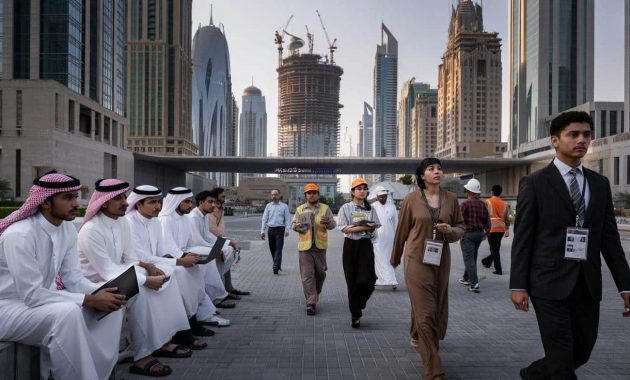
On a Thursday night in Riyadh, the mall food court looks like a miniature United Nations. A Filipino barista calls out orders in accented Arabic, a Sudanese cleaner wipes down chrome tables, an Indian technician fixes a flickering screen. At a corner table, three Saudi graduates in crisp white thobes scroll their phones, half joking, half bitter: “So, where are the jobs for us?”
Outside, cranes dot the skyline, swinging over new metro lines, luxury towers, and glassy business hubs. Projects worth hundreds of billions of dollars promise the future.
Yet for many young Saudis and Emiratis, that future feels oddly out of reach.
Record hiring from abroad, rising frustration at home
Walk through any construction site in Dubai or NEOM, and you hear the same sound: languages from everywhere except the country you’re standing in. Recruiters are signing contracts in Kathmandu, Manila, Lahore, and Cairo at a blistering pace. Gulf governments publish proud figures of mega-project milestones, foreign investment, and innovation parks.
At the same time, youth unemployment in Saudi Arabia and the UAE keeps creeping into the headlines. Official numbers vary, but surveys among locals often tell a sharper story: plenty of degrees, plenty of ambition, and long months at home sending out CVs. The contrast is jarring.
Take 24‑year‑old Rasha from Jeddah. She studied marketing, speaks English fluently, and completed two internships. She dreams of working on one of those high-profile “giga-projects” that flood social media with slick videos.
Instead, she’s been rejected by three international companies that operate just a few hours’ drive away from her house. The roles went to foreign hires with “more experience in global markets”. Rasha now tutors school kids online, earning a fraction of what she could make in a corporate role. She stares at the billboards promising opportunity and feels like they’re talking to someone else.
The logic from governments and businesses sounds almost mathematical. Gulf economies are racing to diversify: tourism, entertainment, logistics, technology, finance. To deliver huge projects on tight timelines, firms say they need people “ready from day one”. That often means recruiting abroad where there’s a long pool of engineers, coders, hotel managers, and specialized technicians.
Local graduates, by contrast, often lack hands-on experience or specific skills private employers want. There’s also a gap between what many young citizens expect in terms of salary, hours, and prestige, and what the market offers at entry level. So companies do what companies do: they take the easiest route to hit their targets.
The hidden rules shaping who gets hired
On paper, Gulf labor policies are clear: nationalization schemes like Saudization and Emiratization set quotas for local hires. Public campaigns urge companies to “invest in our youth”. Some sectors are even legally reserved for citizens. There are training subsidies, internship programs, startup funds.
➡️ Why were Russian submarines the only ones built from titanium?
➡️ Obstructive sleep apnoea is quietly draining billions from Western economies
➡️ Airbus achieves historic first by guiding two jets to the exact same point without collision
➡️ Forget “short strolls”: study reveals how you really should walk for a healthier heart
Yet inside HR offices, a more discreet logic rules the day. Managers quietly weigh risk and speed. A foreign recruit on a fixed contract is seen as flexible: if the project ends or performance lags, visas can be canceled. A local hire is anchored. Firing them is politically sensitive, reputationally risky, sometimes more bureaucratic. When deadlines loom, many recruiters go with the path of least resistance.
There’s also the daily calculus of cost versus perception. Contrary to old clichés, low‑wage foreign labor is no longer the only inflow. Highly paid Western and Asian specialists are arriving in record numbers for roles in consulting, tech, finance, and creative industries. They come with portfolios from London, Singapore, or Bangalore, and can point to similar work elsewhere.
Meanwhile, a Saudi or Emirati graduate sitting across the interview table has enthusiasm but may lack that dense CV. So she’s told to “get some experience first” – without anyone saying where exactly she’s supposed to get it. *That’s the quiet paradox stuck in many living rooms today.*
The education-to-job pipeline still hasn’t really caught up with the economic revolution. Universities across the Gulf expanded rapidly over the past 20 years, pushing more young people into business, IT, and engineering. But many courses stayed theoretical, focused on passing exams rather than building portfolios or solving real client problems.
At the same time, family expectations haven’t shifted at the same speed as the market. A desk job with status is still the dream for many parents. Retail, hospitality, or technical roles are often seen as “temporary” or “not for us”. So you get a strange gridlock: foreign workers fill everything from welding to high finance, while local graduates wait for that perfect, respectable position to open up. Let’s be honest: nobody really does this every single day.
What could actually bridge the gap?
On the ground, the fixes that work best tend to be small, concrete, almost boring. One mid-sized logistics company in Sharjah, for example, took a simple step: pairing every foreign senior manager with a young Emirati “shadow” for one year. The trainee sits in on meetings, helps prepare reports, and rotates across departments.
The company keeps its experienced global staff, but also grows its own local talent, fast. After a year, some of those “shadows” are ready for real responsibility, not just a symbolic job title. When that happens at scale, the equation starts to shift from “import skills” to “build skills”.
For young Saudis and Emiratis, the hardest part is often emotional, not technical. You study for years, you carry family hopes, and then you’re asked to start at a lower position than a foreign recruit your age. That stings.
Yet the people who eventually crack the system tend to do one thing: they drop the idea that their first job must match their degree, salary expectation, and social standing all at once. They take what looks like a detour – a sales role, a shift job in a hotel, a junior analyst post – and turn it into a platform. There’s pain in that decision, but also a quiet power. We’ve all been there, that moment when you realize the official path won’t open and you either sit still or carve your own.
Some local voices are also pushing the debate to a deeper place. They argue the real question isn’t “foreigners vs nationals”, but “short-term projects vs long-term societies”. One young Saudi policy researcher in Riyadh put it simply:
“We’re importing people to build our future cities. But those people will leave. Our own youth are the ones who will live in them. If they feel excluded now, what kind of social contract are we really building?”
Around that question, a few practical levers keep coming up:
- Rewriting incentive systems so companies gain more by training locals than cycling through cheap contracts.
- Making internships and apprenticeships mandatory in universities, tied to real projects, not just signatures on a form.
- Raising the floor of low‑wage jobs so they’re less reliant on vulnerable migrant labor and more open to citizens.
- Opening clearer paths for technical and vocational careers with real status, not just degrees on a wall.
- Giving young people a louder voice in how labor and education policies are actually designed.
A region chasing speed, and a generation asking for a place
Saudi Arabia and the United Arab Emirates are racing against a clock few countries face so clearly. Oil will not pay for everything forever, and the world is moving fast. To hit their ambitious 2030 and 2050 targets, they need skills, bodies, brains – now. That urgency explains a lot of the foreign hiring spree.
Yet there’s another clock running quietly in the background: the patience of their own young citizens. Every year, a new wave of graduates walks out of university gates and into a job market where their own skyline is built by strangers. Some accept it as a stage in the journey. Others feel something closer to betrayal.
The truth is, this isn’t just a Gulf story. It’s a question every fast‑changing society has to ask sooner or later: who gets to participate in the new economy, and on what terms. The Gulf just happens to have compressed that question into a single generation.
No one policy switch will magically align mega-projects, foreign expertise, and local dreams. But each apprenticeship created, each serious investment in vocational tracks, each honest conversation about expectations nudges the balance. The cranes will keep swinging; the visas will keep being issued. The real test is whether, ten years from now, those three graduates in the mall are still scrolling job ads, or signing contracts to lead the projects they once only watched from the food court.
| Key point | Detail | Value for the reader |
|---|---|---|
| Foreign labor surge | Gulf mega-projects rely heavily on international hires across all skill levels | Helps readers see why cranes and growth don’t automatically mean local jobs |
| Youth unemployment puzzle | Educated Saudi and Emirati graduates face barriers in experience, expectations, and hiring practices | Offers context for personal frustration and career planning |
| Paths to change | Mentorships, apprenticeships, and revalued vocational tracks can bridge the gap | Gives concrete levers for policymakers, employers, and young jobseekers |
FAQ:
- Why do Saudi Arabia and the UAE rely so much on foreign workers?Because their economies are expanding faster than their local talent pipelines can supply, companies recruit abroad to quickly fill specialized and lower‑wage roles for massive infrastructure, tourism, and tech projects.
- Are locals really unemployed, or just refusing certain jobs?Both dynamics exist: some young citizens turn down low‑paid or low‑status roles, while many qualified graduates also face real barriers in experience, hiring bias, and access to networks.
- Do nationalization policies like Saudization and Emiratization work?They have pushed more locals into private sector roles, especially in banking and services, but results are uneven and many businesses still treat quotas as a compliance exercise rather than a talent strategy.
- How are foreign workers affected by this debate?Migrant workers, especially at the lower end of the wage scale, often face precarious contracts, limited rights, and social stigma, even as economies depend heavily on their labor.
- What could actually help young Saudis and Emiratis find better jobs?Closer alignment between universities and employers, stronger vocational and technical pathways, meaningful apprenticeships, and incentive systems that reward companies for training and promoting local talent over time.