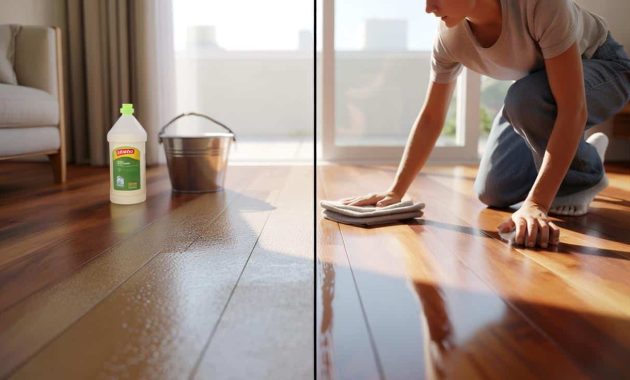
The first time you notice your hardwood floor has gone from warm glow to dull gray is rarely a grand moment. It’s usually something small. A stray ray of afternoon sun hits the boards just right and suddenly every scratch, footprint and cleaning streak pops out like a bad filter on your phone. You crouch down, rub a finger across the wood, and tell yourself, “They used to shine. I’m not imagining this.”
So you do what everyone does. You Google. Vinegar. Wax. Some mystery product that costs as much as a dinner out. Then you test a bit here, a bit there, and your floor ends up looking like a patchwork of failed experiments. That’s when the doubt sets in: did I ruin it, or was it already like this?
And yet, the solution often hides in the most ordinary place in your home.
Why your once-glossy hardwood suddenly looks tired
Walk into any older apartment and you notice it immediately. The floors tell the story before the furniture does. Near the sofa and the kitchen: dull, cloudy, slightly sticky. Under the rug: deep color, quiet shine, as if time stopped there. Same wood, same house, two different worlds.
That “before and after” isn’t just about age. It’s about everything we pour, spray and drag across those planks without thinking. A bit of all-purpose cleaner when you spill coffee, a random product borrowed from a neighbor, a quick mop with something that “smells clean.” Each tiny shortcut leaves a microscopic film. One layer is invisible. Hundreds of layers, over months, turn into a matte veil that kills the reflection.
I saw this play out in a small town house last winter. The owner, proud of her century-old oak floors, swore she’d “tried everything.” She showed me a closet full of half-used bottles: vinegar concentrate, almond-scented soap, a thick paste wax her grandmother used. Parts of the floor were greasy, other spots looked chalky, and some planks felt almost rubbery underfoot. Under her dining table, where she actually cleaned less, the wood looked… better.
We tested a tiny hidden patch with a different approach. No vinegar. No wax. No “miracle” spray. Within five minutes, one small stripe of floor suddenly reflected the window frame again. Not like a showroom, but like a healthy, rested version of itself. She didn’t believe it at first. She bent down, touched it, then compared it with the next board over, which still looked hazy and tired.
What had happened to her floors is what happens in most homes. Vinegar slowly etches some finishes and dries the wood’s surface. Soap and “shiny” cleaners leave residue that dulls the light. Paste wax sits on top and traps dust, then scratches when people walk. Under the rug, protected from all our good intentions, the finish stayed closer to its original state. The shine wasn’t gone. It was buried.
The simple home trick that lifts the haze and brings back the glow
The trick that changed that house – and many others – sounds almost too ordinary: a two-step routine using just warm water and a tiny amount of neutral, pH-balanced floor cleaner, followed by a dry microfiber buff. No vinegar. No wax. No oil. Just a gentle clean to strip away buildup, then a light polish with a cloth that grabs residue rather than smearing it around.
Here’s how it looks in real life. Fill a bucket with warm (not hot) water. Add a small splash of pH-neutral cleaner made specifically for sealed wood floors. Dip a flat microfiber mop, wring it out hard so it’s only slightly damp, then glide it with the grain of the wood. You’re not soaking the floor, you’re just loosening the film. Work in small sections. Then, while that section is still faintly damp, take a clean, dry microfiber cloth or pad and buff it like you’d dry a car after washing.
➡️ How rotating your mattress every 6 months can reduce hidden sleep issues
➡️ Psychology shows why emotional regulation is shaped by experience, not personality
➡️ When pumas return to Patagonia, thousands of penguins vanish
➡️ This small shift prevents cleaning fatigue over time
This last step is where the magic happens. Instead of letting the water and cleaner air-dry into another film, you physically lift it off and leave only the original finish. On that town house floor, the owner watched the dull patch turn into a gentle, satin reflection after just one pass of the dry cloth. No glare, no greasy shine, just that quiet gleam you notice from the hallway.
If you’ve been leaning on vinegar or wax for years, you might feel a bit skeptical or even guilty. You were trying to care for your home, not ruin it. The good news is that most floors are more forgiving than we think. What they don’t love is over-care. Weekly heavy mopping, multiple products, “refresh” coatings piled one on top of another… it all builds a kind of cosmetic makeup that cracks and cakes with time.
Let’s be honest: nobody really does this every single day. You clean when the footprints start to annoy you, or when guests are coming, or when the crumbs under the table reach a point of no return. That’s already enough. A quick dry sweep or vacuum most days, then this damp-clean-and-buff routine once every week or two, often brings more life back to the wood than an expensive refinishing job, at least in the short term.
The mistake many of us fall into is thinking more product equals more shine. On hardwood, the opposite is usually true. Each “shine booster” you add is another layer between your eyes and the actual finish. That’s why this simple, almost boring method works so well: it’s about subtraction, not addition. You’re taking things away until the original glow can breathe again.
Sometimes the person who finally cracks the code is a friend, not an expert. One Paris landlord told me, “I wasted a year yelling at tenants about ‘destroyed floors.’ Then my retired neighbor came over, grabbed a bucket, and quietly restored the shine in one afternoon. No vinegar, no wax. Just microfiber and patience.” His biggest shock wasn’t the result. It was realizing how much his own cleaning routine had hidden the true condition of the wood.
- Use a pH-neutral cleaner
Anything too acidic (like vinegar) or too alkaline slowly attacks the finish instead of the dirt. - Keep the mop almost dry
Standing water seeps into joints and can warp or stain the planks. Damp, never wet, is the rule. - Always finish with a dry microfiber buff
That simple pass removes residue, lifts the haze, and coaxes out a natural, non-greasy shine. - Avoid routine wax on modern sealed floors
Most factory or polyurethane finishes are designed to shine without extra wax layers on top. - Test one hidden board before doing the whole room
Every floor has a past. A tiny patch trial tells you how it reacts before you commit.
When your floor looks new, home feels different
There’s a funny shift that happens when hardwood floors start to glow again. You don’t walk differently, but you notice your own steps. The grain catches the light at the edge of your vision, your room feels a bit warmer, and suddenly that old rug you thought you loved looks a little heavy. It’s not about chasing perfection. It’s about rediscovering a surface you thought was “done” and realizing it still has something to give.
This tiny cleaning ritual becomes almost meditative. A bucket, a mop, a cloth, ten quiet minutes along the hallway. You find forgotten scratches, small dents, the path the dog always takes to the door. Those marks stop looking like flaws and start reading like a kind of personal map. *Shiny doesn’t mean brand new; it just means cared for in a way that suits the material, not the marketing on the bottle.*
And that’s the plain truth: most floors don’t need dramatic rescue, they just need us to step out of the product spiral. If you’ve tried vinegar, wax, oils, and you’re still frustrated, this is the moment to strip your routine back to something simple, gentle, and consistent. Next time a sunbeam crosses your living room, watch what it does on the boards. If the reflection surprises you a little, if you catch yourself slowing down to look, that might be the real sign that your home is starting to feel like new again.
| Key point | Detail | Value for the reader |
|---|---|---|
| Skip vinegar and routine wax | They can damage finishes and trap dirt in cloudy layers over time | Protects your floor’s lifespan and avoids costly refinishing |
| Use a damp-clean and dry-buff method | Warm water, pH-neutral cleaner, then a dry microfiber polish | Restores natural shine with minimal effort and no specialty gear |
| Prioritize regular light care | Frequent dry sweeping, occasional deep but gentle clean | Keeps floors looking “like new” without time-consuming routines |
FAQ:
- Question 1Can I ever use vinegar on hardwood if I dilute it a lot?
- Answer 1
- Even heavily diluted vinegar stays acidic and can slowly dull or etch many modern finishes. It may look fine after one or two washes, but the cumulative effect is a flatter, more fragile surface. Safer to switch to a pH-neutral cleaner designed for wood.
- Question 2My floor already has old wax on it. Should I strip it all off first?
- Answer 2
- If you see a patchy, smeared shine that gathers dust, there’s probably wax buildup. For small areas, you can gently clean and buff as described and see how far that gets you. For heavy, long-term wax layers, a pro-grade wax remover or a flooring specialist may be worth calling before you go DIY with harsh solvents.
- Question 3Will this trick work on laminate or vinyl that just looks like wood?
- Answer 3
- The same gentle approach (damp microfiber + neutral cleaner + dry buff) is usually safe and effective on laminate and luxury vinyl. Just avoid any product labeled as “wax,” “polish,” or “oil” unless the manufacturer specifically recommends it for your exact floor.
- Question 4How often should I do the full damp clean and buff routine?
- Answer 4
- For most busy homes, every 1–2 weeks is plenty, with daily or every-other-day dry sweeping or vacuuming to keep grit from scratching. High-traffic entries might need a bit more, little-used bedrooms a bit less. Let the floor, not the calendar, guide you.
- Question 5What kind of microfiber should I use for the best shine?
- Answer 5
- Choose a flat, tightly woven microfiber pad or cloth rather than a fluffy one. The flat texture traps fine residue and buffs more evenly. Keep separate pads for washing and for dry buffing, and wash them without fabric softener so they stay grippy rather than slick.