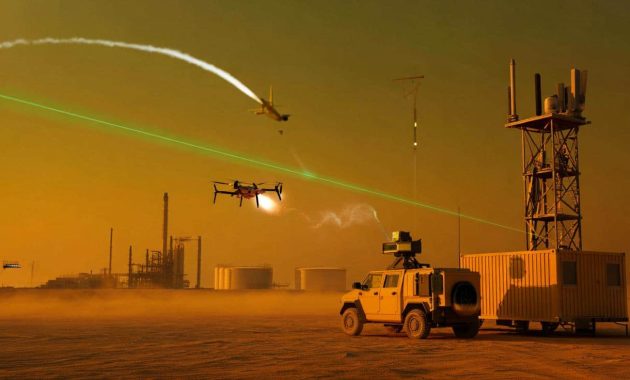
Europe’s MBDA has turned that rethink into Sky Warden, a modular counter-drone system built for swarms and single threats alike. The company has now signed its first export contract for the kit with a Middle Eastern customer that has not been named.
What’s new: a first middle east contract
MBDA, headquartered in France and active across Europe, confirmed the first overseas sale of Sky Warden to a buyer in the Gulf region. The order signals growing demand for counter-unmanned aerial systems as small quadcopters and loitering munitions bite into the cost curve of modern warfare.
First export sale: a Middle Eastern country will field Sky Warden, marking a notable entry for a European counter-drone system in a drone-heavy region.
The contract also carries political weight. European suppliers have trailed American and Israeli firms in this niche. A live deployment in the Middle East puts MBDA’s solution in a demanding environment where drone attacks target bases, oil infrastructure and convoy routes.
How the system works
Modular, open and interoperable
Sky Warden uses an open architecture. Operators combine sensors and effectors like building blocks. That flexibility cuts integration risk and lets budgets scale by mission.
- A multi-sensor C2 node fuses radar, radio-frequency, electro-optical and acoustic tracks into one picture for operators.
- Electronic jammers break GPS or command links to force drones down or push them off target.
- The Mistral 3 infrared missile engages slow, low targets with a reported success rate above 96% in its class.
- The HELMA-P laser from CILAS delivers silent, precise energy on target without blast or fragments.
- Hit-to-kill interceptors strike the airframe with kinetic energy, avoiding explosive warheads near sensitive sites.
Sky Warden fuses multiple sensors, classifies targets with onboard AI, then selects soft-kill or hard-kill in seconds, depending on rules of engagement.
From static sites to convoys
MBDA designed the system for fixed sites, mobile escorts and tie-ins with wider air defense. That versatility matters because threats change by hour and by district.
- Static protection for air bases, refineries, depots and stadiums.
- Vehicle-mounted escort packages for convoys and patrols.
- Integration hooks for medium-range batteries such as VL MICA or CAMM-ER to shape a multilayered shield.
Range, sensors and recent trials
The company states Sky Warden can detect, identify and defeat drones at up to around eight kilometers, subject to the sensors and effectors chosen. It tracks micro-drones small as a hand and larger airframes the size of a small scooter. The system is built to handle single targets and emerging swarm tactics, which stress operator workload and sensor saturation.
In November 2025, after a three-week competitive evaluation, Frontex—the EU border and coast guard agency—awarded its C-UAS prize to Sky Warden. That trial focused on detection of small, slow, and low signatures that often slip through traditional radar coverage.
➡️ How to reuse candle wax leftovers to make fire starters for barbecues or fireplaces and save cash
➡️ A grave upends history: humanity’s first gold jewellery was here
➡️ The Royal Navy’s HMS Prince of Wales Aircraft Carrier Is In Big Trouble
➡️ Hanging bay leaves on the bedroom door: why it’s recommended
➡️ Alzheimer: the vital role of deep sleep, according to researchers
➡️ A rare sighting has scientists reassessing previous theories
Hardware is only part of the equation. The command unit uses embedded AI to refine target libraries and speed up hand-offs between sensors and effectors. That upgrade path matters as adversaries tweak airframes, RF links and flight profiles to evade common counters.
How it stacks up in a crowded market
Counter-drone demand has spiked from Ukraine to the Red Sea, attracting a long list of suppliers. Many products focus on a single layer—jamming, lasers or kinetic shots. Sky Warden’s pitch centers on integration and mix-and-match loadouts.
| System | Origin | Primary defeat options | Status | Standout trait |
|---|---|---|---|---|
| Sky Warden | France (MBDA) | Jamming, laser, missile, hit-to-kill | Operational, first export signed | Open, modular architecture |
| Drone Dome | Israel (Rafael) | Jamming, laser | Operational in the Middle East | Compact footprint and mobility |
| SHIELD | United States (Northrop Grumman) | High-energy laser | In testing | Air platform integration |
| Diehl C-UAS | Germany (Diehl Defence) | Jamming, airburst munitions | Partial operational fielding | Linkage with multifunction radars |
European competitors such as Thales and Leonardo also field lighter or domain-specific kits, with a focus on urban bases and naval decks. Market analysts forecast C-UAS spending could climb to several multiples of current levels by 2030 as civilian sites buy layered protection.
Why this sale matters for europe
A first Middle East deployment gives MBDA a reference user where drone attacks are frequent and varied. That creates feedback loops for software and tactics. It also diversifies a market long dominated by US and Israeli catalogs. For European governments, it shows a path to a homegrown, exportable C-UAS ecosystem that can plug into NATO networks without heavy retrofits.
European industry gains a front-line proving ground, while buyers gain a configurable tool that fits into existing command networks.
Costs, constraints and the real-world tradeoffs
Each effector carries different costs and side effects. Lasers offer low cost per shot and deep magazines, but need clean power, good beam control and favorable weather. Jammers work well against hobbyist links and GPS-reliant navigation, but risk interference with friendly systems and face hardened links. Missiles deliver reach and certainty, yet carry higher unit cost and back-blast constraints near crowds. Kinetic hit-to-kill avoids blast but requires precise tracking and clear airspace.
- Power and cooling: directed-energy modules need generators, thermal management and maintenance cycles.
- Weather and clutter: dust, fog and smoke reduce optical and laser effectiveness, shifting the burden to RF and radar.
- Deconfliction: frequency management, air picture sharing and rules of engagement reduce fratricide and collateral effects.
- Training: crews must practice hand-offs between sensors and effectors under time pressure.
The military and civil use cases
Buyers now protect not only forward bases but also fuel depots, ports and national events. A modular kit helps match threat and risk to budget. A small facility can start with RF detection and jamming. A national hub can layer jammers, lasers and a missile fallback for high-consequence moments. Interoperability with medium-range air defense helps avoid gaps between drone nets and traditional SAM umbrellas.
For urban police or homeland agencies, legal frameworks matter. Jamming and kinetic shots demand strict authorization. Lasers require safety arcs and fire risk checks. A central command node helps route tracks to the right unit, log events and adapt tactics after each incident.
What to watch next
The French armed forces are assessing candidates for a domestic anti-drone “bubble,” with Sky Warden among the options alongside programs such as MILAD, PARADE and BASSALT. Interoperability with fielded European systems, including VL MICA and CAMM-ER batteries, will shape procurement timelines. The pace of software updates, especially AI-assisted classification and swarm handling, will also define the system’s staying power.
For readers new to counter-drone operations, think in layers: detect, track, decide, defeat. A simple base defense might cue an RF sensor for early warning, push a camera to confirm, task a jammer first, then escalate to a laser or missile if the drone presses on. That sequence—often called the kill chain—gets faster with drills and data. The countries that shorten it without risking civilians will get the most out of systems like Sky Warden.