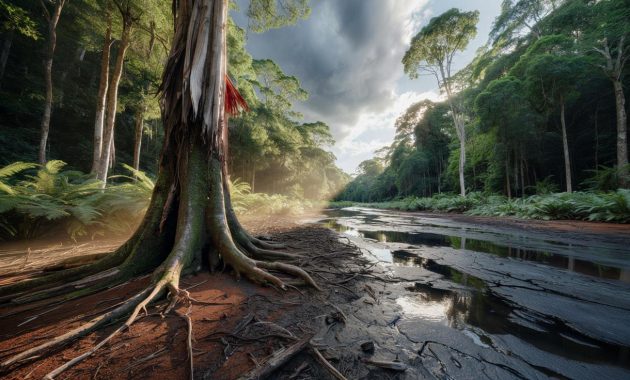
Today they sit in the crossfire of hotter oceans, harder storms and relentless dry spells.
The shift feels subtle at first glance, yet the numbers tell a blunt story. Australia’s tropical forests, among the most intact on Earth, now send up more carbon than they pull down in some regions. That change flips a cornerstone of climate strategies and puts a price on delay.
A rainforest safety net slips
For decades, tropical forests absorbed a large slice of human emissions through photosynthesis. Growth outpaced decay, so the system banked carbon in trunks, branches and soils. The balance depends on living trees replacing dead ones fast enough. When that churn slows, storage weakens and the ledger turns red.
Fresh long-term data from Queensland shows that pivot. Researchers tracked twenty rainforest sites over forty‑nine years. Between 1971 and 2000, these forests stored an average of 0.62 tonne of carbon per hectare each year. From 2010 to 2019, the same forests emitted 0.93 tonne of carbon per hectare per year.
After decades as a sink, parts of Australia’s wet tropics now act as a net carbon source, driven by heat, drought and storm damage.
The driver is not a single villain. Stronger cyclones have ripped open canopies and toppled giant trees. Hotter, longer dry periods stress saplings and old giants alike. Heat speeds up respiration. Drought slows growth. Mortality rises. The renewal cycle stalls.
Why rising CO₂ did not save the day
A common claim says more carbon dioxide boosts plant growth. That signal looks weak here. The study period covered a sharp rise in atmospheric CO₂. The forests did not show a matching growth surge. Nutrient limits, water stress and heat extremes can throttle any fertilization effect. When big storms and hot droughts stack up, the gains vanish.
What the numbers mean in plain terms
| Period | Net carbon balance | Per hectare | CO₂ equivalent |
|---|---|---|---|
| 1971–2000 | Sink | −0.62 t C/yr | ≈ −2.28 t CO₂/yr |
| 2010–2019 | Source | +0.93 t C/yr | ≈ +3.41 t CO₂/yr |
Scale that up across landscapes and you get a quiet shift with loud consequences. A forest that once muted emissions now adds to them in bad years. Those swings complicate budgets used by governments and markets.
Models and climate plans face a stress test
Many global scenarios assume tropical forests keep soaking up carbon for decades. The Queensland trend challenges that assumption. If intact rainforests can flip under modern warming, stressed regions like parts of the Amazon or Southeast Asia may face similar risks as heat and drought intensify.
Australia itself has already warmed more than 1.5 °C on average, according to national risk assessments. Agencies now describe climate threats as cumulative, simultaneous and cascading. That framing matters. A cyclone that tears open a canopy also increases sun exposure, dries the understory and raises fire risk in following seasons. One shock sets up the next.
➡️ Vegetarianism: health effects that aren’t always as positive as you think
➡️ This master gardener reveals the ideal time to sow without fearing drought in 2025
➡️ Goodbye air fryer: new kitchen gadget goes beyond frying with 9 different cooking methods
Forest carbon is not guaranteed. Non‑permanence, abrupt reversals and event‑driven losses now sit at the center of the climate math.
Offsets, land targets and the permanence problem
Forest‑based offsets and net‑zero pledges lean on the idea of durable storage. The Queensland record shows storage can fail when conditions cross thresholds. That risk does not sink restoration or conservation. It does change the prudence level needed for crediting schemes and timelines. High‑quality mitigation must prioritize rapid cuts in fossil emissions, then use nature as a buffer with conservative accounting.
What drives the flip from sink to source
- Cyclone damage: Canopy gaps increase, mortality spikes, and large trees release decades of stored carbon.
- Heatwaves: Tree respiration rises, net photosynthesis falls, and growth slows across species.
- Prolonged drought: Saplings fail to recruit, mature trees embolize, and soil moisture limits recovery.
- Event stacking: Storms, heat and drought compound, leaving shorter windows for regrowth.
- Nutrient limits: Phosphorus‑poor tropical soils can cap any CO₂ fertilization response.
Recovery takes time. In cyclone belts, a late‑season heatwave can hit right after a big blowdown. Dead wood decays faster in warm, moist air, which adds to emissions. If new cohorts cannot close the gap, the balance stays positive for years.
What this means for people and policy
Communities across northern Queensland rely on rainforest services: water regulation, tourism, cultural heritage and biodiversity. A weaker forest sink adds regional emissions while also slicing those services. Land managers need plans that handle both carbon and resilience.
Action that still pays off
Local choices can lower risk even as the climate warms:
- Protect intact cores and climate refuges at higher elevations and moist gullies.
- Restore multi‑species canopies that resist windthrow better than uniform stands.
- Reduce ignition sources after cyclone seasons to avoid blowdown‑fed fires.
- Expand wildlife corridors so species can track microclimates as valleys heat up.
- Prioritize rapid, verifiable cuts in fossil fuel use to ease pressure on forests.
Signals to watch next
Scientists will test whether similar flips appear in other tropical belts. Key indicators include tree mortality rates, cyclone return periods, drought length, and net ecosystem exchange from flux towers. Satellite biomass maps now resolve canopy loss after single storms, aiding faster assessments.
If more regions show declining sink strength, emission pathways that counted on big nature‑based uptake must adjust. That shift affects national inventories, offset markets and sectoral targets. The earlier the correction, the less painful the back‑half of the decade becomes.
Key terms, clarified
Carbon sink vs source: A sink absorbs more carbon than it emits over a given period. A source emits more than it absorbs. Net figures include growth, respiration, decay and disturbance losses.
Tonnes of carbon vs CO₂: One tonne of carbon equals about 3.67 tonnes of CO₂. So +0.93 t C per hectare means roughly +3.41 t CO₂ per hectare each year.
A practical lens for readers
Think of a rainforest as a long‑term savings account. Storms and heatwaves act like sudden withdrawals. Drought cuts your monthly deposit. If withdrawals arrive faster than deposits for several years, the account shrinks. The Queensland study shows that shrink can last through a decade, not just a season.
A simple simulation helps. Take a 10,000‑hectare block in the wet tropics. At +0.93 t C per hectare per year, that area would emit about 9,300 tonnes of carbon annually, near 34,000 tonnes of CO₂. If one strong cyclone increases mortality again, the spike could double in the following two years before tapering. Planning for that volatility matters for budgets and for restoration crews who must replace lost canopy fast.