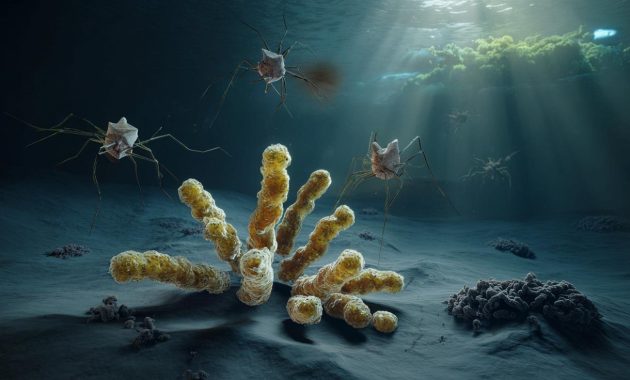
Most days, the ocean surface looks calm, almost empty. Yet an invisible battle between bacteria and viruses may decide how much CO₂ the planet keeps or buries for centuries.
The strange survival trick of a very ordinary bacterium
In this story, the unexpected protagonist is a small marine bacterium with a big job: Cellulophaga baltica. It lives in coastal waters, drifting in the sunlit zone where phytoplankton capture CO₂ and turn it into organic matter. C. baltica helps break down this material and participates in what scientists call the biological carbon pump, the giant conveyor that ferries carbon from the surface to the deep sea.
For years, researchers treated it as just one microbe among thousands. That changed when a team at Ohio State University noticed how aggressively it was hunted by bacteriophages, or phages – viruses that infect only bacteria. To stay alive, the microbe did something radical: it evolved.
Dans ce duel microbien, every defensive mutation changes not just who survives, but how fast carbon sinks into the abyss.
Those defensive tweaks don’t only block infection. They alter the bacterium’s surface, its metabolism, even the way it moves through water. The surprise: some of these “mutant” bacteria no longer float. They clump together and sink, dragging carbon down with them like microscopic ballast.
How viral attacks make microbes heavier
Two main mutation strategies against phages
The Nature Microbiology study identified two broad families of resistance mutations in C. baltica:
- Surface mutations: changes in the outer membrane that prevent viruses from attaching to the cell.
- Metabolic mutations: internal changes that still let the virus in, but stop it from replicating by cutting off key lipids needed to build new viral particles.
Both strategies protect the bacterium from at least some phages. But they also come with a side-effect that matters far beyond a petri dish: they change how sticky and dense the cells become.
In lab experiments, mutant cells tended to glue themselves together more easily than non-mutant strains. The surface mutants in particular formed clumps and aggregates that fell through the water column much more quickly than the original, free-floating bacteria.
When these sticky mutants sink, they act like an elevator for carbon: what started near the surface ends up locked in the deep ocean for centuries.
➡️ A retiree wins €71.5 million in the lottery, but loses it all a week later because of an app
➡️ Why gardeners hang cork stoppers on lemon branches
➡️ In two weeks, the Game of Thrones universe returns with an all-new series!
Once organic carbon leaves the upper few hundred metres and reaches the deep ocean, it often stays there for hundreds to thousands of years before currents slowly return it to the surface. That delay matters. It reduces the amount of CO₂ that can quickly leak back into the atmosphere and warm the planet.
The climate stakes of microscopic “ballast”
This is where a local arms race becomes a global story. Each time a virus attack triggers resistant, heavier mutants, a bit more organic carbon may sink. Not every cell turns into a fast-sinking particle, and ocean turbulence still mixes a lot back up. But across the vast surface of the planet, small changes in sinking speed can add up.
Previous work, including the international Tara Oceans programme, had already shown that viruses strongly influence marine carbon flows by killing microbes and releasing dissolved organic matter. The new research adds a different layer: viruses don’t just destroy; by driving evolution, they also shape what sinks and what stays near the surface.
That link between cell shape, surface chemistry and sinking speed gives climate scientists new levers to include in models. Instead of treating bacteria as uniform “black boxes”, models can start to account for how viral pressure reshapes communities and alters the efficiency of the biological pump.
The high price of resistance for bacteria
Slow growth and fragile winners
Nothing is free in microbial life. The same mutations that block phage infection often hurt the bacterium in other ways. The Ohio State team observed that all resistant strains grew more slowly than their non-mutant relatives.
- Surface mutants: broad resistance against several phages, but sluggish growth and heavier, clump-prone cells.
- Metabolic mutants: more selective resistance, but disrupted internal chemistry that makes them less competitive when nutrients run low.
One mutation, for instance, stops the production of the lipids needed to assemble new viruses. Infection attempts fail, which looks like a win. But those same lipids also matter for the bacterium’s normal physiology. Without them, the cell divides more slowly and loses ground when phages are scarce.
In a calm period with few viruses, the wild-type, fast-growing cells can quickly outcompete the resistant mutants, even if those mutants once “won” the battle.
This dynamic creates a constantly shifting mosaic: bursts of viral attacks favour resistant, sticky, fast-sinking types; quiet phases allow lighter, more efficient strains to dominate again. From a carbon perspective, the ocean doesn’t run one fixed carbon pump, but many, switching modes as microbes and viruses dance around each other.
Could we ever harness “mutant” microbes to trap CO₂?
A tempting idea with serious caveats
The prospect sounds seductive: if certain bacterial traits enhance carbon export to the deep ocean, could humanity deliberately nudge microbial communities to enhance that effect? Some researchers cautiously raise the question, not as an immediate engineering plan, but as a long-term line of inquiry.
Several obstacles appear straight away:
- Ocean ecosystems are intricate; pushing one species could destabilise many others.
- Viruses adapt quickly. Any lab-designed trait might vanish once phages evolve around it.
- We struggle to monitor, let alone control, microbial populations over millions of square kilometres.
So the discussion today stays largely theoretical. Rather than imagining “designer microbes” seeded into the ocean, many scientists focus on using this new knowledge to sharpen climate projections: how will shifting viral regimes under warming, acidification or pollution change the efficiency of natural carbon burial?
Oceans already carry a huge share of our emissions
A massive, but finite, carbon buffer
Every year, the oceans absorb roughly 25–30% of human CO₂ emissions, about 10–12 billion tonnes. Some of that dissolves near the surface as inorganic carbon; some becomes organic matter and sinks with particles, dead plankton and aggregates like those formed by sticky bacteria.
Because seawater already contains around 150 times more dissolved inorganic carbon than the atmosphere, small shifts in chemistry or biology can move enormous amounts of CO₂ on human timescales. That potential has not gone unnoticed.
One Chinese research group recently demonstrated a reactor that treats seawater almost like a chemical factory. Their device forces dissolved carbonate and bicarbonate to convert back into CO₂, then instantly turns that CO₂ into useful molecules, such as building blocks for biodegradable plastics, before it can re-enter the air.
The “blue chemistry” concept treats the ocean as a vast carbon bank, where tiny withdrawals feed industrial products instead of more warming.
Ideas like this sit alongside a wider portfolio of approaches, from reforestation to mineral carbonation, as the world looks for ways to remove and store CO₂ rather than just cut emissions.
Where microbial tricks fit into the wider CO₂ toolkit
How this compares with other carbon removal options
The microbial story belongs to a broader landscape of climate responses already in testing or early deployment. Here is a snapshot of some of the main approaches discussed for 2025:
| Approach | Basic idea | Where it’s happening | Potential benefit | Key concerns |
| Direct air capture (DACCS) | Machines pull CO₂ from air, then store it underground. | Pilot and early industrial plants in the US, Europe, Middle East. | Quantifiable CO₂ removal if powered by low‑carbon energy. | High energy demand, costs, and need for secure storage sites. |
| Bioenergy with CCS (BECCS) | Grow plants, burn them for energy, capture and store the CO₂. | Demonstrator projects and a few commercial plants. | Can deliver net removal if biomass is truly sustainable. | Competition for land, water and biodiversity. |
| Enhanced weathering | Spread crushed rock so it reacts with CO₂ to form stable carbonates. | Field trials on croplands in Europe and North America. | Large theoretical capacity with long‑term storage. | Energy for mining and grinding, monitoring, and logistics. |
| Basalt mineralisation | Inject CO₂ into basalt rocks where it turns into solid minerals. | Projects in Iceland and other volcanic regions. | Very durable storage with low leakage risk. | Needs suitable geology and significant water volumes. |
| Biochar | Heat biomass without oxygen to create stable carbon for soils. | Agricultural projects on several continents. | Moderately durable storage with soil fertility benefits. | Biomass availability and quality control of production. |
| Ecosystem restoration | Rebuild forests, mangroves, peatlands to store carbon. | Global spread, from small projects to national programmes. | Carbon storage with biodiversity and water benefits. | Vulnerability to fires, droughts, and poor monitoring. |
| Ocean alkalinisation | Add alkaline material so seawater can absorb more CO₂. | Lab and coastal pilots, active research phase. | Large long‑term potential if carefully managed. | Uncertain ecosystem impacts and complex governance. |
| Blue chemistry from seawater | Convert dissolved carbon into industrial feedstocks. | Early reactors such as the Chinese bioplastic work. | Couples CO₂ removal with product value. | Scale, energy source and product handling. |
Compared with these engineered options, virus-driven microbial mutations sit in a different category. They are not a human tool yet, but a natural process we are just starting to quantify. Instead of new machines, they offer new parameters for models and, potentially, new indicators to track ocean health.
What this means for research, risk and opportunity
For climate science, the next step lies in measurement. Lab experiments show clear differences in sinking speeds and aggregation patterns between mutant and non-mutant strains. The harder task is to detect these effects in real oceans, where currents, grazing by zooplankton and seasonal blooms constantly rearrange the microbial cast.
New autonomous instruments, genetic sampling from programmes such as Tara Oceans, and satellite data on particle flux could help link viral infection patterns to carbon export more precisely. That work will feed into better risk assessments: how resilient is the biological pump to warming, acidification, and nutrient changes caused by humans?
The potential upside is significant. If scientists can predict when and where viral outbreaks favour high-sinking communities, they may identify regions where natural carbon export runs efficiently, or spots where disruption could sharply reduce burial. Policymakers could then treat those areas as critical climate assets, similar to peatlands or mangroves, even without direct intervention.
On a more conceptual level, the story of Cellulophaga baltica and its phages reminds us that climate is not only about smokestacks, forests and ice sheets. It also depends on microscopic choices made trillions of times a day by organisms we never see: whether to float or sink, to invest in speed or armour, to clump or stay solitary. Those choices, driven by survival in the dark, help decide how much of our carbon stays in the sky.