New research suggests a faint current hums through certain caps right before they let spores fly, turning a quiet patch of forest into a low-frequency briefing.
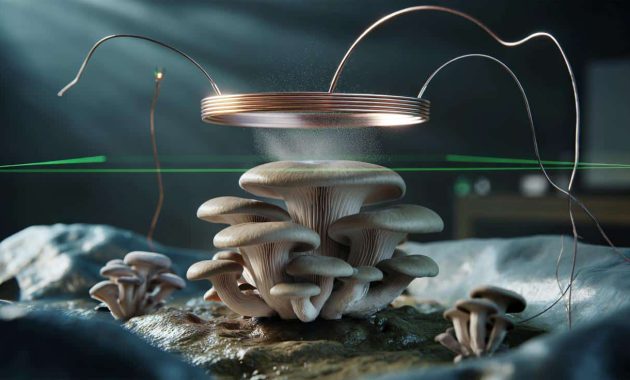
The lab lights hummed, the kind of low sound that only shows up close to midnight. On the bench, a clump of oyster mushrooms breathed damp air while a loop of copper wire hovered like a halo. A laptop traced a calm, almost sleepy line—until a few jittery spikes flicked up, and the high-speed camera caught a soft bloom of spores lifting like dust from a book.
The scientists didn’t cheer. They just looked at each other, half-smiling, as if someone had whispered their name in a crowded room. The spikes kept coming in tiny bursts, and the plumes matched the rhythm. Then the room blinked.
The quiet signal under the cap
What the team kept seeing was simple and weird. Right before spores left the gills, the mushrooms sent out faint, low-frequency electromagnetic pulses, almost like a heartbeat deciding when to start a race. The pulses were tiny—measured in microvolts and nanoteslas—but consistent enough to map.
Mushrooms aren’t just releasing spores at random—they’re timing it together.
One trial reads like a small story. They waited forty-seven minutes with the sensors on idle, the camera capping frames no human eye could track. Then a cluster of signals rose in little bursts around one hertz, and a pale cloud lifted in sync, like a sigh you can see. The same pattern repeated across different caps, a loose chorus reaching the same cue. It didn’t look like noise. It looked like a decision, made softly.
We’ve all had that moment when a room changes mood before anyone speaks. This felt like that—except the room was a patch of mycelium, and the “mood” was a tweak in electric potential. Numbers help here: the field changes were small, but they arrived within seconds of the spore plume starting, over and over. That’s not proof of control by itself, but the correlation stuck around even when the air was still and the light stayed constant.
Why do this at all? If you’re a mushroom, timing is survival. Spores need a tiny lift—an eddy of warm air, a tweak of charge—to get off the gill and out into the world. Electrostatic forces already play a part in spore launch, nudging particles into motion the way a balloon lifts hair. The pulses may be the cap’s way of nudging the local field, easing spores past the boundary layer of still air that hugs every surface. A micro-shift at the right instant could mean meters more travel downwind.
There’s also the crowd effect. When neighboring caps sync their pulses, they might create a thicker plume, a kind of coordinated release that rides the same slow swirl. That doesn’t require language, only a shared trigger. Humidity changes, a stretch of temperature, and yes—the faint electrical whispers carried through the tissue like a cue. The forest floor is noisy with tiny physics. This adds one more instrument to the band.
How the whisper was caught
The method wasn’t mystical. It was patience plus shielding. The researchers staged their mushrooms inside a Faraday tent to cut stray electrical chatter, then looped a coil antenna near the cap and ran it into a low-noise amplifier. A separate pair of electrodes tracked tiny voltage shifts in the tissue. On the other side, a high-speed camera watched for spore release with a laser sheet, the particles glowing as they crossed.
➡️ China floods Europe with 1,000 km hybrids while Brussels doubles down on all‑electric
➡️ Over 60? This type of routine helps maintain independence longer
➡️ Physicists discover a quantum system that refuses to heat up
For a second, the room felt like it was listening back.
If you’re curious about trying a tiny slice of this at home, keep it humble. A loop of enameled copper wire, a portable magnetometer with decent sensitivity, and a dark box can teach you a lot. Let’s be honest: nobody sets up a Faraday tent in the woods every day. But you can still reduce obvious noise—turn off the phone, step away from outlets, wait for the building to go quiet. What matters is rhythm, not perfection. Catch the pulses, then watch the spores.
Here’s what the lead investigator told me after a long night of quiet recordings. “It’s not telepathy,” she said, rubbing condensation off the lens. “It’s timing. Biology uses whatever physics sits within reach.” Then she shrugged, like the mushrooms had done the talking anyway. Below are the takeaways they kept on a sticky note taped to the bench.
“Small signals move big outcomes when the timing is right. Spores need a moment, and the cap gives it to them.”
- Signals: low-frequency bursts, often under 10 Hz, repeating in short clusters.
- Magnitude: microvolts in the tissue, nanotesla-scale shifts near the cap.
- Trigger window: signals rise seconds before visible spore plumes.
- Conditions: effect survives in still air; humidity modulates intensity.
What tripped them up at first wasn’t the measurement—it was the world. Elevators in the building threw out a steady roar of electromagnetic junk. So did fridges, routers, wristwatches, even a passing tram. One researcher laughed when her own sweater crackled near the antenna and looked like a mushroom heartbeat. The fix was low-tech: distance, shielding, and habit. Go slow. Reset between trials. If a reading feels too perfect, do it again with a different coil.
Another near-miss: confusing mechanical tremors with field changes. A footstep can shake a camera and fake a plume; a desk bump can jolt a wire and fake a spike. The group started logging their movements like pilots, noting each tap and turn. It felt fussy until the clean runs lined up with the cleanest signal bursts. The lesson landed hard: patience is a tool, not a mood.
What it changes for science—and for us
This isn’t a fairy tale about talking fungi. It’s a small crack in what we thought was silence. If spore release carries an electromagnetic signature, ecologists get a new handle on when and how forests self-seed. Air modelers can plug real timing into dispersal equations. Growers might even nudge yields in controlled rooms by aligning humidity and gentle field cues, rather than brute-forcing airflow.
The bigger shift is in how we listen to non-animals. We keep finding quiet channels—voltage spikes in plant roots, acoustic clicks in cavitating stems, and now these faint mushroom pulses. Each one adds texture to a world that’s alive with thresholds and timing. Not everything is speech. Some of it is just rhythm laid over matter, the way a tide meets a pier.
There’s a human piece too. Standing in a dark room while a cap breathes and a line crawls across a screen is a slow kind of wonder. It asks for the sort of attention that doesn’t always fit the day. The payoff is subtle: not a headline explosion, just a soft shift you can’t unsee once you notice it. If a mushroom can time its future with a whisper, maybe other quiet systems around us do the same—fields, flocks, even crowds. The trick is to stop talking long enough to hear.
| Point clé | Détail | Intérêt pour le lecteur |
|---|---|---|
| Faint EM signals precede spore release | Low-frequency bursts rise seconds before visible plumes | Reframes mushrooms as active timers, not passive dusters |
| Signals are small but measurable | Microvolts in tissue, nanoteslas near caps in shielded setups | Shows the phenomenon sits within reach of careful tools |
| Coordination may boost dispersal | Syncing plumes can ride the same airflow and charge gradients | Explains how timing turns into more spores traveling farther |
FAQ :
- Can we hear or feel these signals?No. They’re far below human senses and show up only on sensitive instruments as low-frequency, low-amplitude changes.
- Which mushrooms are doing this?The research points to several gilled species in lab tests, like oyster mushrooms and inkcaps. The pattern may vary across species and conditions.
- Does this mean mushrooms are “communicating”?Not in a language sense. The signals look like coordination cues tied to timing, using physics the caps already exploit for spore launch.
- How strong are the fields?Think microvolts and nanoteslas—tiny. That’s why shielded rooms, quiet electronics, and steady baselines matter when measuring.
- Could phones or Wi‑Fi mess with this?High-frequency wireless signals don’t match the slow bursts observed, but electrical noise can swamp measurements. In nature, the effect still shows up despite everyday EM clutter.