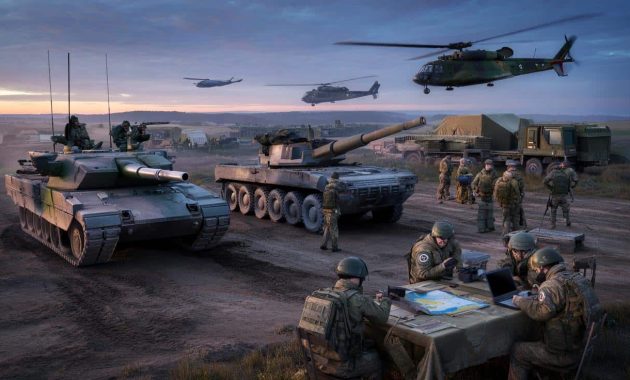
The vast NATO drill in Romania, code-named Dacian Fall 2025, is pushing French forces to a level of commitment in Eastern Europe not seen since the end of the Cold War, while sending a clear political message to Moscow and nervous allies on the alliance’s eastern flank.
France stages its biggest eastern deployment in decades
From 20 October to 13 November 2025, the Cincu training area in central Romania has turned into one of NATO’s busiest hubs. Under Romanian command, Dacian Fall brings together around 5,000 troops from several allied countries.
More than 3,000 French soldiers form the backbone of the exercise, making this France’s largest land deployment to Eastern Europe since 1990.
France is the framework nation for the exercise, responsible for structuring and coordinating this multinational brigade. Paris has sent a heavyweight package: Leclerc main battle tanks, Caesar self-propelled howitzers, Tigre attack helicopters, NH90 transport helicopters, tactical drones and mobile radar units.
That equipment is not just there for show. It allows French commanders to train on what military planners call “high-intensity conventional warfare”: rapid manoeuvre, long-range fires, electronic warfare and tight air–land coordination, all under realistic conditions.
A signal to Moscow, reassurance for allies
The French decision to scale up from a battlegroup-sized presence to a full brigade-level exercise in Romania is driven by two audiences: Russia, and European allies who worry they might face Russia next.
Dacian Fall is designed as both deterrent and reassurance, combining visible firepower with equally visible political commitment.
The choice of Cincu, in Transylvania, places the manoeuvres a relatively short distance from Ukraine and the Black Sea theatre, where Russian and NATO activities already rub up against each other. French officials freely admit that every artillery salvo and armoured assault drill is watched closely in Moscow.
At the same time, capitals like Bucharest, Vilnius, Warsaw and Bratislava read the exercise as a pledge. France is not just talking about European defence; it is willing to put thousands of troops, heavy armour and key command structures in the east, and keep them there for weeks.
➡️ “I was losing $90 a month without even noticing it”
➡️ If you want a happier life after 60 admit you are the problem and quit these 6 habits
➡️ At-home eyebrow tinting simplified with an easy method for soft defined and natural brows
➡️ A bay leaf under the pillow: The small night routine I once mocked – until it changed my sleep
➡️ Pressure mounts on Nasa: the space station is nearing its end and no replacement is ready
Ministers on the ground, partnership on the line
Paris wants the message to be political as much as military. During the exercise, French defence minister Catherine Vautrin travelled to Romania for her first visit in the job, stopping in Sibiu, where French boots have been rotating since 2022, and then moving to Cincu.
She appeared alongside Romanian defence minister Liviu-Ionuț Moșteanu and the French army chief of staff, General Pierre Schill. The three stressed that Franco‑Romanian cooperation has shifted from polite communiqués to hard capability on the ground.
- Romania plans to sign a contract for French-made Mistral 3 short-range air defence missiles.
- France is preparing to deploy “Aurore”, billed as the most powerful air-surveillance radar on the continent.
- Joint training now covers land, air and logistics, not just symbolic patrols.
For Paris, Romania is evolving from a host nation into a long-term strategic partner, a gateway to the Black Sea and a bridge to Ukraine.
How Dacian Fall 2025 is structured
The organisers see Dacian Fall as a step-change in how NATO presents power on its eastern flank. Previous deployments often focused on battalion-sized units, roughly 1,000 troops or less. This time, the aim is a functional, combined-arms brigade able to fight and move as a single organism.
| Element | Details |
|---|---|
| Dates | 20 October – 13 November 2025 |
| Location | Cincu, Transylvania, Romania |
| French forces | 3,000 troops, Leclerc tanks, Caesar guns, Tigre and NH90 helicopters |
| Total troops | Approx. 5,000 NATO personnel |
| Framework nation | France |
| Key goals | Brigade-level coordination, interoperability, long-distance logistics |
| Partners | Romania, Belgium, Luxembourg, Spain |
Behind the jargon, this means French officers are running a real-time stress test: can they plan and execute complex manoeuvres with several national contingents, each bringing different vehicles, radios, procedures and languages, under unified command?
From Eagle Steel to trench warfare drills
Dacian Fall is not an isolated show. It plugs into a wider series of French‑Romanian drills that escalate in realism and difficulty.
At the Eagle Steel exercise, French armoured units practised live-fire engagements, coordinating tank and artillery fire under tight time pressure. Meanwhile, at Topraisar training area, Eagle Warrior pushed infantry troops through trench combat scenarios that look uncomfortably close to Ukrainian frontline footage.
Units rehearsed observation, secure communications, advancing under fire and clearing enemy positions, cycling the same drills until movements became almost automatic. Above them, three Romanian Puma helicopters flew alongside two French NH90s and a Tigre gunship, sharing tactics for insertion, close air support and casualty evacuation.
The goal is not just shared badges, but shared reflexes: soldiers from different flags acting like a single formation when things go wrong.
Logistics: the quiet backbone of the show
One of the least glamorous aspects of Dacian Fall is also one of the most revealing: logistics. Moving, feeding, fuelling and repairing a 5,000-strong force with heavy armour across a foreign country is a major test.
Romanian support has been central, from rail and road networks to fuel depots, maintenance areas and secure communications lines. French, Belgian, Luxembourg and Spanish troops are using this as a rehearsal for how host nations can sustain a sudden influx of allied forces in a crisis.
Command posts are set up to mirror wartime conditions, with multinational staff handling everything from medical evacuations to ammunition resupply. The exercise quietly measures how fast a brigade can shift positions, how vulnerable its supply lines might be, and where coordination breaks down.
A historic scale for France in the east
French officials are blunt: they have not sent this many troops and this much heavy kit to Eastern Europe since the early post‑Cold War peacekeeping operations in the Balkans.
In the 1990s, France deployed up to 7,000 troops to Bosnia under UN and NATO mandates, and later several thousand to Kosovo. Those missions focused mainly on stabilisation and peacekeeping. By contrast, Dacian Fall rehearses high‑end warfighting against a peer adversary.
The exercise underlines a doctrinal shift: France is behaving again like a front-line power on NATO’s eastern flank.
Since Russia’s full-scale invasion of Ukraine in 2022, French deployments in Eastern Europe had already increased, including the Mission Aigle presence in Romania, which peaked at around 1,200 troops. Yet Dacian Fall more than doubles that, and lifts the activity to brigade level.
France’s broader military footprint in Eastern Europe
| Period | Operation / exercise | Location | French troop levels | Mission type |
|---|---|---|---|---|
| 1992–1999 | IFOR / SFOR | Bosnia and Herzegovina | 5,000–7,000 | Peacekeeping |
| 1999–2008 | KFOR | Kosovo | 3,000–4,000 | Post-conflict stabilisation |
| 2014–2016 | Lynx / early eFP | Estonia | 300–500 | Deterrence |
| 2022–2025 | Mission Aigle | Romania | ~1,200 | Forward NATO presence |
| 2025 | Dacian Fall | Romania | 3,000+ | High-intensity exercise |
This trajectory suggests that Eastern Europe is no longer a peripheral concern for Paris. It is becoming a central theatre in French defence planning, on a par with the Sahel missions that dominated much of the past decade.
The Ukrainian dimension: money, weapons, training
While rehearsing future contingencies in Romania, France remains deeply involved in Ukraine’s present war. Since 2022, French military support to Kyiv is estimated at €8.6 billion.
Around €5.9 billion comes in direct military aid: armoured vehicles such as AMX‑10 RC and VAB carriers, artillery systems, munitions, maintenance and training for Ukrainian troops. A bilateral fund worth roughly €400 million allows Ukraine to order French-made equipment tailored to its needs.
On top of that, France contributes around €2.3 billion to the EU’s European Peace Facility, the financing mechanism through which the bloc refunds member states for arms transfers to Ukraine.
For Paris, helping Ukraine and hardening NATO’s eastern flank are two sides of the same strategy: keeping Russia contained and raising the cost of future aggression.
Risks, benefits and what Dacian Fall really tests
Exercises on this scale carry their own risks. Military planners worry about accidents, signalling miscalculations with Russia, or political fatigue at home if deployments become routine and expensive. Allies also watch whether France can sustain such efforts while maintaining commitments in Africa, the Middle East and Indo‑Pacific.
The benefits are just as tangible. Dacian Fall helps identify gaps in ammunition stocks, transport capacity and command structures that look fine on paper but struggle in the field. It gives younger officers combat-like experience without the political cost of actual war. For eastern allies, it anchors a sense that Western Europe will not walk away if tensions with Russia intensify.
For non-specialists, one term matters here: “interoperability”. This is the ability of different national forces to communicate, share data, use each other’s infrastructure and fight side by side without tripping over incompatible procedures. Dacian Fall is essentially a live interoperability laboratory, run under the pressure of time and terrain.
Another helpful mental image is to think in scenarios. NATO planners might imagine, for instance, a rapid Russian escalation along the Black Sea coast or in Moldova. The question Dacian Fall tries to answer is simple: could a French-led brigade, supported by Romanian logistics and other NATO detachments, move fast enough, arrive intact, and operate efficiently once in place?