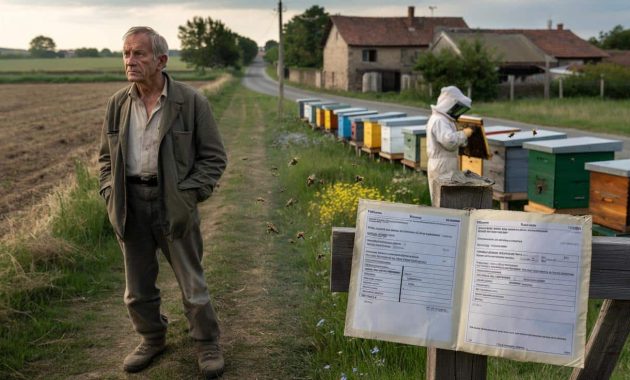
The retiree stands at the edge of his field, hands in the pockets of a worn jacket, watching bees disappear into their wooden hives. The land has lain almost useless for years. So when a local beekeeper asked if he could place a few boxes “just for the flowers”, it felt like a win for everybody. No rent, no contract, just a handshake and the quiet satisfaction of doing something good for nature.
Months later, the only thing that lands in his mailbox is not honey, but a tax bill. Agricultural tax. On activity he doesn’t carry out. On income he never earned.
The bees hum peacefully in the distance. The tax office hums too, but in another tone.
Why the good deed turns into a tax notice
At first glance, the story sounds almost absurd. A retired homeowner, no longer farming his land, simply lends a small plot to a beekeeper so the man can place his hives and keep his activity alive. No money changes hands. No produce is sold by the landowner.
Yet the taxman looks at that same plot and doesn’t see generosity. He sees land used for an agricultural purpose. Under many national tax systems, that single detail is enough to trigger an agricultural land tax, even if the owner’s only real involvement is handing over the gate key.
Picture it in a small village. The retiree, let’s call him Bernard, has half a hectare of old pasture he no longer uses. A neighbor, Julie, is a young beekeeper fighting to keep her activity afloat. She can’t afford to buy land, and the environmental talk in the village is all about protecting pollinators.
Bernard says yes, of course, place your hives here. Months pass. The flowers buzz, the neighbors are proud, and schoolchildren come to see the bees. Then one spring, Bernard opens a letter that recalculates his land as “under agricultural use” and assigns a corresponding tax category. His pension hasn’t moved. The bill has.
Legally, the logic is clean. Tax authorities don’t focus on who pockets the revenue, but on how the land is classified and used. If a piece of land hosts hives, crops, animals or equipment tied to farming, it tips into the agricultural box. That box comes with its own tax rules.
The law also tends to assume that any such use is part of some economic activity, even if the owner swears there’s no rent and no contract. The risk, from the administration’s point of view, is that people might hide real business activity behind “friendly loans”. So the system is designed to be blind to nuance, and that’s where stories like Bernard’s are born.
How to lend land without getting stung (too much)
There are ways to soften the impact, even when rules feel stubborn. The first one is surprisingly simple: talk to the local tax office before agreeing to anything on your land. Explain the project in plain words. Is it a few hobby hives, a semi-professional beekeeper, or a full commercial operation?
➡️ “A world first”: South Korea develops plasma torch that could revolutionise plastic recycling
➡️ A bay leaf under the pillow: The small night routine I once mocked – until it changed my sleep
➡️ NASA confirms new propulsion tests that could allow interstellar travel within a human lifetime
➡️ Physicists discover a quantum system that refuses to heat up
➡️ “I was losing $90 a month without even noticing it”
➡️ Why walking barefoot at home can improve balance over time
Sometimes, a written clarification on how the land is classified can avoid surprises later. In some regions, very small or non-commercial uses might stay in a more favorable tax category. The only way to know is to ask when the bees are still only an idea, not once the bill is already printed.
The second reflex is to put the relationship with the beekeeper on paper, even if it feels stiff compared to a friendly handshake. A simple written agreement can state clearly that the beekeeper is the one running the agricultural activity, not the landowner. It can also mention who pays which tax or charge if the classification changes.
We’ve all been there, that moment when you tell yourself “we’re neighbors, we trust each other, that’s enough.” Then one day you discover that trust doesn’t weigh very much against a legal form or a tax grid. Let’s be honest: nobody really reads the whole tax code before saying yes to a couple of hives.
“I just wanted to help the bees and my neighbor,” Bernard says, “and suddenly I’m treated like I started a farm. I didn’t sign up for that. I signed up to be kind.”
- Clarify the use of the land
Write, in one page, what the beekeeper will do, for how long, and at what scale. - Check local exemptions
Some regions offer reduced tax or relief for small plots, retired owners, or environmental projects. - Talk about money, even if there is none
Specify that there is no rent, or if there is, who declares what. It avoids suspicion later. - Contact farmer or beekeeping unions
They often know real-world arrangements that coexist with tax rules. - Reassess every few years
If the number of hives explodes, or the beekeeper’s business grows, the tax impact can change too.
When fairness, responsibility and quiet battles collide
On paper, the rule is neutral. Land used for agriculture is taxed as such. The administration doesn’t see age, intention, or generosity. It just sees a category, and a line in a database.
For the retiree, though, the story feels less neutral and more like a penalty on goodwill. He doesn’t feel like a farmer. He feels like someone who said yes so that bees would have a place to fly, and a younger neighbor could try to make a living.
The deeper question hiding behind the tax notice is about responsibility. Who should carry the cost of environmental or local solidarity efforts? Should the retired landowner absorb a new tax for the sake of biodiversity? Or should the beekeeper’s activity, even small, carry the load?
Some argue that if the land is part of a real business, that business must logically shoulder the related costs, possibly through a clearer lease or revenue-sharing agreement. Others answer that pushing every good deed into a contract world slowly suffocates spontaneous help between neighbors.
There’s a bigger tension too, between public speeches and private realities. Governments praise pollinators, local food, and citizen initiatives. But the tax grid, often decades old, was built for large fields and formal farms, not for a couple of hives on a retired teacher’s meadow.
*The result is a grey zone where people act from the heart, and the system replies with accounting tables.* That doesn’t mean the tax is “wrong” in a strict legal sense. It does mean that the emotional bill, in terms of trust and willingness to help others, is harder to measure.
Some retirees will quietly pay. Others will say “no more hives, no more trouble”, and that small, invisible loss may be the most costly thing of all.
| Key point | Detail | Value for the reader |
|---|---|---|
| Understand land use classification | Tax applies to how land is used, not just whether you earn money | Helps anticipate hidden costs of “simple” favors |
| Put neighborly deals in writing | Short agreements can clarify who runs the activity and who pays what | Reduces the risk of surprise tax notices and conflict |
| Think long-term before saying yes | Hives or crops can change your tax profile for several years | Lets you balance generosity, budget, and peace of mind |
FAQ:
- Question 1Can I avoid agricultural tax if I prove I earn no income from the beekeeper?
- Question 2Does a tiny number of hives on my land automatically change its tax status?
- Question 3Would a symbolic rent or formal lease change who is considered the “farmer” for tax purposes?
- Question 4What should I ask the beekeeper before agreeing to host hives?
- Question 5Is it safer to refuse any agricultural use of my land once I’m retired?