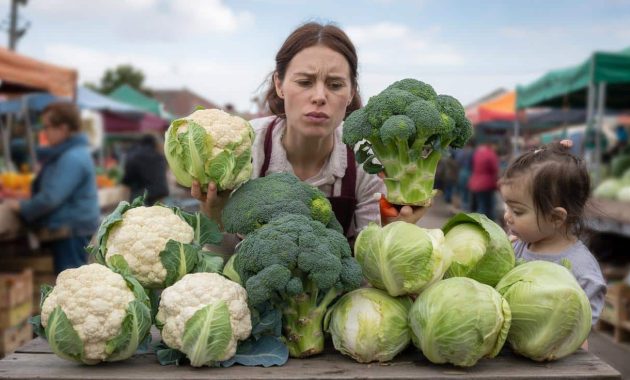
The woman in front of me at the farmer’s market squinted at the crates, visibly puzzled. “So… broccoli is just green cauliflower, right?” she asked the vendor, holding a huge white head in one hand and a dark green tree of florets in the other. A kid tugged at her sleeve, pointing at a pile of shiny cabbage. “Can we get that too?” he said. The mother laughed. “We can’t eat the same thing all week.”
The stallholder smiled, leaned forward, and dropped the quiet bomb: “Joke’s on you. They’re all the same plant.”
That sentence hung in the air, heavier than the bags of vegetables. People glanced at each other, then back at the crates, as if they’d just been told the tomatoes and the peaches were cousins. The truth is we walk past this botanical plot twist every day.
Wait, they’re all the same plant?
At first glance, cauliflower, broccoli, and cabbage look like three completely different characters in the vegetable world. One is a pale brain, another a little forest, the third a tight green ball. On the plate, they don’t feel related at all. One goes in gratins, the other in stir-fries, the last in coleslaw and winter soups.
Yet biologically, they all trace back to the same wild ancestor: Brassica oleracea, a scruffy coastal plant that still grows on cliffs around the Atlantic. It doesn’t look impressive. Few leaves hugging the rocks, salty spray, wind. Over centuries, humans quietly sculpted that modest plant into very different silhouettes.
Picture the first farmers along the European coasts, thousands of years ago, noticing that some wild cabbages had slightly thicker leaves. Others had a more swollen stem. Some formed tighter clusters of buds. They kept seeds from the plants they liked best, season after season, without a genetics lab or fancy terminology. Just observation, patience, and hunger.
Over time, their preferences split the same species into many “vegetable personalities”. Choose for big flower buds, you move toward broccoli and cauliflower. Decide you love compact leaves, you head toward cabbage. Focus on swollen stems or leaf stalks, and you get kohlrabi or kale. One species, endless variations, all shaped by human hands and appetites.
From a botanical point of view, cauliflower, broccoli, and cabbage are not just “related”; they are literally different cultivars of the same species, like dog breeds derived from wolves. They can cross-pollinate. They share the same basic chromosome set. The big differences we see are the result of tiny changes in the way the plant grows and where the energy goes: to leaves, to flowers, to stems.
This is why seed catalogues group them together under “brassicas” or “cole crops”. Same family, same needs, same enemies in the garden. Once you see it, you cannot unsee it. The supermarket aisle suddenly looks less like a random assortment and more like one extended family photo.
How farmers “designed” cauliflower, broccoli, and cabbage
If you want to feel this shared origin in your hands, start with the simplest gesture: cutting them. When you slice open a cabbage, you see a tight spiral of leaves around a central core. Now cut a cauliflower. The white curd is actually a densely packed mass of flower buds attached to a thick stem. Broccoli? Same idea, but the buds are looser, forming small trees on branching stalks.
➡️ Light fast apple cake made with oil and yogurt for effortless desserts
➡️ Extend your battery life: simple charging tips
➡️ After Pausing BRICS, Saudi Arabia Invests $600 Billion in the US
➡️ Why vets are increasingly warning dog owners about tennis balls
➡️ Scientists observe climate tipping signals emerging earlier than expected
➡️ A sunny corner, five well‑chosen plants and the butterflies move in for the season
Look closely and you’ll notice the same pattern repeating. The way the veins spread. The smell when you cut through the stem. The slightly waxy feel of the outer layer. It’s like recognizing the same nose on three different siblings’ faces.
One seed company technician told me about a day spent in a trial field, walking between rows: cabbages on the left, broccoli in the middle, cauliflowers on the right. Under a grey sky, they all had that same bluish-green tone, the same thick leaves curling downwards. At some point, she stopped labeling them in her mind. They just became many versions of one idea.
We’ve all been there, that moment when you suddenly spot a family resemblance between two people you thought were strangers. That’s what happens once you know about *Brassica oleracea*. You start seeing the plant—not just the product. A statistic that often surprises people: globally, the “cole crops” group, including these three, represents tens of millions of tons of food each year, all descending from that one humble seaside species.
The logic behind their shapes makes more sense when you think like a hungry farmer. Want more food from the same plant? You amplify a part that’s easy to cook or store. Cabbage became a living pantry of overlapping leaves. Cauliflower is a captured, swollen flower head, frozen in place before it can bloom. Broccoli was industrialized tenderness: many small bites of immature flowers, ready to be steamed or sautéed.
*Let’s be honest: nobody really thinks about evolutionary strategy when they throw frozen broccoli into a pan on a Tuesday night.* Yet that’s exactly what’s on the plate—a story of selection, time, and a quiet negotiation between human taste and plant survival.
How to cook and use “one plant, three vegetables” like a pro
Once you see them as variations on the same theme, something shifts in the kitchen. You begin to swap one for another with more confidence. Got no broccoli for a stir-fry? Slice cabbage into thin ribbons and toss it in a hot pan with garlic and soy sauce. No cauliflower for a roast? Big chunks of broccoli stems, peeled and oiled, caramelize just as beautifully.
A simple method: treat them by texture, not by name. Firm hearts (cabbage cores, thick stems) love long braises and roasts. Tender florets and leaves are happier with quick heat—stir-fry, steam, flash-roast. Think in minutes, not recipes. If a piece is dense and white, give it time. If it’s green and delicate, keep it brief.
People often throw away the parts that actually reveal their shared origin: the stems and outer leaves. That’s where they’re closest to the original wild plant. You don’t have to feel guilty if you’ve been binning them. Nobody explains this when you first learn to cook.
Peel the fibrous outer layer of broccoli and cauliflower stems, slice the tender center, and cook it like the florets. Shred cabbage cores very finely and toss them into fried rice or soup. The hidden bonus: less food waste, more flavor, and a deeper sense that you’re using the whole plant, not just the pretty bits.
At a cooking workshop I attended, the chef stopped mid-demo, holding a handful of broccoli leaves and cabbage ribs. He said:
“Once you understand these are all the same plant, you stop asking, ‘Can I do this?’ and start asking, ‘How do I cook this part so it tastes good?’”
Then he wrote on the board a boxed list of ideas:
- Use cabbage and cauliflower leaves like kale chips: oil, salt, hot oven, 10 minutes.
- Roast broccoli and cauliflower stems with spices, not just the florets.
- Ferment shredded cabbage and broccoli stalks together into a crunchy pickle.
- Mix all three in a single sheet-pan roast for deeper, layered flavor.
- Save odds and ends for a weekly “brassica soup” with stock and herbs.
These small shifts turn random vegetables into a coherent, flexible pantry built around one very adaptable plant.
The quiet power of knowing what’s on your plate
Once you’ve been let in on the secret, a supermarket display of cruciferous vegetables feels strangely intimate. That mountain of cabbages, the neat stacks of broccoli, the white heads of cauliflower under plastic film—they’re not just choices. They’re echoes of the same original plant, tugged in different directions by centuries of taste and necessity.
It doesn’t suddenly make dinner more complicated. If anything, it simplifies things. You can relax around substitutions, invent recipes based on what’s cheap or seasonal, and feel a little less trapped by strict ingredient lists. Knowing they share so much DNA gives you permission to improvise.
This kind of connection also changes the way you look at agriculture. That cliff-dwelling wild cabbage never “intended” to become a cauliflower. Yet here we are, building diets and economies on the back of a few carefully nudged genes. It’s both slightly unsettling and strangely reassuring. We are not as distant from the land, or from the past, as a fluorescent supermarket aisle might suggest.
Maybe this is the quiet gift of understanding that cauliflower, broccoli, and cabbage are one plant wearing three costumes. You start to notice patterns, not products. You feel a line stretching from your cutting board to a windswept coastline and the hands of people who selected seeds long before any of us were born. And you might just tell the next person who says “I don’t like cabbage, but I love broccoli” that they’re arguing with the same old plant.
| Key point | Detail | Value for the reader |
|---|---|---|
| One species, many vegetables | Cauliflower, broccoli, and cabbage are cultivars of Brassica oleracea | Changes how you see and combine them in cooking |
| Shared structure | Similar stems, leaves, and flower buds arranged in different ways | Helps you use “forgotten” parts like stalks and cores |
| Flexible cooking | Treat by texture (dense vs. tender) rather than by name | Makes substitutions easy, reduces waste, boosts flavor |
FAQ:
- Are cauliflower, broccoli, and cabbage really the same plant?They are all cultivated forms of the same species, Brassica oleracea, selectively bred over centuries for different parts: leaves (cabbage), flower buds (broccoli, cauliflower).
- Do they have the same nutrients?They share a similar nutritional base—fiber, vitamin C, and protective plant compounds—but amounts vary. Broccoli, for example, tends to be richer in certain antioxidants, while cabbage shines in fermented dishes for gut health.
- Can I swap one for another in recipes?Often, yes. Think about texture and cooking time. Cabbage stands in well for broccoli in stir-fries if sliced thin, and broccoli or cauliflower can replace cabbage in soups and braises with slight adjustments.
- Why do some people digest them poorly?All three contain fibers and sulfur compounds that can cause gas in sensitive people. Gentle cooking, smaller portions, and pairing with spices like cumin or fennel often makes them easier to handle.
- Are there other vegetables from the same species?Yes. Kale, Brussels sprouts, kohlrabi, and savoy cabbage are also variations of Brassica oleracea, each selected for a different part of the plant or a different texture.