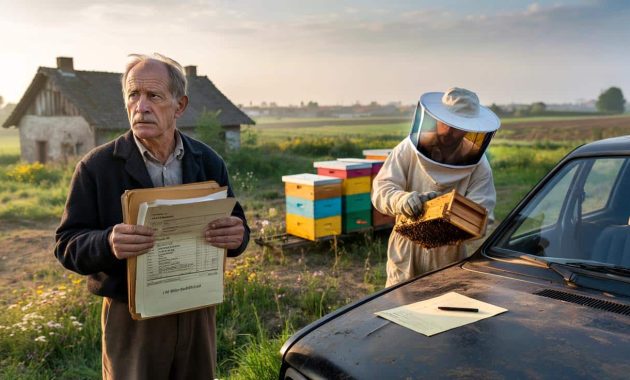
The bees arrived at dawn, humming like a low motor in the mist. Jean, 68, watched the young beekeeper unload his hives at the edge of his small field, the same land he’d mowed by hand before his knees gave out. No contract, no fuss, just a handshake on the hood of a dusty Clio: “You lend me your land, I give you jars of honey. No money, no problems.”
Months later, the letter fell on his doormat like a stone. Tax inspection. Hidden income. Possible requalification of his “friendly arrangement” as a rental business. The beekeeper was told to move the hives. Jean was left with a knot in his stomach and a thick envelope of forms.
All this, for bees that never even stung anyone.
When a few hives turn into a legal minefield
On paper, the deal sounded almost poetic. A young beekeeper, shut out of expensive farmland, finds a retired couple with a spare plot and a taste for nature. He places twenty hives there, promises to mow a bit, maybe prune some shrubs, and pays them in golden jars of honey. Friendly, local, win-win.
Then the tax office gets involved. Suddenly, what felt like mutual aid starts looking, in the cold language of bureaucracy, like undeclared rent, disguised remuneration, or even agricultural activity. The words sound heavy, distant. But they land in real lives.
Ask around in rural Facebook groups or local forums and you’ll hear the same kind of story. A landowner who “just wanted to help out” called in by the tax administration. A small beekeeper questioned about where his hives are, on what status, with what contract.
Often, it starts with something banal. A neighbor complains about bees near a path. An inspector cross-checks agricultural declarations. Or a notary, prepping a sale or an inheritance, spots hives in a corner of the land on satellite imagery and raises a red flag.
What was once an invisible, almost romantic arrangement suddenly becomes a “case”.
Behind this, there’s a simple, cold logic. When land is occupied, even by hives, the law wants to know who has what rights. Tax agencies want to know who benefits. Neighbors want to know who’s responsible if something goes wrong.
The problem is that the law doesn’t really speak the same language as people in the countryside. Where one side says “a bit of land for your bees, don’t worry about it”, the other sees “use of property, potential rent, undeclared advantage in kind”. The gap between the two creates the perfect storm: confused retirees, anxious beekeepers, and a bitter feeling that common sense is being exiled.
➡️ Psychology explains why emotionally intelligent people often prefer fewer but deeper relationships
➡️ A sunny corner, five well‑chosen plants and the butterflies move in for the season
➡️ Why your body needs pauses just as much as movement
➡️ Meteorologists warn early February could trigger a high risk Arctic breakdown scenario
➡️ Hairstyles after 50 that no one can agree on the most controversial cuts to look younger in 2026
How a simple “put your hives here” can quietly slip off the rails
The first quiet trap lies in the word “nothing”. “We don’t want anything, just take care of the land,” many owners say. Except mowing, pruning, and “keeping the land tidy” are technically services. And a service has a value.
Tax and social administrations love value. They can consider that the beekeeper is paying rent in kind, or that the owner is receiving a benefit not declared as income. One letter, one audit, and the entire relationship suddenly needs a paper trail. A land-use agreement. Maybe a symbolic rent. A line in the tax return that nobody had imagined.
The second trap is even more subtle: time. At the beginning, the beekeeper is “just passing through for a season or two”. Then the hives stay ten years. A shed gets added for equipment. A water tank. A little fence.
Little by little, that corner of land looks less like a favor and more like a permanent installation. That’s where lawyers start using words like “agricultural lease”, with strong protections for the farmer and big consequences if the owner wants the land back. The retired couple who thought they were helping “a young lad starting out” discover they might need a formal eviction process. And potentially, fees.
The third trap comes when everyone tries to fix things too late. Someone advises, half-whispered, “Just say it was family help. Or that he didn’t pay anything.” Others suggest backdating a contract. Panic never leads to good paperwork.
That’s how small misunderstandings slide into real risks: tax reassessments, fines, even suspicion of fraud. A plain-truth sentence sits in the middle of this mess: nobody reads the legal fine print before saying yes to a few beehives. And yet, those first five minutes of clarity are what could spare months of anxiety down the road.
Turning a handshake into something that actually protects you
There is a simple gesture that changes everything: sit at the table before the first hive touches the ground. Two chairs, two coffees, one sheet of paper. On it, write the basics in clear terms: who owns the land, who owns the hives, what each person gets, and what happens if one wants to stop.
This doesn’t need to be a 20‑page contract in legalese. It can be a land-use permission, limited in time, with a few concrete lines: “Use of 300 m² for 10 hives”, “No rent, no services in exchange”, “Can be ended by either party with three months’ notice.” Then both sign, and each keeps a copy with their tax papers. Modest, but solid.
The biggest mistake is pretending “we’ll never have problems”. We’ve all been there, that moment when trust feels strong enough to skip the awkward part. Then someone falls ill, children inherit the land, or a neighbor files a complaint because a grandchild was stung. Suddenly, the original goodwill is no longer enough.
Another classic mistake is mixing everything together. The beekeeper who does occasional gardening “to say thank you”, uses the barn for storage, and pays a small amount “for electricity”. Each layer creates a trail that can be read as rent, employment, or undeclared work. *What started as rural solidarity slowly looks, on paper, like a makeshift business with no structure.*
Sometimes, the people involved only realize the fragility of their arrangement when a notary, a tax officer, or even a bank advisor says, dryly: “On what basis are these hives here?”
- Separate friendship from the legal frame
You can keep the warmth of the relationship and still put things in writing. The paper doesn’t kill trust, it preserves it when memories diverge. - Use clear, modest contracts
A basic written permission, dated and signed, often avoids the “disguised rent” accusation. Mention if there is absolutely no financial advantage on either side. - Limit duration and scope
Define a surface, a number of hives, and a time frame (for example, 3 years, renewable). This makes it much harder for anyone to reclassify the deal as a full-blown agricultural lease later. - Talk to your tax person early
One short meeting with an accountant or local legal aid can be worth far more than a stack of explanatory letters sent in panic after an inspection. - Say no if you feel a knot in your stomach
If the beekeeper wants storage, electricity, a shed, plus services in exchange, you’re no longer in the realm of “simple land for honey”. It’s fine to draw a line.
A story of bees that reveals something bigger about us
This “banished beekeeper, betrayed retiree” story hurts because it feels like a symptom. On one side, a younger generation locked out of land, trying to invent small, local ways to work with nature. On the other, owners who have some space and a desire to help, but who feel hunted by forms, codes, and tax letters. Between them, a system that often sees only risks, categories, and boxes to tick.
The debate has already spilled onto social networks and into village cafés. Some accuse the state of suffocating common sense. Others remind us that controls exist to stop abuse and backdoor land grabs. Both have a point, and that’s exactly why the country seems split: we want both solidarity and security. We want informal help and clear rules. Sometimes, we even want them in the same sentence.
Maybe the quiet lesson hiding among the hives is that “just between us” doesn’t work so well anymore when property, land, and money get close to each other. The old handshake culture isn’t dead, but it needs a small, humble companion now: the written line that says plainly what we’re doing together.
Some will find that sad, others reassuring. Yet if a simple one‑page agreement can keep the bees, the retiree, and the tax office all reasonably calm, maybe that’s not the worst compromise. The real debate might not be about bees or taxes at all. It’s about how we want to organize trust in a world where everything leaves a trace.
| Key point | Detail | Value for the reader |
|---|---|---|
| Clarify the deal from day one | Write a short, dated permission for land use with clear limits | Reduces risk of tax or legal reclassification later |
| Separate favors from “payment in kind” | Avoid systematic services or advantages in exchange for land | Helps avoid hidden rent or undeclared income accusations |
| Accept that trust and paperwork can coexist | Use simple agreements without killing the human relationship | Protects friendships, families, and small beekeepers when trouble comes |
FAQ:
- Question 1Can offering a plot for hives really create tax problems for a retiree?
- Question 2Does receiving a few jars of honey count as undeclared income?
- Question 3How can a beekeeper avoid the risk of an “agricultural lease” being imposed?
- Question 4Is a handwritten contract between owner and beekeeper legally valid?
- Question 5What should I do if the tax office contacts me about hives on my land?