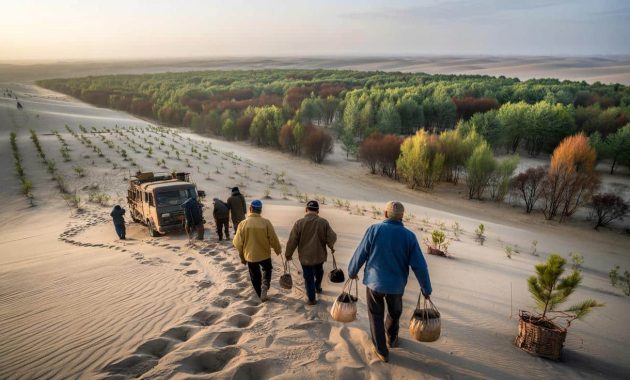
The sun hasn’t yet climbed over the dunes when the planting crew steps off the bus in Ningxia. Their breath comes out in clouds, boots crunching over dry, powdery sand where, a few decades ago, there was still grass. They move in a line, each person with a sack of saplings on their back and a metal dibble in their hands, tracing a green grid on a beige planet. A few meters away, wind whips at a row of older pines, bending them slightly toward the advancing desert.
No one speaks much. Someone’s phone plays a pop song, thin and tinny in the morning air.
This, multiplied by thousands of mornings and tens of millions of hands, is China’s answer to a creeping desert that doesn’t sleep.
China’s giant bet: a living wall against a moving desert
On satellite images, northern China looks like a slow-motion collision between two worlds. Pale yellows and reds of sand seas push southward, while broken bands of green try to hold the line. That green is the **Three-North Shelter Forest Program**, better known as China’s “Great Green Wall.” Launched in 1978, it aims to plant tens of billions of trees across 4,500 kilometers, from Xinjiang in the west to Heilongjiang in the northeast.
The goal sounds almost mythical: tame the Gobi and other deserts with roots and leaves, not concrete and steel.
On the ground, the project looks far less heroic and far more ordinary. In Inner Mongolia’s Kubuqi Desert, villagers who once raised sheep now spend seasons pushing seedlings into the sand, row after row. Some are paid per surviving tree, not per tree planted, a small tweak that has quietly changed behavior. Monitoring drones fly overhead, mapping patches where survival rates have climbed from under 15% in the 1980s to more than 60% in some reforested zones.
Dust storms that used to blanket Beijing for days have become less frequent and less intense, according to Chinese meteorological data from the 2000s onward. People in the capital still remember those “yellow sky” days like a bad seasonal habit the city is slowly breaking.
Scientists point out that the Green Wall is less a single line of trees and more a mosaic of forests, shrubs, grasslands, and shelterbelts around farms. That might sound technical, but it matters. Early years focused heavily on monoculture plantations, especially fast-growing poplars. These stands absorbed sand and wind, yet they also guzzled water and proved vulnerable to pests.
Recent policies lean toward mixed species, drought-tolerant shrubs, and restoring native steppe. The logic is simple: ecosystems that resemble what once grew there tend to live longer than plantations that look good only in the first five years. Desertification is a slow process; fighting it with patience instead of quick fixes is the new mantra.
How you “plant” a wall that stretches across a continent
On paper, the method looks straightforward: identify degraded land, dig holes, add seedlings, repeat. Out there in the dust, it’s a choreography of timing, water, and guesswork. Planters in Ningxia or Gansu often work in pairs: one digs, one presses seedlings into the earth and covers their roots with a thin ring of slightly wetter soil. They plant in grids or staggered lines that break the wind before it can pick up speed near the ground.
➡️ A400M: Airbus bets on a “mother ship” aircraft for drones
➡️ Hygiene after 65 : not once a day, not once a week, shower frequency that keeps you thriving
➡️ Scientists observe a sudden change in volcanic gas emissions without eruption signs
➡️ Why some people feel uncomfortable receiving help, according to psychology
➡️ Almost one in two people will develop cancer in their lifetime, says Robert Koch Institute
➡️ Bad news for balcony bird lovers: this “harmless” winter habit may be slowly killing songbirds
Many saplings arrive pre-treated, with root systems wrapped in biodegradable film to keep moisture. Others are grown in small local nurseries that have become employers in towns that were losing people to the cities.
The big mistake of the early Green Wall years was treating the desert like a blank canvas. It isn’t. It’s a system already in motion. Planting willows in deep sand where groundwater sits far below? They die. Covering grassland that only looks “barren” with dense forests? You risk killing steppe grasses that held the soil better than the new trees ever will.
Policy has been adjusting. Ecologists now warn against “green blindness”—the temptation to judge success by leafiness alone. The Chinese government has started to categorize land by what it can actually support: forest, shrubland, grassland, or, in some cases, spaces that should be left as desert because that’s what naturally belongs there. *Not every brown patch needs a tree.*
Local forester Zhang Wei, who has worked in Inner Mongolia since the 1990s, sums it up in one line: “We didn’t understand at first that the desert also has rules. Once we started listening, more trees survived.”
- Plant slow, not just big: Long-term survival data now matters more than annual planting targets.
- Mix species and heights: Combining shrubs, grasses, and trees creates layered protection against wind and erosion.
- Follow the water, not the map: New projects align more closely with groundwater and rainfall patterns.
- Pay for care, not only for planting: Some regions tie income to tree survival, changing incentives on the ground.
- Respect natural desert zones: Part of the “wall” is accepting that some dunes will stay dunes.
Between ambition and limits: what this Green Wall really changes
Step back, and the Green Wall is both breathtaking and messy. China says more than 66 billion trees have been planted under the project since it began, though outside researchers debate the numbers and survival rates. Satellite analyses from UN and independent teams do show a clear trend: the country is one of the few on Earth where total tree cover has grown since the 1990s, much of it in the north.
People living there notice the difference less in graphs and more in daily details. Less dust on windowsills. Fewer days where the sky turns a gritty gray. Slightly cooler microclimates around older shelterbelts.
At the same time, critics warn that planting trees can’t be a magic eraser for deeper pressures. Overgrazing, intensive farming, and overuse of groundwater all dry out soils. If those practices don’t change, trees become a thin green band over a landscape still losing its moisture. Let’s be honest: nobody really changes land habits overnight just because a policy document says so.
We’ve all been there, that moment when a big, inspiring plan crashes into the stubborn reality of how people actually live and work. In parts of Inner Mongolia, bans on grazing to protect new forests have pushed herders into financial corners. Some leave, others quietly bring animals back at night, and the land has to absorb those contradictions too.
The emotional power of the “Great Green Wall” label is obvious. It echoes another wall built to keep things out. This time, it’s sand and dust instead of invading armies. Yet what’s really emerging is less a rigid barrier and more a negotiated boundary between human ambition and ecological limits. Chinese scientists now share data with Sahel countries attempting their own Great Green Wall in Africa, swapping notes on wind patterns, tree survival tricks, and the politics of planting in poor regions.
The desert will keep moving; climate change tilts the odds in its favor with hotter, drier seasons. But the story unfolding in northern China suggests something quieter than victory and less dramatic than defeat. A long, patient argument with the sand, carried out one seedling, one season, one storm at a time.
| Key point | Detail | Value for the reader |
|---|---|---|
| Scale of the Great Green Wall | 4,500 km band, tens of billions of trees planted since 1978 | Grasp the sheer ambition behind China’s desert-control experiment |
| Evolving methods | Shift from monoculture plantations to mixed, drought-resistant ecosystems | Understand why quality of planting now matters more than raw numbers |
| Real-world impacts and limits | Reduced dust storms, but ongoing water stress and land-use conflicts | Gain a nuanced view of what large-scale tree planting can and cannot do |
FAQ:
- Question 1What exactly is China’s “Great Green Wall”?It’s a vast reforestation and land-restoration project, formally called the Three-North Shelter Forest Program, designed to slow desertification across northern China with forests, shrubs, and grasslands.
- Question 2Has the Great Green Wall reduced dust storms?Chinese meteorological data and independent studies indicate that major dust events affecting cities like Beijing have become less frequent and severe since large-scale planting began, though other factors like industrial changes also play a role.
- Question 3Do all the trees planted actually survive?No. Early phases saw very low survival rates, sometimes below 20%. Improved species choices and planting techniques have raised survival in many areas, but long-term success still varies a lot by region and water availability.
- Question 4Is planting trees always good in desert regions?Not necessarily. Planting the wrong species, too densely, or in places with almost no water can stress ecosystems and waste resources. Many experts now advocate restoring native grasslands and shrubs instead of forcing forests everywhere.
- Question 5Could other countries copy China’s approach?Parts of it, yes. The mix of long-term planning, local incentives, and evolving science is already inspiring projects from the Sahel to Central Asia. But each region needs its own version, tuned to local climate, culture, and water, not a one-size-fits-all wall of trees.