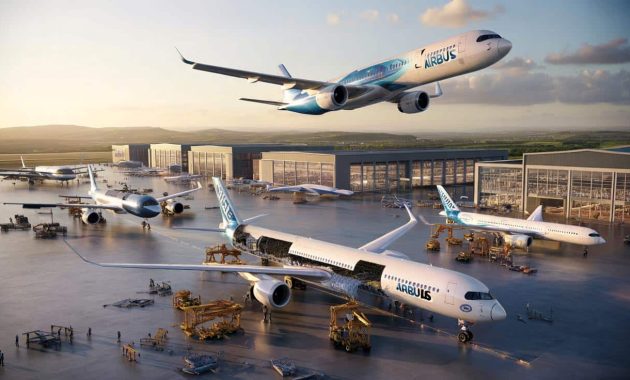
The European aircraft maker has just taken a decisive step in its long-running rivalry with Boeing, snapping up six key Spirit AeroSystems plants across four countries in a bid to regain control over some of its most critical parts.
Airbus tightens its grip on its own supply chain
On 8 December 2025, Airbus finalised the acquisition of six major Spirit AeroSystems sites in the US, UK, France and Morocco.
The €377 million deal (about $439 million) gives Airbus direct control over production of vital components for its A220, A320, A321 and A350 programmes.
For years, Airbus had depended on Spirit for large fuselage sections, wing structures and pylons – the structures that attach engines to the wings. Those parts may be invisible to passengers, but any delay or quality issue there can freeze an entire production line.
Airbus is not just buying factories; it is pulling back inside its walls some of the most sensitive links in its industrial chain.
This move reflects a clear goal: reduce dependence on external suppliers, especially US-based ones, and secure the ramp-up of its most promising aircraft.
Who is Spirit AeroSystems and why does it matter?
Spirit AeroSystems is hardly a household name, yet its footprint runs through much of global aviation.
The company was created in 2005 when Boeing sold its Wichita Division to Canadian investment fund Onex. The business itself traces its roots back to the early days of aviation in the 1920s.
Today Spirit ranks among the largest aerospace subcontractors in the world, with more than 20,000 employees and factories on several continents.
➡️ No more hair dye: the new trend that covers grey hair and makes you look younger
➡️ If you feel uncomfortable being vulnerable, psychology explains what your mind is protecting
Its work includes fuselages, wing structures and pylons for multiple manufacturers, including Boeing, Airbus and Bombardier. If you have flown in a modern jet in the last decade, there is a strong chance some part of that aircraft came from a Spirit facility.
The six sites now moving under Airbus control
Airbus has not bought Spirit outright. Instead, it cherry-picked the sites tied most closely to its own programmes.
- Kinston, North Carolina (US): builds fuselage sections for the A350 long-haul jet.
- Saint-Nazaire, France: another A350 fuselage facility, now folded into Airbus Atlantic under the Cadréan name.
- Casablanca, Morocco: produces components for the A220 and A321, now operating as Airbus Atlantic Maroc Aero.
- Belfast, Northern Ireland: manufactures A220 wings and centre fuselage sections, rebranded Airbus Belfast.
- Prestwick, Scotland: builds wing elements for the A320 and A350, now part of Prestwick Aerosystems.
- A220 pylons: work historically done in Wichita, Kansas will be transferred to Airbus’s Saint-Éloi site in Toulouse.
These sites now form a new industrial belt tightly tied to Airbus’s commercial aircraft unit.
| Location | Country | Main production | New Airbus entity |
|---|---|---|---|
| Kinston | United States | A350 fuselage sections | Airbus Aerosystems Kinston |
| Saint-Nazaire | France | A350 fuselage sections | Airbus Atlantic Cadréan |
| Casablanca | Morocco | A220 and A321 components | Airbus Atlantic Maroc Aero |
| Belfast | United Kingdom | A220 wings and centre fuselage | Airbus Belfast |
| Prestwick | Scotland | A320/A350 wing elements | Prestwick Aerosystems |
| Wichita → Toulouse | US → France | A220 pylons | Saint-Éloi, Toulouse |
4,000 workers, skills and habits now under the Airbus banner
The transaction is not just about buildings and machines. Around 4,000 Spirit employees will now wear Airbus badges.
They bring with them manufacturing skills, site culture and production routines built up over decades. Those assets are often harder to absorb than hardware.
Airbus executives present the deal as a way to get closer to the shop floor and reduce layers between design teams and the people actually building the parts.
Instead of pushing suppliers to speed up from a distance, Airbus now has to manage those bottlenecks from inside its own organisation.
The challenge will be integration: harmonising processes and standards without crushing local expertise that keeps these plants efficient.
Why Airbus wants less subcontracting and more control
Since the pandemic, commercial aviation has faced wild swings in demand. Airframers first slashed production, then had to ramp up again as travel rebounded.
That stop-start pattern exposed how fragile long supply chains can be. When just one subcontractor struggles with cash, staffing, or materials, deliveries of finished aircraft can slip by months.
Airbus has felt this pain on narrow-body programmes such as the A320neo and, increasingly, on its newer A220 line.
The A220, originally designed by Bombardier as the CSeries, sits in a sweet spot between regional jets and standard single-aisle aircraft. Airlines value its fuel burn and cabin comfort.
The A350, meanwhile, anchors Airbus’s long-haul offer against Boeing’s 787 Dreamliner. Every delay on A350 fuselage or wing structures hits a highly visible segment of its business.
By internalising work on wings, pylons and fuselage sections, Airbus aims to secure volumes, stabilise schedules and cut the risk of late penalties with airlines.
A tighter balance with the US and Boeing
The deal also shifts the balance of power around Spirit itself.
Spirit will continue to exist, but with a smaller footprint and a much sharper focus on Boeing as its key customer.
For Airbus, buying the Spirit sites reduces its reliance on a US-based supplier that has long sat closer to Boeing in terms of history and geography.
This does not cut Airbus off from the US entirely, but it gives the European group more autonomy on critical aircraft structures at a time when industrial and political tensions can easily spill into trade.
What the €377 million price tag actually covers
The reported value of the transaction stands at $439 million, or around €377 million.
That figure includes adjustments for inventory levels, the state of equipment and buildings, and certain contractual liabilities picked up by Airbus along the way.
In practical terms, Airbus has paid not just for physical assets but for the right to secure future cashflows tied to aircraft already sold or under negotiation.
The company chose not to buy every Spirit site. It targeted only locations directly tied to Airbus programmes, leaving Spirit to reorganise around Boeing and other clients.
What this means for airlines and passengers
Airlines care less about who owns which factory and more about one thing: getting aircraft on time and on budget.
If Airbus succeeds in stabilising its industrial chain, carriers could see more reliable delivery schedules for A220s, A320 family jets and A350s.
That matters for fleet planning. A delayed long-haul aircraft can wreck route launches and force airlines to keep older, less efficient jets flying longer than planned.
For passengers, the changes remain invisible. You are unlikely to notice that your A350’s fuselage now comes directly from an Airbus-owned plant instead of a Spirit one. The effect shows up in indirect ways, such as more consistent cabin products if airlines receive their jets on time and can plan refits properly.
Key concepts behind the deal, explained simply
Two industrial ideas sit at the heart of this move: vertical integration and supply-chain risk.
Vertical integration means a company brings more steps of production under its own control instead of outsourcing them. Airbus used to design aircraft and rely on partners for many large structures. With these Spirit sites, it shifts a slice of that work in-house again.
Supply-chain risk covers all the ways things can go wrong between raw materials and finished aircraft: labour shortages, quality issues, transport delays or financial troubles at a supplier. By owning more of the chain, Airbus hopes to identify problems earlier and react faster, though it also takes on more responsibility and overhead.
There is a trade-off. More integration can improve coordination, but it also means Airbus must manage more staff, more equipment and more local politics, from North Carolina to Morocco.
What could happen next
Several scenarios now sit in front of Airbus:
- If the integration goes smoothly, Airbus could use the new sites to push production rates higher than suppliers alone could manage.
- If bottlenecks just shift inside Airbus, the group may find itself carrying more fixed costs without big gains in output.
- Competitors, including Boeing and China’s COMAC, will watch closely and may rethink their own mix of in-house production versus outsourcing.
For aerospace workers, this kind of move can cut both ways. Being inside a large, well-capitalised group like Airbus can protect jobs in downturns, but it can also bring stricter performance targets and restructuring if plants fail to hit them.
What is clear is that Airbus has chosen a path of greater industrial sovereignty, even at the cost of a bigger, more complex manufacturing footprint spread across Europe, North America and North Africa.