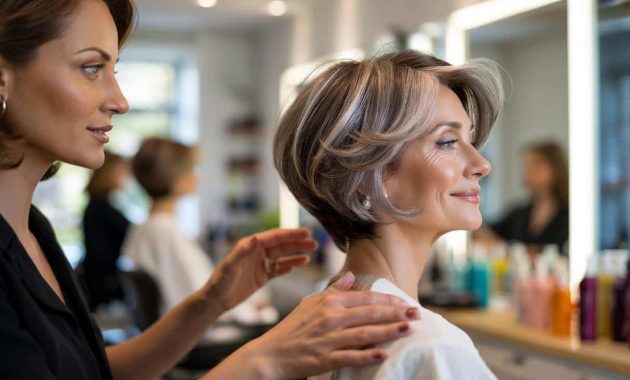
The other morning, a woman slid into my chair, dropped her bag with a sigh and said, “I turned 50 last week. Cut it. I’m done with long hair.”
Her voice had that mix of excitement and panic I know by heart. She tugged at her shoulder-length waves like they were a heavy winter coat in June.
Around us, the salon hummed: hairdryers, gossip, the faint smell of coffee and hairspray. I wrapped the cape around her and saw it in her eyes. She didn’t just want shorter hair. She wanted a new chapter that still looked like her.
That’s the secret nobody tells you: short hair at 50 isn’t about age. It’s about honesty.
The real reason so many women cut their hair at 50
I’ve been a hairdresser for more than 20 years, and there’s a pattern that walks into my salon almost daily. Around 50, long hair starts to feel like a costume from an old life.
Kids are grown, careers shift, faces change, and suddenly that long ponytail doesn’t match the woman in the mirror.
Some clients whisper, “Aren’t I too old for long hair?” Others confess they’re terrified of looking “mumsy” with a short cut.
They come in convinced there are only two options: keep their length and look “younger”, or chop it off and look “sensible”.
The truth sits somewhere else entirely. Short hair at 50 can be sharper, softer, lighter, stronger. It depends on one thing: your story, not your age.
Take Claire, 52, who came in with waist-length hair she hadn’t really worn down in years. She always had it piled into a messy bun, more out of habit than love.
Her friends told her, “Don’t cut it, men love long hair.” She rolled her eyes when she repeated that sentence to me.
We went for a textured bob just below her chin, with a soft side fringe skimming her cheekbones. Nothing extreme.
When I spun her towards the mirror, she lifted her hands to her hair and started laughing. “I actually look awake,” she said.
Two weeks later, she sent me a photo from a dinner with her daughters. No filters, just a grin and hair that moved.
She didn’t look younger. She looked more present.
There’s a simple reason this happens. As we hit 50, everything becomes a touch more visible: texture changes, volume shifts, the line between “effortless” and “tired” gets thinner.
Long hair can drag the face down when density isn’t what it used to be.
➡️ Lara Croft is back with two new Tomb Raider games, but something major has clearly changed
➡️ Gardeners urged to act now for robins with a 3p kitchen staple you should put out this evening
➡️ No bleach or ammonia needed: the simple painter-approved method to eliminate damp at home for good
Shorter cuts, when they’re right, pull the eye up. They frame cheekbones, open the neckline, lift the whole expression.
They also remove the driest, dullest lengths that hoard frizz and split ends.
*Short hair, on the right woman, is a strategic optical illusion as much as a style choice.*
It’s not about hiding age. It’s about redirecting attention to the features that still tell the clearest story: eyes, bone structure, smile.
How to choose the right short cut at 50 (from a hairdresser who’s seen the regrets)
Before the scissors even move, I always do the same thing with a client who wants short hair at 50.
I watch how she sits. How she touches her hair. How much time she spends looking at her phone while I talk about styling.
Then I ask three blunt questions:
“How much time will you really spend on your hair in the morning?”
“What do you always try to hide?”
“What do you secretly love about your face?”
Those answers matter more than any Pinterest board. A woman who admits she has five minutes most mornings should not walk out with a high-maintenance pixie that needs daily blow-drying.
The right short cut starts with your real life, not a filtered photo.
There are a few classic traps I see women fall into. The first is the “default short hair” offered at some salons: a round, helmet-like bob that sits at jaw level, too heavy and too smooth.
On a 50-year-old woman, that shape can harden the jaw and make the neck look shorter.
The second trap is copying a celebrity cut without translating it to your texture.
Fine, thinning hair cut too blunt can look flat and sparse. Very thick hair cut too short without layers can puff out and feel like a triangle.
And then there’s the emotional trap: cutting everything off in one go after a breakup, a health scare, or a big birthday.
Those cuts are rarely about style. They’re about shock. I always try to slow those clients down and go shorter in stages. Hair grows, yes. But those first weeks? They feel very long when you hate your reflection.
I often tell my clients, “Short hair at 50 is less about the length, and more about the lines.”
Where the cut hits your face can change everything. A bob that stops at the sharpest part of the jaw can make it look squarer. Ending just below that point softens it.
Here’s the plain truth: nobody really styles their hair exactly like the salon every single day.
So the cut has to work with air-drying, half-hearted blow-dries, and rushed mornings.
“Give me something that looks good even when I’m late,” one of my regulars, Anna, 55, always says.
We ended up with a layered bob hitting the collarbone, slightly shorter at the back, with texture through the ends.
She can tuck it behind her ears, wear glasses without disappearing behind her frames, and still feel polished on a Zoom call.
- Go slightly longer than you think if you’re nervous. You can always go shorter next visit.
- Ask for softness around the face: light layering or a long fringe can be gentler than a blunt line.
- Think “movement”, not “volume”: texture stops a short cut looking stiff.
- Match the cut to your neck and shoulders, not your age: open space there is incredibly flattering.
- Bring photos, but talk about what you like in them: fringe, texture, length, not “I want to be her”.
Living with short hair at 50: what nobody warns you about
Once the first shock of seeing hair on the salon floor passes, real life with short hair begins.
You notice new things: how your earrings suddenly matter, how your lipstick looks brighter, how your glasses become part of the whole picture.
Some clients tell me they feel oddly exposed the first week, as if everyone is staring.
They’re not. But you’re seeing yourself with fresh eyes, and that can feel intense.
There’s also the rhythm of upkeep. Shorter hair needs more frequent trims, every 5–7 weeks, or it loses its shape and starts to balloon.
That sounds like a chore, yet many women end up loving the ritual. It becomes a standing appointment with themselves in the diary.
Hair texture at 50 isn’t the same as at 30. Hormones, stress, health, menopause – they all leave fingerprints on your strands.
You might suddenly discover new waves you never had, or find your hair gets frizzier around the hairline.
That’s why products matter more with short hair. Not an army of them, just the right ones. A light volumising spray at the roots for fine hair. A smoothing cream the size of a pea for coarse hair.
Let’s be honest: nobody really does a full round-brush blow-dry every single day.
The trick is to work with what your hair already wants to do.
If you’ve got a natural cowlick at the front, I’d rather cut a fringe that embraces it than fight it with half a can of hairspray.
The most flattering short cuts at 50 don’t look forced. They look like they grew there.
There’s an emotional layer too. I’ve seen women cry in my chair, not from regret, but from relief.
Short hair can feel like permission: to stop hiding, to stop apologising, to take up less space in some ways and more in others.
One client told me, “I spent my 20s and 30s hiding behind my hair. I want my face back for my 50s.”
Her new crop showed off a silver streak at the front that she used to dye over every four weeks.
Sometimes the biggest shift isn’t in the mirror, but in how they walk out of the salon. Shoulders back, neck visible, earrings swinging.
That’s the detail I notice most. The haircut is just the excuse.
| Key point | Detail | Value for the reader |
|---|---|---|
| Choose based on lifestyle | Match the length and styling needs to the time and energy you realistically have | Reduces daily frustration and avoids “I can’t manage this” regret |
| Focus on lines, not age | Use cut length and shape to flatter jawline, neck and cheekbones | Creates a fresher, lifted look without chasing “youth” |
| Work with your texture | Adapt the cut and products to fine, thick, straight or wavy hair | Makes styling easier and keeps hair looking healthy and intentional |
FAQ:
- Is short hair always more flattering after 50?No. Short hair can be stunning, but so can mid-length cuts. The key is balance: where the hair ends on your neck and jaw, and whether the shape lifts your features instead of dragging them down.
- Will short hair make me look older?Only if the shape is too hard, too flat, or doesn’t suit your texture. A soft, textured cut with movement often looks fresher than long, tired ends that hang with no shape.
- How often should I trim short hair at 50?Every 5 to 7 weeks for most styles. If your hair grows very fast or the cut is very precise, you might prefer every 4 weeks to keep the structure clean.
- Can I go short if my hair is thinning?Yes, and it can actually help. Shorter, layered cuts can create the illusion of density. Avoid very heavy blunt lines and talk with your hairdresser about where your hair is most sparse.
- Do I have to dye my grey if I go short?Not at all. Short hair with natural grey can look incredibly chic. You can blend grey with soft highlights instead of full coverage if you want dimension without constant root touch-ups.