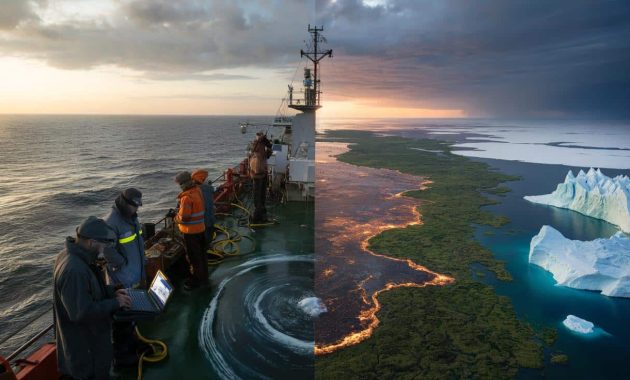
On a Wednesday morning that felt like any other, a small team of scientists stood on the deck of a research ship in the North Atlantic, watching the ocean tilt from steel blue to almost black under a passing cloud. The wind was ordinary, the waves routine. Yet the data blinking on the laptops in the cramped control room below said something else entirely. Ocean currents that should be steady were stuttering. A pattern that’s usually smooth was suddenly jagged.
One of the researchers rubbed their eyes, thinking it must be a sensor glitch. It wasn’t.
Far from shore, a quiet line had been crossed.
Climate tipping points are not distant science fiction anymore
For years, climate tipping points were talked about like far-off landmarks on a road we hoped never to travel. Something for 2050, maybe 2100. Not for now. Yet those early-warning signals, the subtle flickers that show a system is approaching a point of no return, are starting to show up in real data.
From Greenland’s ice sheet to the Amazon rainforest and the Atlantic circulation, scientists are spotting patterns they once only saw in computer models. The word they keep repeating in private conversations is simple and heavy. “Sooner.”
Take the vast Atlantic Meridional Overturning Circulation, or AMOC, the ocean conveyor belt that carries warm water north and sends cold water back south at depth. For decades, it looked stable enough, even as the planet warmed. Then teams started noticing something odd: the currents weren’t just slowing, they were becoming more erratic.
Studies in 2021 and 2024 flagged a worrying trend — the kind of statistical “wobble” that often appears before complex systems shift state. One paper suggested the AMOC could be headed toward a tipping point this century rather than centuries from now.
On screen, that shift appears as a slow, nervous flicker instead of a clean, confident line.
The same story is unfolding on land. Satellite records show parts of the Amazon losing resilience, reacting more slowly after drought and fire. In the Arctic, sea ice doesn’t just shrink; it struggles to regrow in predictable ways. These are classic signatures of what scientists call “critical slowing down” — a system that needs more time to bounce back after a shock.
The logic is unsettling but clear. As we keep adding heat, some parts of the Earth’s climate are shifting from elastic to brittle. Instead of springing back, they bend and stay bent. Past a certain point, they may not come back at all, even if emissions fall later. That’s the quiet fear behind the graphs and jargon.
➡️ These ski mistakes happen all the time: “We don’t think about it when we clip into our skis”
➡️ Nivea cream under fire experts say your skin may be paying the hidden price
➡️ Zoo staff overjoyed as a critically endangered Amur leopard cub takes its first steps on camera
➡️ 3 WhatsApp-Einstellungen, die du sofort ausschalten solltest (für deine Privatsphäre)
➡️ Inheritance: the new law coming into force in January that changes everything for descendants
How scientists are catching the whispers before the cracks
Spotting a tipping point on a warming planet isn’t like watching a glass shatter on the floor. It’s more like listening for a building’s faint creak before the beam gives way. Researchers track tiny changes in variance, autocorrelation, and recovery time in long-term datasets: temperatures, ice thickness, river flows, tree cover, ocean salinity.
They feed these streams of numbers into algorithms trained to detect early-warning signals. When the same pattern appears across multiple measurements — slower recovery, more erratic swings, stronger memory of past states — the red flags start piling up. That’s when teams begin to whisper that dreaded word again. “Tipping.”
The challenge is, real life is messy. Sensors fail, buoys drift, political budgets cut projects just when records get interesting. We’ve all been there, that moment when a crucial hard drive dies and takes months of work with it. Climate science lives with that anxiety every day.
Still, cross-checking helps. When tree ring data, satellite images, and ground stations in the Amazon all show forests taking longer to recover after droughts, it’s harder to dismiss. When multiple climate models — built by rival teams — independently find that Greenland’s ice melt is flirting with runaway loss, a pattern emerges.
Each dataset is imperfect. Together, they start to sound like a chorus.
This is also why some early warnings appeared “earlier than expected”. A lot of older projections assumed linear responses: add a bit more CO₂, get a bit more warming, lose a bit more ice. Reality doesn’t always play that way. Feedback loops can kick in: melting ice exposes darker surfaces that absorb more heat, drying forests burn easier and release more carbon, thawing permafrost belches methane.
*The models are catching up with the chaos we’ve already unleashed.*
Scientists are now re-running long-term scenarios with updated observations, and the picture is sharpening. Some tipping elements, like Arctic summer sea ice, look frighteningly close to their thresholds. Others, like the AMOC or parts of the West Antarctic ice sheet, might not tip tomorrow — but the early tremors are there. Those tremors are what we’re finally learning to read.
What we can still do while the window is cracked but not closed
On the ground, the “what now?” question can feel paralyzing. Yet early tipping signals are not a prophecy, they’re a warning siren. The most direct move is brutally simple: cut planet-warming pollution fast, especially from fossil fuels. That means fewer new oil and gas projects, stricter efficiency rules, and building out renewables so fast that old infrastructure starts to look embarrassing.
Cities and regions that act early can shift the curve. When coal-heavy grids switch to wind and solar, local air gets cleaner, health improves, and emissions fall. That buys time, and time is the fragile currency that keeps tipping points from being triggered.
At a personal and community level, people often swing between guilt and denial. One day you swear off flights, the next day you order stuff online that crosses three oceans in a week. Let’s be honest: nobody really does this every single day.
The more helpful lens is agency, not perfection. Supporting policies for clean energy, voting with climate in mind, joining local resilience projects, cutting food waste, eating lower on the food chain — these aren’t tiny, symbolic gestures when millions of people do them. They shift markets and narratives. They signal to leaders and companies that delay is the risky choice, not action.
The mistake is thinking your influence stops at your own carbon footprint.
Scientists who spend their lives staring at these fragile signals rarely talk like doomsday prophets in private. They sound more like mechanics who’ve found a crack in the engine. Urgent, yes. Fatalistic, no.
“Early tipping signals are not the end of the story,” says one climate physicist I spoke with. “They’re the last big chance to change the story. The tragedy would be seeing them clearly and still pretending we didn’t.”
- Pay attention to credible science – Read summaries from trusted institutions rather than random social posts.
- Support policies that cut emissions fast – Clean energy, efficient buildings, better public transport.
- Protect and restore living systems – Forests, wetlands, peatlands store carbon and soften climate shocks.
- Talk about tipping points calmly – Panic shuts people down; shared understanding moves them.
- Focus on leverage, not perfection – Your vote, your workplace, your community can amplify change.
Living with a world that’s near the edge, but not over it
There’s a strange kind of vertigo that comes with knowing the climate system is flirting with tipping points in real time. You still go to work, pick up kids, stream shows at night, yet somewhere far away a glacier is flowing a little faster, a rainforest is taking a little longer to heal after fire, a current is hesitating as it turns.
The danger is obvious, but so is the temptation to look away. These signals feel too big, too abstract, too far from daily life. And yet they’re already shaping insurance costs, food prices, migration patterns, and the background anxiety humming under many conversations.
There’s another way to read them: as a rare moment of clarity. For once, the planet is shouting in a language we’re finally starting to decode. It’s telling us that the comfortable timelines we clung to were off. That some risks are on fast-forward, not slow motion.
What we do in the next decade will decide whether those tipping signals fade back into stable patterns or harden into irreversible shifts. That choice is not reserved for presidents and CEOs alone. It runs through town councils, school boards, company meetings, dinner tables, and yes, search bars like the one that brought you here.
This story is still being written, in data and in daily life. How we respond — or don’t — is the plot twist.
| Key point | Detail | Value for the reader |
|---|---|---|
| Early warning signals are appearing now | Data from oceans, ice sheets, and forests show classic tipping-point patterns emerging earlier than projected | Helps you grasp why climate news feels more urgent and less theoretical |
| Nonlinear change, not just gradual warming | Feedback loops and “critical slowing down” mean systems can flip suddenly after long periods of stability | Clarifies why delays today can lock in damage for generations |
| Action still shapes the outcome | Fast emission cuts and ecosystem protection can prevent or soften tipping events | Gives practical angles for individual and collective impact, beyond doomscrolling |
FAQ:
- Question 1What exactly is a climate tipping point?
- Answer 1A climate tipping point is a threshold where a part of the Earth system shifts abruptly into a new state, often irreversibly on human timescales, after a relatively small extra push.
- Question 2Which tipping elements are scientists most worried about right now?
- Answer 2Current research highlights the Greenland and West Antarctic ice sheets, the Atlantic overturning circulation, Arctic summer sea ice, and parts of the Amazon rainforest as especially at risk.
- Question 3Does “earlier than expected” mean past models were wrong?
- Answer 3Past models often underestimated how quickly feedbacks would kick in or lacked high-resolution data. New observations refine those timelines, showing some risks materializing faster than projected.
- Question 4Is it already too late to prevent major tipping points?
- Answer 4No. Some damage is locked in, but many thresholds haven’t been crossed yet. Rapid emission cuts and protecting ecosystems can still prevent or limit the most extreme shifts.
- Question 5What can one person realistically do about such huge systems?
- Answer 5Your direct emissions matter, but your larger leverage is social and political: how you vote, what you support at work, where you bank and invest, and how you talk about climate in your community.