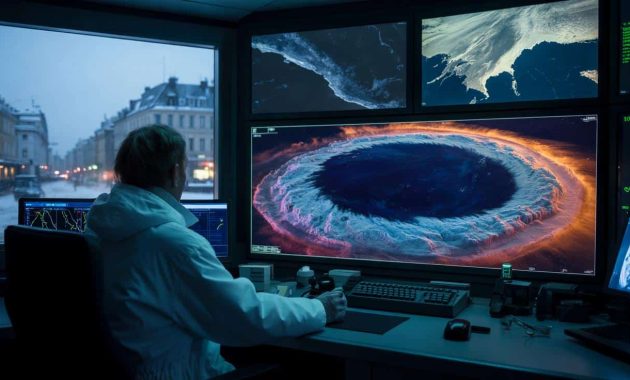
At 3:14 a.m. in a quiet data center on the outskirts of Berlin, a weather model suddenly flashed red. On the screen, a ring of cold air wrapped around the North Pole twisted like a frayed cable. The atmospheric scientist staring at the pixels blinked twice, took a screenshot, then another. The numbers coming from 30 kilometers above our heads were not just noisy. They were familiar in a way that made his stomach drop.
He opened an old folder named “Extreme Winters” and pulled up three historic traces: 2009–2010, 2013, 2018. The line on the image from tonight slid perfectly over them, like a ghost retracing its steps. Outside, the city was mild for January, almost gentle. Inside the lab, someone whispered what no one wanted to say aloud.
The stratosphere is acting like it does before winter goes wild.
When the sky above the sky starts to wobble
Walk outside on a calm winter day and the air can feel deceptively ordinary. No blizzard, no biting wind, no hint that anything strange is happening 30 to 50 kilometers above you. Yet that’s where researchers are watching the atmosphere warp, in a thin, icy band called the polar vortex. Think of it as a giant invisible ring of wind circling the Arctic, trapping the cold in place.
When that ring is strong and tidy, winter behaves itself. When it weakens, tilts or snaps, the cold is suddenly free to spill south. The worry now is simple and chilling: the current readings match only a handful of winters people still talk about years later.
In late December 2009, a technician at the UK Met Office noticed a similar pattern. The stratosphere over the Arctic was warming rapidly, turning the usual minus 80°C zone into something far less brutal. Within days, the polar vortex split into two lopsided blobs. The atmosphere above rearranged like broken plate glass.
A few weeks later, London buses were crawling through snow. Parts of Europe recorded the coldest December in a century. In the United States, the phrase “Snowmageddon” made the rounds as Washington D.C. disappeared under drifts. Behind those headlines sat a quiet, nerdy truth: the chaos started tens of kilometers above, where almost nobody ever looks.
That’s the unsettling echo scientists hear now. Instruments on satellites and weather balloons are picking up the same kind of stratospheric instability: rapid warming, odd wind patterns, pressure fields that don’t sit where they should. These are the fingerprints of what specialists call a “sudden stratospheric warming” event, the kind that can flip winter on its head a few weeks later.
The logic is fairly straightforward. Disturb the stratosphere hard enough and it sends ripples down through the troposphere, where our weather lives. Jet streams buckle. Storm tracks shift. Some regions are slapped with dangerous cold, others sit under unseasonal warmth and flooding rain. The drama on the ground is just the last act of a story that began far above the clouds.
How scientists are reading warning signs in the upper air
Tracking this instability begins with an almost obsessive daily ritual. Teams pull data from weather balloons, satellite soundings, and reanalysis models like ERA5, checking wind speeds at 10 hPa, temperatures over the pole, and the exact shape of the vortex. They compare those traces to archived winters, lining them up like fingerprints at a crime scene.
➡️ A sunny corner, five well‑chosen plants and the butterflies move in for the season
➡️ Three years after buying an e‑bike, I finally know which accessories you actually need
When the lines match, people in those labs don’t sleep well. Right now, their graphs line up with only a small club of winters: 1985, 2009–2010, 2013, 2018. Every one of those years brought at least one brutal cold outbreak somewhere in the mid-latitudes. Nobody can say which region will take the hit this time, but the pattern is not subtle.
One senior forecaster in New York described a recent shift as “watching the ceiling crack before the plaster falls.” He’d just seen a sharp reversal of stratospheric winds over the pole, flipping from strong westerlies to weak, chaotic flows. A similar reversal preceded the infamous “Beast from the East” that froze Europe in late February 2018.
That year, people in Rome woke to snow on the Colosseum. Schools shut down across the UK as pipes burst and trains froze on their tracks. Power systems in Eastern Europe were stretched by relentless demand. On paper, the trigger was abstract: a zonal mean wind going negative at 60°N and 10 hPa. In real life, it meant kids skating on streets that rarely see ice.
The analysis today leans on those memories. Climate reanalyses show that sudden stratospheric warmings are becoming slightly more frequent, and their surface impacts seem more entangled with a warming world. Warmer oceans feed stronger planetary waves that punch upward, disturbing the polar vortex from below. At the same time, reduced Arctic sea ice changes how heat and momentum move through the high latitudes.
That tension sends a blunt message. **A warmer planet doesn’t mean an end to extreme cold – it can twist winter into sharper, stranger shapes.** While global averages creep upward, the distribution of cold can get patchier, more concentrated, more surprising. The data flashing across researchers’ screens this season suggests we may be standing at the edge of one of those sharpened episodes.
What this means for daily life, from heating bills to flight paths
So what do you actually do with the knowledge that the stratosphere is wobbling? For meteorologists and planners, the first move is time. Stratospheric signals often give a lead of one to three weeks before the surface fully reacts. That window lets energy providers line up fuel, hospitals review staffing plans, and cities dust off cold-weather protocols that have been sitting quietly in drawers.
Behind the scenes, forecast desks are already adjusting their outlooks. They nudge probability charts toward colder scenarios, flag potential snowstorm corridors, and brief aviation managers about more erratic jet streams. *It doesn’t feel dramatic on day one, but those subtle shifts can save lives and a lot of money when the pattern breaks loose.*
For ordinary people, the temptation is to shrug. We’ve all been there, that moment when you hear “polar vortex” in the news and think, “Here we go again, another scary headline.” And yes, long-range forecasts are messy. Not every stratospheric disturbance leads to a record-breaking freeze in your backyard.
Yet small, grounded steps still matter. Checking your home’s insulation, knowing where blankets and backup heaters are, clearing gutters for heavy, wet snow, talking with neighbors who might be vulnerable. Let’s be honest: nobody really does this every single day. But when specialists start whispering that this year’s pattern looks like the short list of notorious winters, basic preparation stops feeling paranoid and starts feeling like common sense.
Scientists themselves are walking a delicate line between alarm and accuracy. They know their models can’t pin down the exact neighborhood that might see minus 20°C, or which storm will dump half a meter of snow on a Friday instead of a Sunday.
“The stratosphere is shouting, not whispering, right now,” one polar researcher told me. “We can’t say whose driveway will be buried, but we can say the dice for severe winter weather are suddenly loaded.”
- Watch the lead indicatorsFollow updates on polar vortex strength, sudden stratospheric warmings, and jet stream shifts from trusted weather services.
- Think in weeks, not daysStratospheric changes often take 10–21 days to shape surface weather, which gives you a real, usable planning window.
- Translate science into actionUse early warnings to prep homes, adjust travel plans, and check on people who struggle with extreme cold.
- Avoid forecast absolutismLook for probabilities, not promises. Anyone offering exact snowfall totals three weeks out is selling comfort, not clarity.
- Stay emotionally balancedAwareness doesn’t have to mean anxiety. Use the information as a tool, not a threat.
Living under an unstable sky
There’s something oddly intimate about knowing the air far above you is unsettled. You can’t see the vortex fraying, you can’t hear the stratosphere warming, yet your daily routine could pivot on those distant shifts. A plane ticket bought for next month, a school exam date, a long-awaited family visit – all of it a little more fragile than it looked on the calendar.
As researchers compare this year’s upper-air signatures with the handful of winters that truly broke the mold, a quiet question hangs over their work. How do we live in a world where the extremes are no longer rare, but recurring guests? Not every winter will be historic, not every signal will cash out in snowdrifts and broken records. Still, the atmosphere is telling a story, and lately that story feels less like background noise and more like a character in our lives.
Maybe the real shift is this: we’re starting to see weather not just as something that “happens to us,” but as a system we can read early, interpret, and respond to together. The stratosphere may be unstable, but our choices in the face of that instability don’t have to be.
| Key point | Detail | Value for the reader |
|---|---|---|
| Stratospheric instability as an early warning | Sudden changes in polar vortex strength and temperature can flag extreme winter risks 1–3 weeks ahead. | Gives you time to plan travel, prepare your home, and anticipate energy needs. |
| Historic parallels | Current readings resemble rare events like 1985, 2009–2010, 2013, 2018, all tied to severe cold spells. | Helps you understand that this isn’t hype, but a pattern with real-world precedents. |
| Turning science into action | Following trusted long-range updates and taking small, concrete steps beats either panic or denial. | Reduces stress, protects vulnerable people, and can limit financial and health impacts. |
FAQ:
- Question 1What exactly is “stratospheric instability”?
- Answer 1It’s when the normal circulation and temperature patterns in the stratosphere, especially around the polar vortex, become disrupted, often through sudden warming and wind reversals.
- Question 2Does stratospheric instability always mean a brutal winter where I live?
- Answer 2No. It raises the odds of extreme events somewhere in the mid-latitudes, but the exact region affected varies from case to case.
- Question 3How far in advance can scientists see these events coming?
- Answer 3They usually detect signs 1–3 weeks ahead, sometimes a bit more, by tracking the polar vortex, upper-level winds, and temperature anomalies.
- Question 4Is climate change making these stratospheric events more common?
- Answer 4Research suggests sudden stratospheric warmings may be slightly more frequent and their impacts more complex in a warming world, but the picture is still evolving.
- Question 5What’s the most practical thing I can do with this information?
- Answer 5Follow updates from reputable weather services, use early warnings to prepare your home and plans, and check in on people around you who struggle during extreme cold.