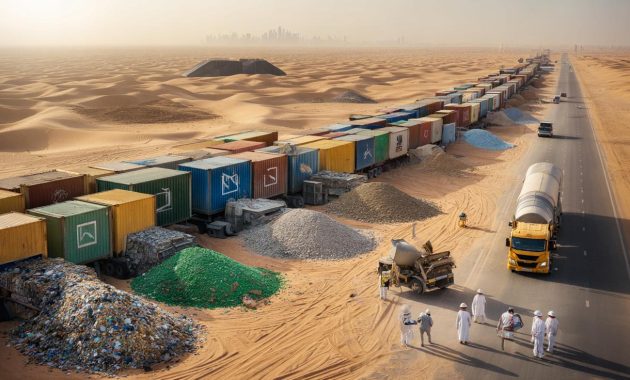
From the highway outside Riyadh, the desert looks endless. Beige waves of sand, broken only by the silhouettes of cranes and concrete skeletons of new towers rising under a white-hot sky. But if you follow the trucks, you notice something strange: many of the containers rumbling into these construction zones aren’t filled with fresh cement or steel from local factories. They’re carrying shredded plastics from Europe, crushed glass from Asia, reclaimed metals from ports thousands of kilometers away.
The richest oil nations on earth are importing other people’s trash to build their future skylines.
And the desert, wide open and seemingly empty, is watching quietly.
Why desert kingdoms are buying other people’s waste
The easy story would be: there’s so much desert, you can just dump anything, anywhere. That’s the old cliché about Saudi Arabia and the United Arab Emirates. Yet on the ground, the picture is inverted. While landfills do spread out on the fringes of cities, the big construction projects in Riyadh, Jeddah, Dubai and Abu Dhabi are fed by a parallel supply chain of recycled aggregates and imported waste-derived materials.
The desert is not a free, bottomless bin. It’s real estate, and it’s getting expensive.
Stand near Jebel Ali Port in Dubai at dawn and you’ll see the choreography. Containers marked “recyclables” stacked like Lego bricks. Forklifts moving bales of plastic that once wrapped supermarket goods in Germany. Pallets of scrap aluminum from car factories in Japan. A logistics manager explained that some of these materials end up as part of “green concrete” mixes, or as fillers in roads and artificial islands.
In Saudi Arabia, trucks leave industrial ports near Dammam carrying recycled steel and rubber crumb used in asphalt for the country’s colossal road programs.
What looks like a paradox is, in fact, raw economics. Local landfills do exist in both countries, often sprawling into desert outskirts where land seems cheap. Yet the cost of wasting materials is climbing fast. Vision 2030 in Saudi Arabia and net-zero pledges in the UAE push developers to show lower carbon footprints. Investors and global hotel brands now ask for sustainability reports, not just glossy renderings.
So **importing high-grade recycled inputs** can sometimes be cheaper, cleaner and faster than pulling new material from the ground.
Inside the strange business of desert recycling
On a construction site in Dubai’s outskirts, an engineer in a dusty helmet points at a slab of curing concrete. “This mix,” he says, “contains crushed demolition waste from Europe and recycled fly ash.” He scrolls through a WhatsApp from a supplier showing certificates, photos, shipping logs. This is how recycled materials travel now: not as a noble mission, but as line items in a spreadsheet and photos on a phone.
The method is simple on paper. Cities export what they cannot or will not process. Gulf developers buy what helps them hit green targets.
Many people imagine that with so much empty land, local authorities just bury construction debris and move on. Reality is messier. Landfills near Riyadh and Dubai are under pressure, communities don’t want new dumps near their homes, and regulators are setting recovery targets. So planners look at a global marketplace of waste. They pick the streams that are easy to certify and easy to blend: recycled metals, glass cullet, plastic flakes, construction aggregates.
We’ve all been there, that moment when a “temporary” solution quietly becomes the default way of doing things.
There’s also a more awkward side. Some Western exporters view the Gulf as a convenient outlet when their own recycling systems clog up. The receiving countries, for their part, sometimes accept mixed or low-quality loads that need extra sorting under harsh conditions. A Saudi consultant put it bluntly:
“Everyone talks about circular economy. Nobody wants the circle to close in their own backyard.”
To keep some sanity in that circle, Gulf authorities are slowly tightening standards, and a few big developers now publish lists of accepted recycled inputs:
- Recycled steel with verified origin and composition
- Concrete aggregates from certified demolition waste
- Glass cullet for façade and tile production
- High-quality plastic flakes for pipes and fittings
- Rubber crumb for highways and sports surfaces
What this paradox says about the future of building in the Gulf
Once you start seeing imported waste in the desert, you can’t unsee it. Those futuristic renderings of mirrored cities in Saudi Arabia or palm-shaped islands in the UAE are built on a mosaic of global leftovers: recycled beams, repurposed glass, fly ash from foreign power plants. It’s not necessarily cynical. It’s just how the 21st-century construction machine feeds itself.
Let’s be honest: nobody really does this every single day, but if you walk past a major site and ask where each material came from, you’ll hear some uncomfortable pauses.
➡️ 3 WhatsApp-Einstellungen, die du sofort ausschalten solltest (für deine Privatsphäre)
➡️ Una volta visto cosa succede, werdet ihr Zitronen für immer einfrieren
This raises a quiet question about responsibility. When a European city ships its sorted plastic to the Gulf, and that plastic ends up in pipes under a new luxury district, who owns the environmental story? The exporter, proud of hitting recycling quotas? The Gulf developer, proud of **low-carbon construction**? Or the workers in the desert sorting and mixing all this under 45°C heat?
*The glossy sustainability slides rarely show the faces in the dust.*
For readers watching from afar, this isn’t just a Gulf story. It’s a preview of a world where waste doesn’t “disappear” but floats along invisible trade routes, landing where land is available and rules are flexible. Saudi Arabia and the UAE are simply at the sharp edge of that experiment: building fast, under global scrutiny, on land that looks infinite yet feels strangely fragile.
The desert is no longer just a backdrop for oil wealth. It’s becoming a test lab for what we do with everything we’ve already thrown away.
| Key point | Detail | Value for the reader |
|---|---|---|
| Desert land isn’t “free” space | Landfills in Saudi Arabia and the UAE are politically sensitive and increasingly costly | Helps you see why importing recyclables can beat endless dumping |
| Recycled materials travel globally | Plastics, metals and aggregates cross continents to feed Gulf mega-projects | Shows how your local trash can quietly shape faraway skylines |
| Sustainability is partly a logistics story | Green targets push developers to seek certified recycled inputs, wherever they are | Gives context for reading “eco-friendly” claims from big projects with a sharper eye |
FAQ:
- Is importing waste for construction legal in Saudi Arabia and the UAE?Yes, within regulated categories. Both countries allow certain recycled materials such as metals, glass cullet and construction aggregates, provided they meet technical and environmental standards.
- Why don’t they just recycle their own waste instead of importing it?They do, but local recycling systems are still developing. Large projects often need more consistent, certified volumes than domestic facilities currently provide, so they top up with imports.
- Does this mean the Gulf is becoming the world’s dumping ground?Not in a simple way. The materials used in construction are usually the higher-value, easier-to-certify fractions, not random mixed trash. The real issue is transparency and labor conditions, not just geography.
- Is using imported recyclables better than using new raw materials?Often yes, from a carbon and resource perspective, especially for metals and certain aggregates. The climate impact depends on shipping distances, processing methods and how clean the waste stream is.
- What does this change for ordinary people outside the Gulf?It means your local recycling choices and your city’s export deals can literally end up in another country’s buildings. It’s a reminder to question where “recycled” actually goes, not just whether the bin is the right color.