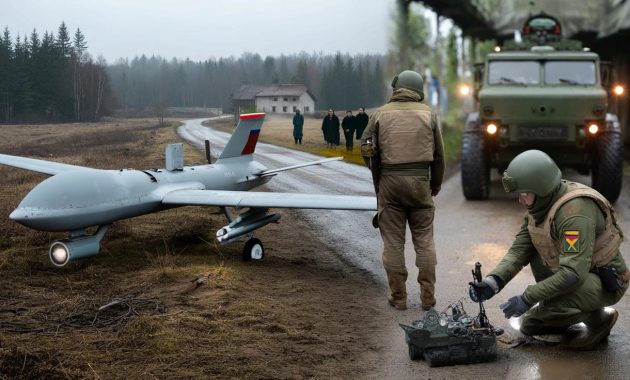
As the fighting in Ukraine grinds into its fourth year, new threats are emerging far from the front line, from an explosive-laden Russian drone that ended up in Lithuania to a reported surge of HIV infections tearing through the Russian army.
Explosive Russian drone raises alarm in Lithuania
Lithuania is pressing NATO for rapid action after confirming that a Russian military drone carrying explosives crashed on its territory at the end of July.
On 28 July, a Russian drone crossed the Lithuanian border and went down in a rural area only a short distance from Belarus, according to officials in Vilnius. The incident has rattled a country that already lives on the edge of Russia’s confrontation with the West.
A military drone from Russia violated Lithuanian airspace and was later found to be carrying an explosive device that had to be neutralised on site.
Lithuania’s prosecutor general, Nida Grunskiene, told reporters that investigators discovered an explosive charge inside the unmanned aircraft. Specialist teams disabled it at the crash location. No injuries were reported, but the political shock was immediate.
Vilnius has now requested “immediate measures” from NATO to tighten air defence of the alliance’s eastern flank. Newly appointed NATO Secretary General Mark Rutte publicly confirmed that the aircraft was a Russian military drone and that it had breached Lithuanian airspace, which is also NATO airspace.
Accident or testing the limits?
Prosecutors say one working theory is that the drone strayed off course by accident during operations near the Belarusian border. Russia frequently uses drones for reconnaissance and for kamikaze-style strikes in Ukraine and in occupied areas.
At the same time, Lithuanian authorities are not ruling out a deliberate probe of NATO defences.
Investigators are treating accidental incursion as the main scenario, while assessing parallel theories that include a possible test of allied reaction times.
The incident comes against a backdrop of repeated complaints from Baltic states about Russian and Belarusian pressure: cyberattacks, disinformation campaigns and airspace violations. For small NATO members like Lithuania, each incident raises fears of a miscalculation that could trigger the alliance’s collective defence clause.
Why this drone matters for NATO
The downed aircraft has become a test case for how NATO responds when the war in Ukraine physically spills across borders. Lithuanian officials want:
- More allied fighter jets deployed for air policing over the Baltics
- Additional air defence systems, including mobile units, near the Belarusian frontier
- Clearer rules on how to respond if armed drones or missiles cross into NATO airspace again
For residents near the border, the incident has underlined how little distance there is between local life and the front lines of a wider confrontation. Farmers in the area told local media they now report any unfamiliar noise overhead, worried it could be another drone.
Six dead as strikes intensify far from the front
While Lithuania grapples with the drone incident, Ukraine is again counting civilian casualties.
Local authorities reported that six people were killed on Tuesday in Russian strikes on the south and north-east of Ukraine. At the same time, four people died in Ukrainian shelling of areas under Russian occupation, according to Moscow-backed officials.
The Ukrainian city of Lozova suffered what local leaders described as the most intense attack since February 2022, with dozens of drones launched at once.
In Lozova, more than 80 kilometres from the front line in Kharkiv region, two people were killed and rail infrastructure was damaged. The local mayor said Russia used 34 drones against the city and surrounding area. Ukraine’s air force claimed to have shot down 29 drones across the north and east of the country during the same night.
Shifting drone warfare
The twin stories of Lozova and Lithuania show how drone use in this war keeps evolving:
| Location | Type of incident | Key concern |
|---|---|---|
| Lozova, Ukraine | Mass drone strike on city and rail hub | Destruction of logistics and civilian casualties |
| Lithuania | Armed Russian drone crash in NATO territory | Risk of escalation beyond Ukraine |
For Ukraine, drones are a daily threat, forcing constant investment in air defence and rapid repair teams. For NATO members on the border, a single drone can raise questions about the alliance’s readiness and Russia’s intentions.
HIV cases surge inside Russian forces
Alongside these military developments, a quieter but serious crisis is reportedly spreading through Russia’s own army. A research paper from Carnegie Politika, a Berlin-based institute focusing on Russia, estimates that HIV cases among Russian servicemen have jumped by roughly 2,000% since the full-scale invasion began in February 2022.
Researchers link the rise in HIV infections among Russian troops to unprotected sex and drug use, compounded by poor access to treatment.
These are not official Russian figures. Moscow keeps tight control on health data related to the armed forces. But the think tank’s assessment draws on interviews, leaked regional statistics and accounts from doctors and soldiers’ families.
How war fuels an epidemic
Multiple factors appear to be driving the surge:
- Long deployments far from home, often with limited supervision
- Increased sex work around military bases and occupied towns
- Use of injectable drugs in stressful frontline conditions
- Patchy HIV testing and stigma that discourages treatment
Russia already faced a serious HIV problem before 2022, with one of the largest epidemics in Europe. The war has added chaos to an already fragile public health response. Field hospitals focus on trauma care, not chronic infections. Commanders may avoid reporting cases to keep combat units at full strength.
For the army, widespread HIV infections can erode readiness. Untreated HIV weakens the immune system, increasing the risk of other illnesses and reducing fitness for combat. Over time, the cost of medical care also climbs, a burden for a military already stretched by long campaigns.
What HIV means for soldiers and their families
Beyond strategy, the human impact is brutal. Infected soldiers may only discover their status during basic medical checks or after returning home sick. Stigma remains strong across many Russian regions, especially in conservative communities that supply a high proportion of recruits.
Families often face silence from the authorities. Official notifications mention “serious illness” or “complications” without specifying HIV. Wives and partners might not realise they need testing. Social workers and independent NGOs that once offered support have been restricted or labelled “foreign agents”, shrinking the safety net.
Key terms and scenarios going forward
What HIV and drones mean for the next phase of the war
Both the Lithuanian drone incident and the HIV surge inside Russian ranks point to how the conflict keeps expanding in unexpected directions.
On one track, the risk of accidents or miscalculations grows as drones, missiles and electronic warfare systems operate close to NATO borders. A similar aircraft crashing in a populated Lithuanian town, or in neighbouring Poland or Latvia, could ignite a serious diplomatic clash, even if no one was hurt.
On another track, health issues inside the Russian military could quietly weaken units over time. A force grappling with rising HIV, untreated trauma and drug use may struggle with discipline and cohesion, especially during long rotations along a vast front.
Understanding HIV in a war zone
HIV (human immunodeficiency virus) attacks the immune system. Without treatment, it can progress to AIDS, leaving the body vulnerable to infections that would normally be manageable. Antiretroviral therapy allows people with HIV to live long and often healthy lives, and it drastically lowers the risk of transmission.
In war zones, regular blood tests, stable medication supplies and confidential counselling are hard to guarantee. Soldiers are moved quickly, medical records get lost, pharmacies run short. Commanders focus on short-term combat strength, not long-term health. In that environment, the infection spreads quietly through barracks, occupied towns and returning veterans.
If the conflict continues for years, the interaction between military operations, public health breakdowns and cross-border incidents like the Lithuanian drone crash will shape both the battlefield and the societies around it. The war in Ukraine no longer stops at the trenches; it now cuts through hospitals, border villages and the private lives of the soldiers sent to fight it.