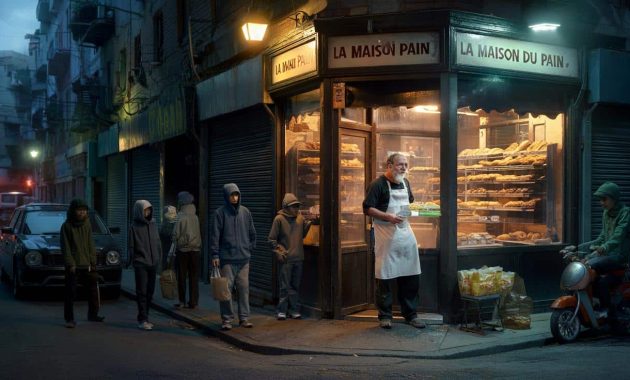
At 1:43 a.m., the line in front of La Maison du Pain looks like a glitch in the neighborhood’s reality. The shutters of the hair salon are down, the bar on the corner is dark, even the streetlights seem tired. Yet under the bakery’s neon sign, a dozen hoodies move in slow motion, phone screens lighting up faces, car engines idling double-parked along the curb.
Inside, behind glass fogged by the ovens, the owner’s son slides a tray of croissants into the back while, out front, a guy in a Canada Goose whispers through the service window and passes a folded note. The smell of fresh brioche collides with the raw, grassy hit of cannabis.
Half the people here came for a pain au chocolat.
The other half didn’t.
When the bakery becomes the after-hours dispensary
By day, this place looks like every other family bakery clinging to survival in a gentrifying city. Chalkboard menu. Sticky jam jars on the tables. A kid doing homework at the back counter while their mother yells orders in two languages. You’d never guess that by midnight, the same counter turns into the calm eye of a small neighborhood storm.
The shift is subtle. Light dimmed just a little. Back door propped open. Regulars who never come before 10 p.m. shuffling in with their caps low and their eyes on the floor. The card machine still beeps, the till still rings, but what’s changing hands isn’t just baguette tradition.
From the outside, it looks like hustle.
From upstairs windows, it feels like a slow-motion takeover.
Talk to the family and you don’t hear the word “drug corridor.” You hear “rent.” You hear “electric bill.” You hear “the café across the street closed last year, we were next.”
The owner, who’s been baking since 4 a.m. for thirty years, will tell you the cost of flour jumped, the gas bill doubled, working people started buying supermarket bread instead of fresh loaves. Then one night, a cousin brings around some cannabis gummies “to help with the insomnia crowd” and suddenly the counter is busy again after 11 p.m. Word travels faster than the smell of croissants.
The takings from 10 p.m. to 2 a.m. begin to cover what the mornings no longer do.
Soon enough, late-night weed money is the difference between staying open and shuttering for good.
Urban planners have a cold name for this: “informal economies filling service gaps.” On the ground, it looks like people trying not to drown grabbing the only rope thrown their way. Regulations on cannabis are loosening in some cities, stuck in a grey area in others, but the street market keeps moving. It finds the cracks.
➡️ Trend hairstyle 2026: This is what the mid-length feather cut looks like
➡️ A lightweight cardboard technique protects crops and boosts garden harvests more than expected
And bakeries have very convenient cracks. Already licensed, already trusted, already open before dawn and able to extend the shift past midnight without attracting instant suspicion. **A bakery that smells like weed at 2 a.m. doesn’t make headlines.** It just makes the neighbors quietly furious.
This is the collision point where legalization debates meet everyday life.
Not in parliament, but on one small block that never voted to become the city’s informal dispensary strip.
The fragile line between lifeline and nuisance
If you stand on the corner from 11 p.m. to 3 a.m. for a week, you start to see the recurring pattern. Cars looping around the block, music turned low but bass still thumping through the doors. Delivery scooters double-parking. Small clusters drifting between the bakery and the playground bench further down.
Then come the “little” things that neighbors always mention first. The broken beer bottles. Roaches on the sidewalk. A stranger asleep in the entrance hall at 4 a.m., keys jammed, buzzer pressed ten times in a row. One resident I met had a spreadsheet tracking the nights they called the non-emergency police line. The cells were full.
The city hadn’t officially drawn a red line through this street.
Yet it’s been quietly marked on the mental map of every dealer in a two-mile radius.
There’s always a tipping point story. On this block, it was a mom walking her eight-year-old to school at 8:10 a.m., right past the bakery. Two guys who clearly hadn’t gone home yet were still on the sidewalk, loud and slightly wired, trading what looked very much like small baggies.
Her kid asked, “Why are they still awake?” She didn’t have a good answer. That afternoon, the building’s WhatsApp group exploded. Photos. Voice notes. A video of a shouting match at 1 a.m. Residents petitioned the city, tagged the mayor on social media, demanded patrols. The bakery owner read the thread and didn’t sleep for two nights.
For the first time, he could see that his survival plan was turning the street into something his own kids wouldn’t feel safe walking home on.
That realization landed heavier than any unpaid invoice.
From a distance, it’s easy to take sides. “Shut them down, they’re dealing drugs.” Or, just as bluntly, “Let them work, the system failed them.” Reality on this tiny stretch of sidewalk sits in the grey. The residents aren’t anti-bakery. Many of them grew up on those croissants. They’re anti-being-drafted-into-a-drug-zone-without-a-vote.
And the family isn’t blind to the harm. They see the loitering. They hear the fights. They also see spreadsheets with red numbers, a landlord texting every month, and suppliers threatening to cut off flour deliveries. *From the inside, the calculus is brutal.*
Let’s be honest: nobody really dreams of selling weed out of their grandfather’s bakery.
But when the choice looks like “float by bending the rules” or “sink by obeying them,” a lot of people pick the same side.
What a healthier compromise could look like on a single block
For streets that suddenly find themselves dragged into this kind of underground economy, the instinct is often just to call the cops and hope for the best. Sometimes that’s necessary. Though there’s a different first move that can change the tone: talk, in daylight, before everyone’s exhausted and angry.
One resident on this block decided to lightly “bump into” the owner at 8 a.m., coffee in hand, instead of only seeing him framed by police flashlights at night. She brought photos of the mess, calmly described nights her kids couldn’t sleep, and asked, “What would help you stop this without closing?” That question hit the only pressure point that matters in a family business: dignity plus survival.
From there, tiny practical steps emerged. No sales after midnight, no more hanging around in front, clients redirected to a side alley for pick-up, at least while the neighborhood figured out its longer-term fight with City Hall.
Imperfect, but a start.
Residents fall into a common trap in these situations: waiting until rage boils over before speaking. By the time the first real conversation happens, it’s already framed as war. Accusations fly, defenses harden, everyone retreats to “my rights” and “your fault.”
A more useful path starts earlier and sounds messier. Admitting to the bakery owner, “We get that you’re scared of closing, we’re scared of our street changing forever, and we have no idea what the perfect solution is.” That sentence alone can pull the conflict out of Twitter and back into human territory. **You can be absolutely against drug dealing on your block, while still refusing to paint your struggling neighbor as a comic-book villain.**
The mistake isn’t feeling angry.
The mistake is letting anger be the only voice in the room.
“We don’t want the bakery to close,” one resident told me. “We just never agreed to live above a place that smells like weed at 2 a.m. and has guys sitting on our steps. There has to be another way to keep a family business alive that doesn’t turn our street into the city’s backdoor dispensary.”
- Document the reality, not just the emotion
Keep a simple log of nights, photos, noise levels. It shifts the conversation from “you’re exaggerating” to “here’s what last week looked like.” - Talk like neighbors, not as enemies
Daylight chats on the sidewalk or over a coffee do more than 20 angry emails. Start from shared fears, not instant blame. - Pull the city into the room
Ask for a mediated meeting with the bakery, residents, and a city official. Push for legal, regulated options so the family isn’t cornered into the shadows. - Set boundaries you’ll actually defend
Quiet hours, no loitering zones, closing times. Vague complaints change nothing; specific limits can reshape behavior. - Support the bakery’s “clean” income
Organize morning orders, promote their legit products, help them see a future that doesn’t depend on late-night cannabis cash.
When a single small shop carries everyone’s fears
Walk down that same block at 7 a.m. on a Tuesday and you’d never guess the night stories. Strollers on the sidewalk. Teenagers in uniforms clutching coffee. The bakery doorbell chiming every thirty seconds as regulars pick up their warm bread, trading gossip in three different languages. This is what everyone here wants to protect, under the anger and petitions and late-night calls to the city hotline.
The unease around cannabis isn’t just about the plant. It’s about who gets to decide what a street becomes, and who ends up carrying the cost when urban trends and legalization half-steps collide with rent spikes and fragile family businesses. A bakery can be the lifeline that keeps a family above water. It can also be the crack where a whole block’s sense of safety starts leaking out.
Some neighbors will say shut it all down. Others will say let them hustle. Most people in between are just quietly asking the same question:
Is there a way to keep the ovens on without turning our address into the city’s unofficial drug corridor?
| Key point | Detail | Value for the reader |
|---|---|---|
| Street-level impact | Late-night cannabis sales change noise, safety, and daily routines for residents who never chose this shift. | Helps you name what feels “off” on your block and frame concrete complaints. |
| Economic pressure on family shops | Bakery margins are collapsing, pushing owners toward grey-zone income as a survival tool. | Lets you argue for solutions that protect both quality of life and small businesses. |
| Path to healthier compromise | Early dialogue, clear limits, and city involvement can redirect the situation before it explodes. | Gives you a playbook if your own street starts sliding into “informal” drug corridor status. |
FAQ:
- Question 1Isn’t this just a policing problem that needs more patrols at night?
- Question 2Can residents really influence what a private business does after hours?
- Question 3What if I like buying cannabis but don’t want my street taken over?
- Question 4Could legal dispensaries actually help neighborhood bakeries instead of competing with them?
- Question 5How do you support a struggling family business without endorsing their illegal side hustle?