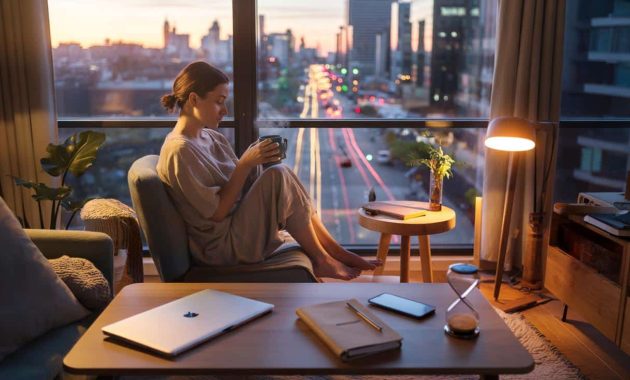
Fewer errands. Fewer pings. More room to breathe, think, and reset, behind a closed door.
Across busy cities and tired timelines, a different kind of protest takes shape. It swaps chants for calm and slogans for silence. The idea sounds almost too simple: make home a refuge, not a waiting room between tasks.
Why staying home resonates now
South Korean–German philosopher Byung-Chul Han, recently awarded the 2025 Princess of Asturias Prize for Communication and Humanities, has become the unlikely banner-carrier of this shift. His core claim hits a nerve in a hyperactive age: resist the pressure to perform every minute, and you reclaim your time from an economy that counts even your rest.
Han’s target is the so‑called performance society. We track our steps, optimize sleep, monetize hobbies, and polish our personal brands. Free hours turn into side-hustle fodder. Even rest must look productive online. In that loop, home risks becoming just a charging station for devices and a staging area for the next sprint.
Refusing to optimize every spare hour acts like a small strike against the “always on” imperative.
Han argues for guilt‑free silence and anonymous time. Not isolation. Not retreat for its own sake. Rather, a local act of sovereignty: time without witnesses, without metrics, without proof of value. The quiet, unposted hour gives attention back to the person who holds it.
The philosophy in plain clothes
Think of “lucid resistance” as subtractive politics you can do in slippers. Close the laptop. Let the phone sit face down. Skip the reflex to justify your evening. The measure is not output; it is whether you can hear your own thoughts.
The hours you do not optimize often return clarity, direction, and a steadier pulse.
This does not romanticize loneliness. It defends the right to rest without apology, to be unproductive without shame. A home can become a bastion of freedom when it stops mirroring the dashboard culture outside.
From thesis to habit: home therapy
Call it “home therapy” if you like: shaping a house or flat into something that protects, recharges, and orients you. The space doesn’t need marble countertops. It needs intention. A soft chair by a window. A shelf cleared for a daily ritual. An hour ring‑fenced for nothing in particular.
➡️ At a blistering 603 km/h, this new maglev officially becomes the fastest train ever built
➡️ “I recovered $1,200 a year by cancelling things I no longer used”
➡️ Goodbye to dark nights on Earth as a California startup plans thousands of space mirrors
➡️ If your vegetables bolt too early, temperature is not always the main trigger
Writers of calm—like Kankyo Tannier on silence and Marie Kondo on mindful order—treat the domestic sphere as a training ground for attention. Han’s thinking lands in the same square: your place can be a small temple of regeneration. That sounds lofty. In practice, it looks ordinary and reachable.
- Create tiny islands of quiet each day: two minutes before you open messages, five minutes after dinner with no screens.
- Drink coffee or tea without multitasking. Notice aroma, warmth, and breath. End when the cup empties.
- Keep a handwriting journal. One page a day. No audience. No goal beyond honesty.
- Try “craftfulness”: knitting, simple embroidery, a model kit, a small repair done slowly and well.
- Play for play’s sake with kids, a partner, or alone. Cards, Lego, a short jam on a dusty keyboard.
- Cook one slow meal this week. Stretch the process, not the budget.
- Set a gentle planning ritual on Sundays: three priorities, one reward, one thing you will deliberately not do.
- Build a nook: a chair, a low light, a blanket, a book. Call it your sanctuary corner.
- Run a low-cost home spa: warm bath, epsom salts if you have them, deep breathing, early bed.
What about work, loneliness, and inequality?
Not everyone can sink into long, quiet afternoons. Many juggle shifts, care, or crowded flats. Some homes do not feel safe or restful. The “home as resistance” stance can still be scaled to fit lives that run hot.
- Think in minutes, not hours. Five sanctuary minutes still count.
- Trade time with housemates or family so each person gets one daily pocket of privacy.
- If home feels tense, use nearby safe spaces—library corners, community rooms, a calm café at off‑peak times.
- Schedule social contact so quiet time does not slide into isolation. Two check‑ins a week can anchor the quieter days.
- If safety is an issue, prioritize support and professional help first. Quiet comes after safety.
For many, the sensible unit is not a “day at home” but a ritual window: an analog morning opener, a no‑scroll lunch, a sunset pause on the doorstep. Small, repeatable, claimable.
How this quiet rebellion bends the economy
When people stay in more and consume less, something shifts outside too. Impulsive purchases drop. Time-rich activities—reading, making, mending—replace quick hits. That means fewer deliveries and a lighter footprint. It also cools the pressure to perform online just to feel visible.
| Performance society script | Home resistance practice |
|---|---|
| Track and optimize every minute | Leave blank space that no app measures |
| Build a personal brand | Keep a private life off‑stage |
| Turn hobbies into income | Do things for their own delight |
| Notifications set your tempo | Analog rituals set your pace |
| Buy to reward stress | Rest to unwind stress |
The gains are quiet: steadier attention, calmer mornings, fewer late‑night jitters. Those benefits compound. They spill into work quality, relationships, and health costs that never appear because the crash never comes.
Small experiments you can run this week
You do not need a manifesto. Try a simple five‑day sequence. Note how each change feels. Keep what helps, drop what doesn’t.
- Monday: First 30 minutes device‑free, even if you commute. Breathe, stretch, make the bed slowly.
- Tuesday: Curate a single shelf. Clear it. Place one object that signals calm.
- Wednesday: Play for 25 minutes. No goals. No learning curve. Just play.
- Thursday: Slow dish night. Cook with music. Eat at a table. No screens in reach.
- Friday: Candle or lamp hour. Journal one page. Plan the weekend with one anchor joy.
What others are finding
Advocates of silence note that stillness is active. Your senses do the work. Your nervous system downshifts. Organizing experts point out that space supports behavior. A clear corner makes daily rest more likely. Han’s language is starker—he frames it as resistance—but the practice intersects with slow living, mindful routines, and creative rest.
If silence feels strange, start where you are
Silence can feel awkward at first. That’s normal. Set a timer. Let discomfort rise and fall. Add a soundtrack of rain or wind if pure quiet grates. Use earplugs or a cheap white‑noise fan to carve auditory privacy in a shared home.
You can stack benefits. Pair silence with low‑cost care: stretching, a warm shower, or a tidy‑up sprint. Combine solitary rituals with intentional connection later—call a friend, share a meal, join a neighbor walk—so calm does not calcify into isolation.
Home becomes a refuge when you stop performing for it and start letting it hold you.
Two terms help the practice stick. First, “sanctuary minutes”: short, protected windows you treat as non‑negotiable. Second, “enoughness threshold”: decide what counts as a good day before the day starts, and keep it humane—three meaningful actions, one joy, sleep on time. The combination reduces the churn and keeps the quiet alive when life gets loud.