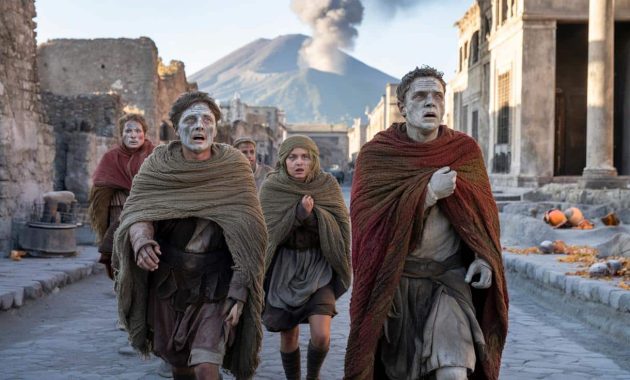
New research on textile traces trapped in famous plaster casts suggests that many residents of Pompeii died in heavy wool garments, raising fresh doubts about the accepted date of the Vesuvius eruption in AD 79 and the conditions they faced as the disaster unfolded.
Wool coats in the shadow of Vesuvius
For more than a century, visitors to Pompeii have stared at the eerie plaster figures lying where they fell. Those casts were created by pouring plaster into the voids left in hardened ash after human bodies decomposed. Until recently, most attention focused on posture and facial expressions.
Now a Spanish research team from the ÁTROPOS group at the University of Valencia has looked closer at something different: the ghostly marks of clothes pressed into the plaster surface.
The team examined 14 plaster casts from the Porta Nola necropolis and found clear impressions of thick woollen textiles, including cloaks layered over tunics.
Microscopic study of the surface showed tightly woven patterns, consistent with dense, heavy wool rather than light summer fabric. These garments appeared both indoors and outdoors, suggesting a widespread pattern, not a one-off curiosity.
According to the traditional timeline, Vesuvius erupted on 24 August AD 79. Southern Italian summers at that time of year are typically hot and humid. Cloaks would usually stay in storage until cooler weather arrived. The unexpected presence of winter-style clothes has reopened an old debate: was the eruption actually a late-summer event at all?
A long-running dispute over the date of the eruption
The mystery of the woollen clothes connects directly to a bigger archaeological dispute: when did Vesuvius erupt?
The main written evidence comes from Pliny the Younger, who described the disaster in letters to the historian Tacitus. Medieval scribes copied those texts, and one widely circulated version mentions a late August date. Many textbooks and museum panels still repeat that date as fact.
Several physical clues found in Pompeii, though, point toward a later moment in the year, perhaps October or even early winter.
➡️ At a blistering 603 km/h, this new maglev officially becomes the fastest train ever built
➡️ The one mistake that makes home workouts far less effective over time
Archaeologists have uncovered remains of autumn fruits such as pomegranates and walnuts, as well as jars holding products typically harvested after August. Some houses show signs of braziers being used, which would be more typical of cooler nights. An inscription in charcoal on one wall appears to carry an October date, suggesting activity in the city weeks after August.
Historian Pedar Foss, who has closely studied the eruption and Pliny’s letters, argues that while the August date remains the mainstream view, copying errors in manuscripts cannot be ruled out. A single misread Roman numeral or month name centuries ago could have shifted the accepted date.
The new textile analysis does not prove a specific day, yet it fits more comfortably with a cooler season than the height of Mediterranean summer.
Cold weather or desperate protection strategy?
Climate is not the only possible explanation for the woollen garments. The Spanish researchers and other specialists stress another scenario: panic and improvisation.
As ash, rock and scorching gases rained down, people grabbed whatever they could find. A thick cloak could act as a rough shield, even in stifling heat. Wrapped tightly, wool can protect skin from burning particles and reduce inhalation of fine ash.
In a catastrophe, comfort comes second. Heavy wool might have felt unbearable in normal August weather, yet still seemed better than exposed skin under a deadly ash fall.
Archaeologist Steven Tuck notes that wool was the most common and affordable textile in Roman Italy. People wore wool tunics routinely, and finer distinctions between “summer” and “winter” garments were less sharp than today. Even so, cloaks layered over tunics during daytime, across multiple victims, are difficult to reconcile with a typical hot season without some special trigger.
What wool could realistically protect against
The protective role of clothing in volcanic disasters is well documented in modern eruptions. First responders near active volcanoes today use:
- Thick garments to reduce burns from hot ash
- Masks or cloths over the mouth and nose to filter particles
- Hoods and goggles to protect eyes and hair
Ancient Pompeiians had no modern gear, but wool offered several advantages. Its fibres can trap air, forming an insulating layer. Dense cloth can slow down hot particles before they hit the skin. When wrapped around the head, a cloak can act as a crude respirator and hood combined.
That said, wool cannot save a person from a pyroclastic surge—a fast-moving cloud of gas and ash that can exceed several hundred degrees Celsius. Most victims in Pompeii and nearby Herculaneum are thought to have died almost instantly when such surges reached the cities.
How plaster casts capture vanished textiles
The method used to read these lost garments is itself a story of ingenuity. Since the 19th century, archaeologists have injected liquid plaster into cavities found in the compacted ash layers. As the plaster sets, it preserves a three-dimensional replica of whatever once occupied the space.
Cloth fibres decayed long ago, but they left shallow impressions on the ash that later pressed against the hardening plaster. Under raking light and magnification, patterns of weave, thickness, and sometimes seams can be reconstructed.
These delicate surface textures act like a negative of the original fabric, letting specialists identify not only material but also garment type and even quality.
By comparing patterns in multiple casts from Porta Nola, the ÁTROPOS team could distinguish thick cloaks from lighter tunics, and robes from possible mantles or shawls. This kind of textile archaeology, once overlooked, is now reshaping how historians picture daily life and death in Pompeii.
Rewriting the last hours of Pompeii
Each new strand of evidence changes the mental image of how the catastrophe unfolded. The woollen garments suggest a population either enduring cooler temperatures or reacting to frightening conditions.
If the eruption took place in October, residents might already have been wearing heavier clothes when the first ash began to fall. People fleeing would not have changed outfits; they simply ran out in what they had on. In that scenario, the clothes say less about panic and more about the season.
In an August scenario, the same evidence paints a different picture: dark skies at midday, ash swirling through narrow streets, and residents pulling cloaks off pegs or out of chests, trying to protect children and elderly relatives as they escaped.
Key archaeological clues currently debated
| Clue | What it suggests |
|---|---|
| Woollen cloaks on victims | Cooler weather or emergency protection during eruption |
| Autumn fruits and harvest products | City active later in the year than late August |
| Charcoal inscription dated to October | Human presence in Pompeii weeks after the traditional date |
| Pliny the Younger’s letters | Literary source for a late-summer eruption, but subject to copying errors |
Why the dating debate matters beyond Pompeii
Shifting the eruption date by a few weeks might sound minor, yet it affects several lines of research. Volcanologists compare written records to geological layers and regional climate data to refine models of Vesuvius’ behaviour. A different season changes prevailing winds, humidity, and even how ash spread over the landscape.
For Roman historians, the timing influences interpretations of trade patterns and harvest cycles. If Pompeii fell during the autumn harvest, the stockpiles of grain, wine and oil found in shops take on new meaning, linking the disaster directly to the agricultural calendar.
Some terms and scenarios worth unpacking
Two technical ideas often appear in this discussion: pyroclastic flows and ash fall. A pyroclastic flow is a dense, ground-hugging surge of scorching gas, rock and ash that can travel at highway speeds. No clothing can protect against direct exposure to such a flow.
Ash fall, by contrast, involves finer material raining down from the eruption column. In that situation, simple steps can improve survival chances: covering the head and mouth, staying indoors away from weak roofs, or sheltering in vaulted spaces. Wool layers would be most useful in this type of phase, before the deadliest surges reached the city.
Modern safety guidelines for people living near volcanoes echo some of these improvised ancient strategies. Emergency kits often recommend sturdy clothing, long sleeves, and face coverings. The choices made by Pompeii’s residents—grabbing heavy cloaks, layering fabrics, covering bodies—fit the pattern of instinctive risk management under extreme stress.
As researchers continue to test ash samples, re-read Latin manuscripts and scan plaster casts with new imaging technologies, those woollen threads from Porta Nola may keep pulling at the accepted story of AD 79, reminding us that even events written into school textbooks can shift when tiny details are taken seriously.