Many motorists think they understand every sign they pass, yet some of the most important ones are the least familiar – and failing to react correctly can mean points on your licence and a hefty fine.
A mysterious red and white circle that means “stop now”
Ask most drivers about compulsory stops and they’ll talk about the classic red octagonal STOP sign. That one is globally recognised. But in France, and in several neighbouring countries, another sign carries exactly the same legal weight, while being much less understood.
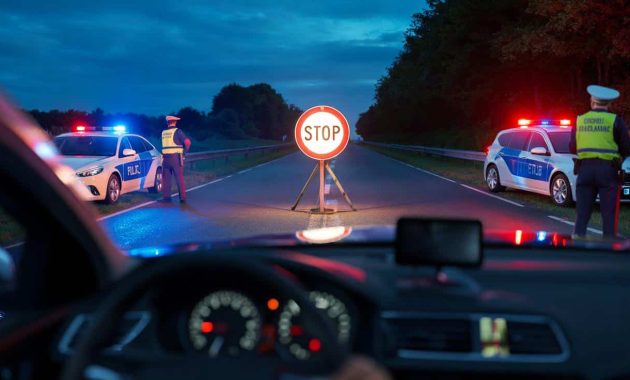
Instead of the word “STOP”, drivers will sometimes see a round sign with a red border and a white centre, often with wording such as “DOUANE” (customs), “POLICE” or “GENDARMERIE”. In everyday traffic, lots of motorists barely register it. Yet, in the eyes of the law, this disc means a full, complete stop is mandatory.
That plain-looking red and white disc is not a suggestion or a warning: it is a legal order to bring the vehicle to a complete halt.
Unlike direction signs or advisory panels, this one is part of the “B” family of signs in French road law – the category that indicates strict obligations. Ignoring it is treated in much the same way as driving through a regular STOP sign.
What the different “stop” discs actually mean
French regulations list several versions of this compulsory stop disc, each tailored to a specific situation. They all share the same basic shape: circular, red border, white background, and a short instruction in the middle.
The permanent customs sign: B4
The first variant, code B4, is usually fixed at borders. Drivers will see it when approaching customs checkpoints, particularly when passing between two countries by road.
- B4: border customs post – wording such as “DOUANE” in one or two languages
- Purpose: require every vehicle to halt at customs control
- Typical location: permanent installations at frontier crossings
For tourists who cross borders regularly, this sign is fairly familiar. Yet even there, some motorists slow down, glance at the booth and then roll on without fully stopping, assuming no one will care late at night or in light traffic. Legally, that is still a violation.
Mobile signs for police and gendarmerie checks: B5a and B5b
Things become trickier with mobile versions. The B5a sign is used by the gendarmerie, while B5b is used by the police. These panels are portable: officers load them into vans or cars and place them on the road during spot checks.
➡️ China turns a desert into a giant fish and shrimp farm
➡️ Slippery terrace and green slabs: these 4 kitchen staples beat bleach at killing moss
➡️ India watches nervously as its main rival moves to buy 50 new warships
| Code | Who uses it | What it signals |
|---|---|---|
| B5a | Gendarmerie | Temporary checkpoint or roadblock |
| B5b | Police | Temporary checkpoint or roadblock |
These operations might target drink‑driving, speeding, drug offences, vehicle paperwork or wanted persons. Because the signs are temporary, some drivers mistakenly treat them like suggestions, particularly if officers look busy with other vehicles.
Whether the panel is fixed in concrete or propped on a tripod by the roadside, the legal effect is identical: you must stop completely.
The toll road version: B5c
Another relative, B5c, appears at toll plazas, where the sign demands a compulsory halt in front of the booths. Even where toll systems are partly automated, the sign still indicates a point at which vehicles must come to a standstill before paying or passing an electronic gate.
This sign is more often permanent, but the rule remains the same: no rolling through on the assumption that your tag will beep while you keep moving.
What counts as a “real” stop?
From the perspective of traffic law, slowing down doesn’t qualify. Nor does that half‑second “almost stop” that many drivers convince themselves is good enough.
To comply, the vehicle has to be completely immobilised. The wheels must stop turning. There should be a brief moment where the car is fully at rest before moving again.
Officers often advise drivers to pause for at least a couple of seconds: count “one, two” while stationary before pulling away.
This is not just a box‑ticking exercise. At border posts, checks may detect illegal trafficking or stolen vehicles. At police and gendarmerie checkpoints, officers are trying to catch drunk drivers, uninsured cars and serious offenders. Skipping the stop undermines those safety operations and places others at risk.
The fines and penalties for ignoring the sign
French rules treat the failure to obey these mandatory stop signs as a significant traffic offence. The standard fixed fine is €135. On top of that, four points are deducted from the driver’s licence.
That applies whether the sign is permanent (such as at customs or a toll) or temporary (like a police roadblock). Repeated offences can trigger higher fines or a licence suspension, especially if combined with other violations such as speeding or drink‑driving.
- Standard fixed fine: €135
- Licence penalty: −4 points
- Possible add‑ons: higher fine, licence suspension, or criminal charges in serious cases
In practice, officers have some discretion. A driver who simply failed to notice the sign may receive the standard penalty, while someone who accelerates through a checkpoint after being waved down can face far tougher consequences, including prosecution for refusing to obey a lawful order.
Why so many drivers misunderstand this sign
Several factors contribute to the confusion. The first is design: unlike the STOP sign, there is no universal symbol. The wording inside the disc changes with the context and country – “DOUANE”, “STOP POLICE”, “ARRÊT”, and so on. Tourists and even locals may not immediately associate it with a full stop requirement.
The second factor is that mobile panels appear only occasionally. Many commuters can drive for months without encountering a gendarmerie or police checkpoint sign, then meet one at night on a dimly lit road and react too late.
There is also a behavioural side. Some drivers assume that if officers seem busy with other cars, they can roll past slowly. Others treat the sign as a polite invitation rather than a binding order. In French law, that interpretation is simply wrong.
Practical scenarios drivers might face
Night‑time checkpoint on a rural road
You are driving back from a dinner, a little tired, on a national road. In the distance you see flashing lights and a red‑and‑white disc with “STOP GENDARMERIE” written on it. The correct response is clear: gently brake, check your mirrors, and stop your car fully where indicated, even if no one is yet waving you down.
Officers might only ask for your licence and insurance, then let you go. If you roll past at 10 mph, shrug and continue, they can note your registration and issue a fine, or flag you down more assertively further along.
Border crossing with an apparently empty booth
On a quiet Sunday morning, you approach an international border. You see the B4 disc with “DOUANE”, but there is no visible queue and the booth seems closed. Legally, you still need to halt. Stop, look for instructions, and move on once it is clearly safe and permitted. Cameras and remote monitoring can record non‑compliance even if no officer is standing on the tarmac.
Key terms drivers should know
Two expressions often appear in official documents and are worth understanding:
- “Arrêt obligatoire”: literally “mandatory stop”. This means the vehicle must be fully immobilised, not just slowed down.
- “Panneau mobile”: a moveable road sign, usually on a stand or frame, used for temporary controls, works or events.
Both concepts matter, because mobile signs carry the same legal weight as fixed ones. The temporary nature of the panel does not weaken the obligation.
How this affects foreign drivers and hire cars
Holidaymakers in rental cars often assume that local police will go easy on them. That can be a costly miscalculation. Rental companies routinely receive notice of fines tied to number plates. They then pass the cost on to the customer, often with added administrative fees.
For drivers from points‑based licence systems, four points lost on a short trip can hurt just as much as it does for residents. In some cases, serious offences may lead to bans from driving on French territory, regardless of where the licence was issued.
Staying safe and legal when a sign appears unexpectedly
When that unfamiliar disc appears ahead, the safest mindset is simple: treat it like the standard STOP sign. Plan a controlled halt, check your surroundings, and wait for officers or signage to indicate your next move.
This approach protects you from fines and helps operations that aim to keep dangerous drivers off the road. A few seconds spent fully stationary can spare you a painful hit to both licence and bank balance – and may prevent far worse outcomes for other road users.