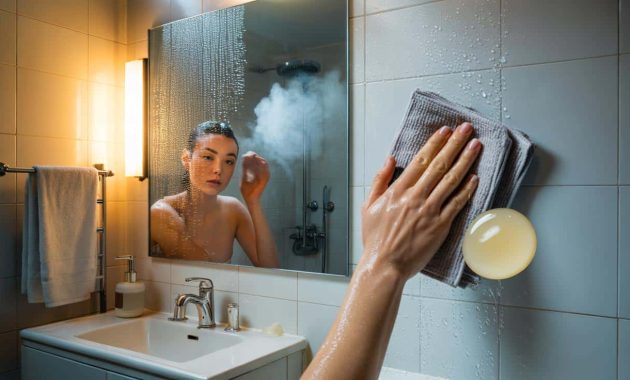
You’ve got meetings, a razor in hand, and a mirror that’s white with fog like it’s keeping a secret from you. You swipe, it smears. You try the towel, it streaks. By the time the glass clears, the kettle’s boiled, the bus has gone, and your patience along with it. There’s a solution hiding in plain sight, and it doesn’t ask you to remodel your bathroom or buy a gadget. It nudges the laws of physics to work for you.
Steam lifts off the tiles as if the room has just exhaled. I watched a man in a hotel in Manchester draw a porthole with his finger on a fogged mirror, trying to line up his beard in that tiny clear circle. It looked like he was shaving through a keyhole. The extractor fan hummed, late to the party. I wiped a circle with my palm and made it worse. The fix costs pennies.
The bit nobody mentions: your mirror is losing a temperature battle
Your mirror fogs not because the room is steamy, but because the glass is colder than the air. Warm, moist air hits a cool surface, the water vapour condenses, and you get that grey bloom. You can open windows, blast fans, wave towels and scold the shower. The glass stays cold, so the fog keeps winning. The answer is to shift the fight to where you can actually win it.
We’ve all had that moment when you reach for toothpaste and your reflection is a ghosted outline. I met a bathroom fitter in Leeds who laughed at my list of sprays and wipes. He tapped the mirror with a knuckle and said, “That’s just a cold slab.” He showed me a neat trick before I stepped in: warm the glass, then give it a microscopic shield. Two minutes later, the mirror stayed crisp while the room looked like a sauna.
Think of dew on grass. Dew appears when the grass is colder than the air’s dew point. Your mirror is the same: a thin sheet of glass that cools quickly, begging steam to settle. Change the temperature of that glass and the dew point maths changes too. Add a whisper-thin surfactant film and the droplets can’t bead the same way, so they slide off before they scatter the light. That’s the whole game: temperature and surface tension. Get those right and the fog has nowhere to cling.
The quiet trick: warm the glass, then prime it
Here’s the method. Before you shower, run the hot tap and soak a microfibre cloth or flannel until it’s nicely hot. Wring it, then press it flat against the mirror for 20–30 seconds. You’re not cleaning; you’re warming the glass. Now add a pea-sized dot of washing-up liquid to a dry corner of the cloth and buff the mirror in wide arcs until it looks completely clear. No smears, no suds. This leaves an invisible film that tweaks how water behaves on the surface. Step into the shower. When you’re done, your reflection is… still a reflection.
Common mistakes? People use too much product. You want a film, not a layer. If you can see it, it’s too much. Don’t follow with glass cleaner or you’ll strip the film you’ve just laid down. Crack the door a finger’s width while the water runs to encourage a gentle drift of air. If you’ve got an extractor, switch it on as you start, not after the room turns misty. Let’s be honest: no one really does that every day, so build it into your muscle memory—flannel, buff, door. Small, repeatable, done.
One bathroom consultant put it simply: warm the glass, not the room. Give the surface a tiny advantage and the fog gives up fast.
“Heat beats humidity every time, and a microfilm buys you minutes,” said Mark, a fitter who installs high-end demisters but still uses this trick at home. “I tell clients: ninety seconds before, not nine minutes after.”
- What you need: one microfibre cloth, a warm flannel, a dot of washing-up liquid.
- How long it takes: about 90 seconds before your shower.
- How often: refresh the film once or twice a week; a quick buff keeps it going.
- What to avoid: glass cleaner straight after buffing, waxy products, heavy sprays meant for cars.
- Bonus: if you’ve got a towel radiator, hang the flannel there—ready-warm.
Why this tiny ritual changes your mornings
You’re not fighting steam anymore—you’re orchestrating it. The hot flannel preps the surface so it sits nearer the air temperature you actually bathe in. The microfilm smooths the terrain, so droplets can’t scatter light and turn everything pearly. You step out, face clear, shaving lines clean, makeup accurate. It’s ordinary magic, grounded in physics and a habit you can do with your eyes half shut. A 90-second habit beats a 10-minute fog delay.
➡️ Rafale: India prepares a second major Rafale M carrier jet contract
➡️ If conversations drain you, this boundary helps quietly
➡️ Science says it clearly: 24-hour days are wobbling — and we’ve already noticed
➡️ The surprising reason your house feels colder even when the thermostat says 21°C
➡️ Forget fabric softener this fruit peel trick makes laundry softer and more fragrant naturally
There’s another layer to this. The bathroom becomes kinder. You’re not whipping a towel at the mirror, not introducing lint and streaks, not scrubbing in a rush. Small rituals have a way of calming the rest of the morning. The film doesn’t last forever—you’ll renew it—but the payoff stacks. Your future self gets an unhurried face and a mirror that behaves. Soyons honnêtes: personne ne fait vraiment ça tous les jours? Maybe not. But when you do, the difference is immediate and oddly satisfying.
You might share it with a flatmate and watch them scoff until they try it. You might show it to your teenager who’s mastered eyeliner but battles fog. Or you might quietly keep it, the way people keep shortcuts to a better day. It’s not a gadget. It’s not a hack that smells like a petrol station. It’s the unglamorous truth of glass and air meeting on your terms. That tiny tilt in your favour is the bit no one talks about.
| Point clé | Détail | Intérêt pour le lecteur |
|---|---|---|
| Pre-warm the mirror | Press a hot flannel on the glass for 20–30 seconds before showering | Raises surface temperature above the fog threshold |
| Prime with microfilm | Buff a pea-sized dot of washing-up liquid until invisible | Makes droplets slide off instead of scattering light |
| Gentle airflow habit | Crack the door and start the fan early | Keeps moisture moving without chilling you |
FAQ :
- Does shaving cream work as well as washing-up liquid?Yes, a thin buffed layer of shaving cream creates a similar surfactant film. Use a tiny amount and polish until the glass looks clear.
- Is vinegar safe on mirrors for anti-fog?Vinegar cleans well but doesn’t prevent fog by itself. If you use it, apply the film afterwards or you’ll strip the protective layer.
- Will toothpaste stop fogging?Toothpaste can scratch and leave residue. It’s made for enamel, not glass. Skip it and use a proper surfactant film instead.
- Can I use car anti-fog or Rain‑X indoors?Many car products aren’t designed for small, steamy rooms. Read the label for indoor safety and ventilation. A simple washing-up liquid film is safer.
- How long does the effect last?Usually a few days to a week, depending on how often you shower and clean. Refresh with a quick buff when fog starts to return.