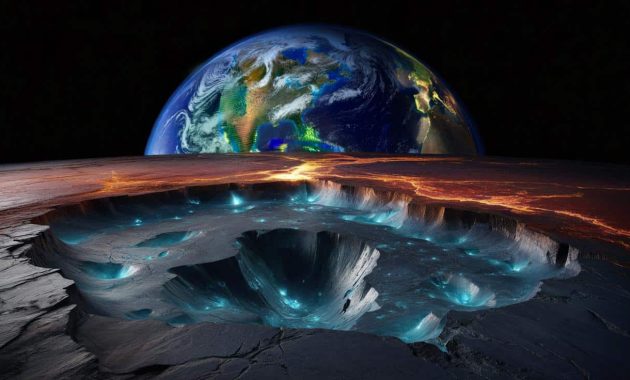
On a gray morning in Chicago, geophysicist Steve Jacobsen stared at a jagged blue blotch on his seismic model and felt his stomach drop. For months, his team had been listening to echoes from earthquakes on the other side of the planet, trying to map the invisible layers of the deep Earth. That day, the data stopped behaving the way it was supposed to. Waves slowed down. Patterns twisted. Something vast and strange was hiding 700 kilometers beneath our feet.
He zoomed in. The models sharpened. What looked like a ghostly ocean unfurled across the screen, buried inside solid rock.
An ocean that no one can ever sail.
The hidden sea under our feet
If you could slice the Earth open like a ripe fruit, the surprise wouldn’t just be the molten core. Somewhere between the crust we walk on and the fiery heart below, there’s a twilight zone of rock called the mantle transition zone. That’s where scientists now say a colossal, water-rich layer is quietly locked away.
Not water in lakes or rivers. Water trapped inside crystals, bonded to minerals under insane pressure and heat. Yet when you do the math, the amount of water stored down there could rival, or even exceed, all the oceans on the surface.
The story really took shape in 2014, when a tiny, battered diamond from Brazil landed on a researcher’s desk. Inside it: a microscopic mineral called ringwoodite, formed only at extreme depths. Under the microscope, that mineral carried a whisper from 700 kilometers down.
Ringwoodite can hold water, and this one did — about 1% of its weight. That sounds small. But spread that ratio across an entire layer of the planet, and you end up with something like a hidden ocean spread through rock, not pooled in empty space. Seismic waves from earthquakes then backed up the hint from the diamond: the deep Earth was behaving like a sponge stuffed with water.
Geophysicists now talk about this region as a vast reservoir, not a hollow sea. The mantle transition zone, roughly between 410 and 660 kilometers down, seems to be loaded with water-bearing minerals. Deeper still, near 700 kilometers, the signatures looked even stranger.
Earthquake waves slow and bend in ways that suggest parts of this deep layer are partially melted. That kind of melt often needs water to exist. It’s like hearing a slosh through a wall you thought was solid concrete. The “ocean” is not something you could swim in, but it behaves like a planetary water bank shaping everything above it.
Why this buried ocean changes the story of Earth
Understanding this underground ocean begins with something almost boring: minerals changing shape. Under the crushing weight of hundreds of kilometers of rock, familiar minerals like olivine shift into new forms. One of those forms, ringwoodite, can hold surprising amounts of water.
➡️ Cancer hijacks an embryonic machinery to turbocharge its growth
➡️ This is the most effective way to stop condensation and mould on windows
➡️ To slow the desert, China bets on a “Great Green Wall” of tens of billions of trees
➡️ You only need one tablespoon: It drives moths out of your home for good
➡️ Trees in Panama’s tropical forests are growing longer roots in the face of drought
➡️ People who fear happiness may secretly confuse peace with the calm before a storm
When rock sinks from the surface down into the mantle, it drags water with it. That water bonds with the crystal structure, hiding in atomic-scale spaces. At the depths around 700 kilometers, conditions are just right for a huge amount of that water to be stored instead of escaping upward or downward.
Most of us picture the water cycle as clouds, rain, rivers, and oceans. A neat surface loop you learned at school. The reality is messier and far more dramatic. Tectonic plates shove oceanic crust under continents, subducting slabs loaded with wet sediments and hydrated rocks. That material plunges deep, carrying surface water into the planet.
Some of it comes back up in volcanic eruptions. Some of it stays trapped for millions of years. This buried ocean means the true water cycle is a conveyor belt from sea to mantle and back, a full-planet circulation that runs on the timescale of continents drifting.
This hidden reservoir might be one of the quiet architects of life’s stability on Earth. Water deep in the mantle can change how stiff or soft rock behaves, which influences plate tectonics. Moving plates create mountains, basins, volcanic arcs — the landscapes we depend on. They also help regulate carbon and climate over geologic time.
If the mantle were bone-dry, our planet might look more like Mars: rigid, cracked, geologically sleepy. With this hidden water, **Earth stays restless**, recycling its crust, venting heat, and slowly sculpting habitats where life can thrive. Let’s be honest: nobody really thinks about that when they turn on the tap.
How scientists “see” an ocean they can’t touch
The practical question is simple and maddening: how do you study something you can never visit? There is no probe diving 700 kilometers down. No drill going anywhere near that. So scientists turned to three tools — earthquakes, diamonds, and experiments that feel like science fiction.
Seismologists use massive networks of sensors to record tremors. When big earthquakes hit, waves shoot through the planet. Their speed and direction shift depending on what they pass through. By comparing thousands of earthquakes, researchers piece together 3D maps, a bit like an ultrasound of Earth’s interior.
Then there are the diamonds. Not shining in jewelry stores, but dark, ugly crystals erupted by deep volcanic plumes. These diamonds are time capsules from the mantle. Trapped inside them: tiny fragments of once-unreachable minerals, still bearing traces of the pressure, temperature, and water content from where they formed.
We’ve all been there, that moment when a tiny detail blows up your entire mental map of reality. That Brazilian diamond did exactly that to geoscience. Suddenly, the idea of a deep, water-rich layer wasn’t a wild hypothesis. It was sitting under a lens, stubbornly, undeniably real.
Laboratories then tried to recreate hell. Using diamond-anvil cells and lasers, teams squeezed and heated minerals like ringwoodite to pressures and temperatures matching 700 kilometers below the surface. They watched how much water these minerals could absorb before transforming or melting.
“We didn’t find a free ocean,” one researcher said, “we found something stranger: a wet planet pretending to be dry.”
- Earthquake imaging — Reads wave speeds to detect water-rich or partially molten zones — Helps map where this hidden “ocean” is thickest.
- Deep diamonds — Carry microscopic minerals formed at mantle depths — Offer direct physical samples of water-bearing phases.
- High-pressure experiments — Simulate deep-Earth conditions in the lab — Reveal how much water minerals can realistically store.
A wetter, weirder planet than we thought
Once you accept that a vast ocean is locked inside the mantle, a simple walk along a beach feels different. The waves at your feet, the clouds above, the moisture in the air — they’re just the visible skin of a much deeper system. Our planet is not a dry rock with water on top. It’s *water all the way down*, woven into its structure.
This changes how we think about other worlds too. If Earth hides oceans in its interior, maybe super-Earth exoplanets, those giant rocky worlds orbiting distant stars, are also saturated with internal water. Some may never show blue seas on the surface, yet still be dripping with hidden reservoirs deep below.
| Key point | Detail | Value for the reader |
|---|---|---|
| Deep “ocean” in the mantle | Water stored in minerals around 700 km down, possibly rivaling surface oceans | Reframes what you think you know about Earth’s structure |
| Expanded water cycle | Water circulates from oceans into the mantle via tectonic plates and back via volcanism | Shows how deeply connected climate, geology, and life really are |
| New view of habitable worlds | Planets can hide massive internal water without obvious surface seas | Widens the kinds of planets that might support life |
FAQ:
- Is there really a liquid ocean 700 km below the surface?
No. The “ocean” is not a free body of liquid water. It’s water stored inside solid minerals, plus small regions of partial melt. The total amount of water, though, could match or exceed all surface oceans.- Could humans ever reach this hidden ocean?
No. The deepest drill hole ever made is about 12 km, a tiny scratch compared to 700 km. Temperatures and pressures at those depths are far beyond our current engineering capabilities.- Does this underground water affect earthquakes or volcanoes?
Yes, indirectly. Water in the mantle changes how rocks melt and flow. That can influence where magma forms, how easily tectonic plates move, and how stress builds up before quakes.- Does this mean Earth has more water than we thought?
Most likely. The discovery suggests a much larger total water budget for the planet, with a huge fraction locked away in the mantle instead of visible on the surface.- Could other planets have similar hidden oceans?
Quite possibly. If Earth’s mantle can store this much water, other rocky planets with similar compositions could too. That makes some dry-looking worlds more interesting in the search for life.