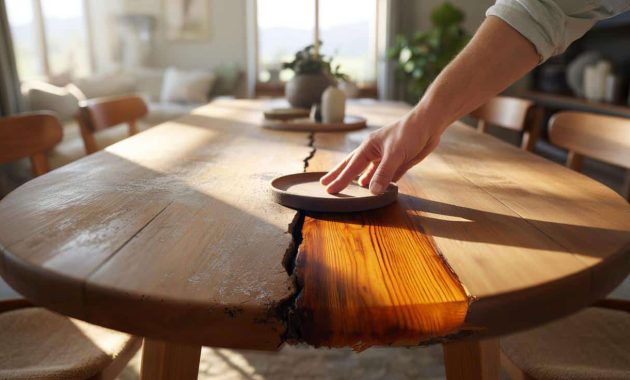
Not damaged, not ruined, just… faded, like someone had turned the saturation down on a family photo. The owner, Sarah, stroked the oak surface and sighed, convinced the wood was getting “too old”, as if it had passed some invisible expiry date. Yet under the edge of a coaster, a strip of honey-gold shone through, rich and vivid. The colour of the wood that used to be everywhere.
That small contrast tells a story most people miss. Wood doesn’t really “die” with age, at least not in the way we imagine. The first thing that fails is what we put on top of it. Varnish, lacquer, oil, wax: the transparent skins that break long before the wood itself gives up. The tragedy is quiet and slow, almost invisible.
Until one day you look up and realise your favourite piece of furniture has gone dull.
Why your wood furniture suddenly looks “old” overnight
You often notice it on a grey Tuesday morning. The light falls differently, your coffee mug leaves a faint ring, and the sideboard that once glowed now seems flat, almost chalky. It feels like ageing, like time catching up on an object that has seen too many years and too many moves. So you sigh, call it patina, and live with it.
What’s really happening is less poetic and more chemical. The protective layer on top – that thin film you rarely think about – is breaking down. Tiny scratches from keys. Heat from laptops. Moisture from plant pots. Sunlight eating away at the finish, not the wood. *The wood underneath is often still gorgeous, just trapped under a tired coat that’s lost its shine and depth.
Think of a clear phone screen protector full of scuffs: you don’t blame the glass underneath, you change the film. With furniture, most people never make that mental switch.
Take Mark, who inherited his grandmother’s walnut chest of drawers. He was convinced it was “too far gone”, its surface cloudy and sticky, with pale patches where sunlight had lived for decades. He planned to push it into the spare room, a kind of elegant exile. A local restorer persuaded him to let her “just clean and strip the finish, nothing dramatic”.
Three hours later, under fluorescent workshop light, the truth showed up. The bare walnut glowed, complex and warm, with dark veins and golden swirls. The dramatic “ageing” he’d been seeing was mostly an old varnish that had gone soft and amber, like old plastic. Once sanded lightly and re-finished with a modern varnish, the chest looked closer to new than to antique shop cliché.
Stories like this aren’t rare. Surveys among furniture restorers often repeat the same thing: most pieces people describe as “too old” or “finished” are structurally sound. The real failure point? The top 0.2 millimetres.
There’s a deeper logic at work. Wood is a stubborn material. Solid oak, walnut, beech – they’re built to last in trees that survive storms. Inside your living room, they’re comparatively protected. What suffers are the artificial shields we add. Varnishes become brittle. Oils dry and oxidise. Waxes attract grime. UV light shifts pigments in the finish, long before it truly bites the fibres below.
➡️ Bird lovers use this cheap December treat to keep feeders busy and attract birds every morning
➡️ If your house feels noisy, this small change can make it feel calmer instantly
➡️ A robot builds a 200 m² home in 24 hours : a breakthrough that could ease the housing crisis
➡️ North Korea flexes its muscles with ‘successful’ tests of a new class of nuclear-capable missiles
The eye reads the dull, scratched layer and blames the wood because it’s all one surface to us. Yet if you look at the edge of a chip, or lift a coaster that’s been sitting in the same place for five years, you suddenly see a bright, living colour that doesn’t match the rest of the top. That contrast is your clue: the wood is not old. The armour is.
Once you know that, “old furniture” looks different. You start seeing finishes that have failed, not timber that’s too tired to bother with. And that changes what you do next.
How to bring back the glow: working with the protective layer, not against the wood
The most effective move is surprisingly modest: refresh the finish before it dies completely. Not a full, sanding-down-to-bare-wood epic, just a light intervention while there’s still some life left in the top layer. Wipe the surface with a gentle cleaner, let it dry, then apply a compatible product – a fresh coat of wax on waxed pieces, oil on oiled ones, or a thin recoat of varnish after a very light sanding.
This doesn’t erase every scratch or water ring. It does something more useful. It nourishes the protective layer and fills in the micro-scratches that make light scatter instead of reflect. Your eye reads that as “tired” or “dusty”, even when the surface is technically clean. A refreshed finish pulls light back into the wood grain. Suddenly the piece looks deeper, darker, more three-dimensional.
The wood hasn’t changed in a day. The window you look through has.
Here’s the difficult part: we tend to care for wood furniture like we care for dentists’ appointments. We wait until there’s obvious pain. So the coffee table ends up with deep white heat marks, dark water spots, and a dry, thirsty look before anyone reacts. By then, the top coat is often broken right through, exposing raw wood in places. Repair is still possible, but it’s no longer a small job.
One quiet habit makes a huge difference: a real maintenance schedule, even if it’s laughably relaxed. Once or twice a year, stop, wipe, and renew. Soyons honnêtes : personne ne fait vraiment ça tous les jours. Yet once a spring, once an autumn? That’s doable. A Sunday where you open the windows, turn on the radio, and slowly move from table to table.
The emotional frame matters. You’re not “saving” doomed old furniture. You’re just keeping the armour flexible and clear, before it cracks and turns cloudy.
As one restorer in Bristol put it while rubbing oil into a battered ash table:
“Wood doesn’t get boring with age. Our finishes get tired, our habits get lazy, and our lighting gets harsher. Fix those three, and most ‘old’ furniture wakes right up.”
That might sound idealistic, yet there are a few concrete levers anyone can pull:
- Choose finishes you’re willing to maintain, not just those that look good in the shop.
- Use coasters and mats where heat and moisture are daily guests, like under kettles and plants.
- Keep strong sunlight off the same patch of wood for hours every day; rotate or use light curtains.
- Do a “finish check” once a year: if the surface feels dry, sticky, or rough, it’s asking for help.
- Accept micro-scratches as life marks; react only when the top layer looks broken, not merely used.
None of this is about chasing perfection. It’s about letting a table age like a good leather jacket: worn, yes, but still alive and glowing.
Rethinking “old” wood: what really ages is our way of looking
There’s a hidden relief in understanding that your oak table didn’t suddenly lose its soul. The glow you miss is usually still there, waiting under a film that’s past its best days. Once you see furniture this way, you might hesitate before dragging something to the curb or replacing it with a flat-pack stand‑in. You might run a fingertip along the underside, notice the untouched colour, and feel a small jolt of possibility.
We often say that objects hold memories, yet we treat them as if they have a short emotional shelf life. One scratch, one dull patch, and they’re “done”. What if dullness was just a maintenance message, not a life sentence? That thought shifts the conversation from “out with the old” to “how could this look if I just helped the top layer along a bit?” It’s a quieter, more curious way to live with the things we already own.
On a practical level, this knowledge is also a kind of power. You start spotting bargains at flea markets because you can tell the difference between dead wood and dead varnish. You negotiate better prices because you’re not scared of cloudiness on the surface. You take more time choosing finishes when you buy new pieces, asking how they’ll behave after ten years, not just ten days. And when a friend says their table is “too old”, you might gently slide a coaster aside and show them the strip of hidden colour beneath.
Once you’ve seen that reveal a few times, it’s hard not to talk about it. People share before‑and‑after photos, pass on the names of patient restorers, or just swap stories of how a dull, inherited piece suddenly became the centre of a room again. Somewhere between the smell of fresh oil and the first glimpse of revived grain, you realise something simple and a bit comforting: wood doesn’t really age out of beauty. We mostly just forget to take care of the fragile layers we ask to protect it.
| Point clé | Détail | Intérêt pour le lecteur |
|---|---|---|
| Vieillissement du bois vs. vieillissement du vernis | La plupart des meubles ternes souffrent de couches protectrices fatiguées, pas de bois “trop vieux”. | Aide à comprendre que beaucoup de pièces peuvent être sauvées plutôt que remplacées. |
| Entretien régulier des finitions | Un nettoyage doux et un rafraîchissement une à deux fois par an prolongent la vie du meuble. | Offre une méthode simple pour garder ses meubles plus beaux, plus longtemps. |
| Lire les signes de la surface | Texture sèche, collante ou rugueuse = finition en fin de vie, pas forcément bois abîmé. | Permet de décider quand agir, sans paniquer au moindre défaut visuel. |
FAQ :
- How can I tell if the finish is failing, not the wood itself?You’ll feel roughness, stickiness, or see cloudiness and white rings on the surface. If you look under an object that’s been in one place for years and the wood there is richer in colour, the problem is almost always the top coat, not the timber.
- Do I always need to sand back to bare wood to restore shine?No. Light sanding and a fresh compatible coat often work if the finish is worn but not completely broken through. Full stripping is for surfaces with deep damage, peeling, or multiple incompatible layers.
- What kind of finish is easiest to maintain at home?Oiled and waxed finishes are usually friendlier for DIY maintenance, because they can be refreshed locally without heavy sanding. Film finishes like lacquers look tough but are trickier to repair invisibly when damaged.
- Can old, dull furniture be revived without hiring a professional?Yes, for many pieces. Gentle cleaning, light sanding with fine grit, and careful reapplication of oil, wax, or varnish can transform them. For antiques or sentimental items, a restorer’s advice is still worth seeking.
- How often should I refresh the protective layer on wood furniture?Most everyday pieces benefit from a check once or twice a year. If the surface looks flat, feels dry, or no longer repels water, it’s a good moment to clean and renew the finish before real damage sets in.