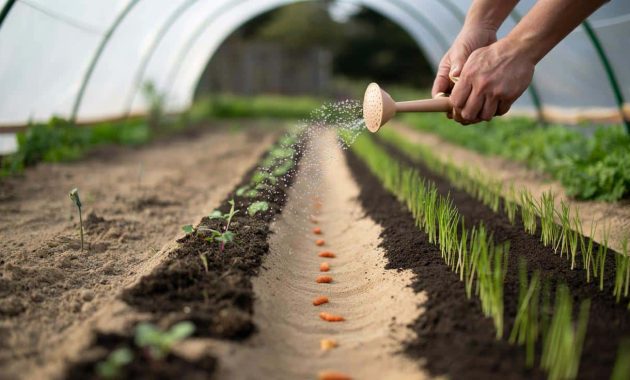
Across Britain and beyond, frustrated growers blame bad seed, the wrong moon phase or “this year’s weather”, when their early carrots simply fail to appear. Yet the real culprit often lies just a few millimetres beneath the surface.
The mystery of the bare carrot row
Every year, the same scene repeats itself. Someone sows carrots in February under a cloche or tunnel, waits three anxious weeks… and the row stays stubbornly brown. Maybe a few wispy plants appear in clumps, with long gaps of bare soil in between.
Carrots get labelled “tricky” or “temperamental”, but that reputation hides something far more prosaic: technique. Carrot seed is tiny, light and short on stored energy. That physical reality dictates how it must be handled.
Carrot seeds live or die on millimetres: too deep, they exhaust themselves; too shallow, they dry out.
When a seed germinates, it runs on reserves stored inside it. For a carrot, those reserves are extremely limited. They are just enough to push a thread-fine shoot to the surface, open the first leaves and begin photosynthesis. Ask that seedling to travel a few extra millimetres through heavy soil, and the tank runs dry before it reaches daylight.
Why cold weather gets blamed — and why it’s not the main problem
February soil is cold, and that makes an easy scapegoat. Many gardeners assume their early carrots rotted or froze. Yet early varieties are bred for cool conditions and can germinate at surprisingly low temperatures if protected from the worst of the weather.
A fleece, poly tunnel or cold frame can lift soil temperatures just enough. Under those covers, many seeds cope just fine with the chill. The real challenge is the physical barrier around them: the soil itself.
A cloddy, sticky seedbed is like trying to escape under concrete. When the first root and shoot hit a lump or crust, the tiny plant has to waste energy twisting and pushing. Often, it simply runs out of strength and dies just below the surface, unseen.
It’s not always the frost that kills your carrots. It’s the burial you gave them.
➡️ $9 billion, 730 missiles: the US–Saudi arms deal sparking fresh controversy
➡️ France and Rafale Lose €2.9 Billion Fighter Program Amid Corruption Allegations Probe
The golden rule: half a centimetre, not more than one
Market gardeners who rely on carrots for their income work with a clear rule: control the depth, or accept failure. Hasty, deep furrows scratched with a hoe are the enemy of carrot seed.
For reliable germination, the sowing depth should be between 0.5 and 1 cm. Not “about there”, not “a finger joint”, but genuinely shallow.
Why depth matters so much for carrots
Imagine a seed placed 3 cm down in the soil. It may still sprout; the biology is working. But the tiny seedling has to climb through 3 cm of compacting particles, in cold, often wet conditions. A carrot seed simply doesn’t have the stored fuel for that journey.
At 0.5–1 cm, the route is shorter. The plant can break the surface while it still has energy in reserve, then switch to solar power through its first leaves.
The “sweet spot” for carrot seed sits between 5 and 10 millimetres below a fine, loose surface.
Scatter seeds too close to the surface, though, and a windy, dry afternoon can dehydrate them before they even germinate. Birds and insects can also carry them off. The margin between “too deep” and “too exposed” is remarkably small, which is why many gardeners miss it.
Covering seeds: why sand and fine compost beat garden soil
Getting the depth right is only half the story. What you place over the seed is just as critical. Many garden soils, especially clay-based ones, behave badly after winter rain followed by a dry spell.
They form a hard skin known as a crust. For a strong bean seedling, that’s an irritation. For a carrot, it can be fatal.
The case for a light, sandy covering
Experienced growers often avoid putting the raw garden soil back on top of carrot seeds. Instead, they use a light, sifted material just for that top centimetre.
- Fine seed compost: holds moisture, crumbles easily, gentle on seedlings.
- Washed river sand: drains well, never forms a hard crust, very easy to push through.
- Mix of sand and compost: combines moisture retention with light texture.
By filling the shallow furrow with this lighter material up to a maximum of one centimetre, you create a soft corridor to the surface. The underlying soil can be heavier; the seedling doesn’t need to fight through it straight away.
A thin, sandy cap over the row is like a ramp to daylight for weak seedlings.
There’s another practical bonus. A strip of pale sand clearly marks where you sowed, which makes hand weeding less nerve-racking. You can see where the carrots are meant to be before they emerge.
Watering without washing everything away
The final hurdle is water. One heavy blast from a hose or a full-can shower can undo perfectly measured sowing in seconds. Seeds get washed into clumps or pushed deeper into the soil, precisely where you did not want them.
For carrot rows, the surface should be kept evenly moist rather than soaked. Think “mist” instead of “downpour”.
Gentle methods that protect your rows
- Use a watering can with a very fine rose, held low, so water lands as soft rain.
- Point the rose upwards so droplets fall back gently rather than thumping the soil.
- On very small beds or seed trays, use a hand sprayer to keep moisture levels steady.
- Check the soil daily: it should feel slightly damp, never bone dry and never waterlogged.
In late winter conditions, carrot seeds can take two to four weeks to appear, even under protection. That long wait makes steady moisture management crucial. Short, light watering sessions work better than rare, heavy drenchings.
Turning precision into abundance: spacing, thinning and timing
Once you accept that carrots need surgical precision in their first centimetre of life, the rest of the crop becomes easier to manage. Shallow depth and fine covering often lead to a more even line of seedlings, with fewer bald patches and dense clumps.
That makes thinning less of a chore. You can remove excess plants where they stand shoulder to shoulder, leaving 3–5 cm between each for medium-sized roots. The more regular the early germination, the more predictable the final harvest.
Good carrot rows look boringly uniform — and that uniformity starts with a one-centimetre decision.
Starting early, in February or early March under cover, also spreads risk. If one row fails due to a cold snap or missed watering, you still have time to sow again. Success comes less from heroics, more from small adjustments made consistently.
Applying the one-centimetre rule to other seeds
Carrots are the starkest example, but this logic applies to other fine seeds too. Radishes, lettuces and many herb species react strongly to depth and soil texture.
Radishes can tolerate slightly deeper sowing, yet still benefit from a fine, crumble-like surface. Lettuces, with even tinier seeds, often prefer an almost surface-level sowing with just a dusting of compost. The shared theme is simple: small seed, shallow depth, gentle cover.
| Crop | Seed size | Typical sowing depth | Best covering material |
|---|---|---|---|
| Carrot | Very small | 0.5–1 cm | Fine compost or sand |
| Lettuce | Tiny | Surface to 0.5 cm | Thin compost dusting |
| Radish | Small | 1–1.5 cm | Fine soil or compost |
Key terms gardeners often hear − and what they actually mean
The phrase “seedbed preparation” gets tossed around frequently. In practical terms, it means breaking soil into small particles, removing stones and large clods, and levelling the surface. For shallow-sown crops like carrots, that top 3–4 cm of soil behaves like a nursery. If it’s lumpy or compacted, the smallest seedlings lose the fight.
You may also hear “battance” or “soil crusting” in gardening guides. That refers to the hard layer that forms on top of fine soil after heavy rain followed by sun and wind. Avoiding that crust is one reason sand and light compost are so valuable just above carrot seeds.
A realistic late-winter scenario
Picture a small bed under a simple plastic tunnel in early February. The soil has been forked but not overturned deeply, then raked until the surface feels like coarse flour. Shallow drills, no deeper than a child’s little finger nail, are scratched in straight lines.
Carrot seed is trickled in, as thinly as patience allows. A mix of river sand and seed compost is used to fill the drills, level with the surface. The row is watered with a fine rose until the sand darkens. A fleece cover goes back on, and the gardener walks away.
Over the next three weeks, the bed is checked often. If the sand looks pale and dry, a light misting tops up the moisture. Cold nights come and go, but the top centimetre stays crumbly and soft. Then, almost overnight, a faint green line appears. One careful centimetre has quietly paid off.