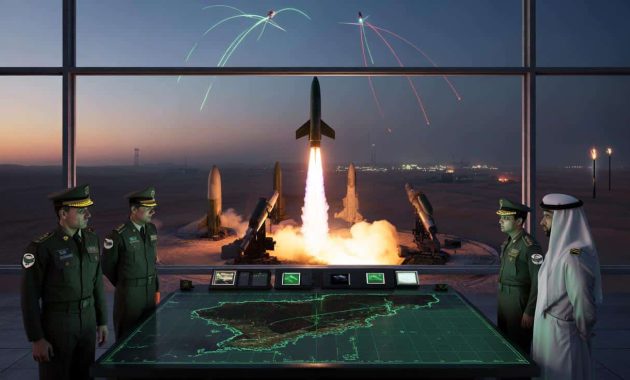
Washington has signalled its readiness to greenlight a multi‑billion‑dollar package of advanced air‑defence missiles for Riyadh, deepening a long‑standing but increasingly controversial partnership at the heart of Middle East geopolitics.
A $9 billion deal with high stakes
The proposed agreement centres on the sale of 730 PAC‑3 MSE missiles, the latest generation of Patriot air‑defence interceptors, to Saudi Arabia. The package is valued at roughly $9 billion, or around €8.3 billion, and includes training, software, documentation and long‑term technical support.
The deal would deliver 730 Patriot PAC‑3 MSE missiles, significantly boosting Saudi Arabia’s ability to shoot down hostile aircraft, drones and ballistic missiles.
These missiles are designed to intercept incoming threats in the final phase of their trajectory. In practice, that means attempting to destroy ballistic missiles or sophisticated drones before they can reach Saudi territory, oil facilities or military bases used by US and allied forces.
According to information notified to Congress, the package goes far beyond simple hardware. It adds a wide range of collateral services and equipment:
- Non‑major defence equipment and associated components
- Training for Saudi personnel on maintenance and operation
- Technical assistance from US contractors and government staff
- Logistics support, spare parts and long‑term sustainment
- Software and both classified and unclassified documentation
For Washington, this scale underlines not just a sale, but an ongoing strategic commitment to keep Saudi air defences interoperable with US forces.
Who approves a deal like this?
The proposal has already cleared a key hurdle: formal approval by the US State Department, which oversees foreign military sales. From there, responsibility passes to the Defense Security Cooperation Agency (DSCA), the Pentagon body that administers such exports.
DSCA has issued the legally required certification that the sale fits with US foreign policy and national security goals. It has also notified Congress, giving lawmakers an opportunity to scrutinise or attempt to block the package within a limited time window.
The US labels Saudi Arabia a “major non‑NATO ally”, a status that facilitates access to advanced military technology and joint projects.
➡️ To slow the desert, China bets on a “Great Green Wall” of tens of billions of trees
➡️ The plant that perfumes the home and repels mosquitoes : here’s why everyone wants it in spring
This political label is not a defence treaty like NATO, but it does signal that Saudi Arabia is treated as a key partner. It eases the path for arms sales, intelligence cooperation and joint training programmes.
Why Saudi Arabia wants the PAC‑3 MSE
Saudi Arabia already operates the Patriot system, and it has been tested repeatedly by missile and drone attacks, particularly from Houthi forces in Yemen. Those attacks have struck oil facilities, airports and critical infrastructure, sometimes slipping through existing defences.
Defending airspace in a volatile region
The PAC‑3 MSE variant — the “Missile Segment Enhancement” model — offers improved range, manoeuvrability and accuracy compared with older Patriot interceptors. It is optimised to tackle modern threats such as short‑ and medium‑range ballistic missiles and low‑flying drones.
US officials argue that upgrading Saudi capabilities will help shield not only Saudi towns and oil fields, but also American troops and bases stationed in the kingdom and nearby Gulf states. For Washington, that offers a direct national‑security argument in favour of the sale.
US officials insist the new missiles will not “alter the basic military balance” in the Middle East, a pledge aimed at calming worried neighbours.
That assurance is intended to reassure states such as Iran, Qatar and the United Arab Emirates that the deal is defensive, not a sign of preparations for offensive action.
The political backlash in Washington
The sale lands in the middle of an intense debate about America’s relationship with Riyadh. Members of Congress from both parties have, in recent years, pushed back on arms exports to Saudi Arabia over civilian deaths in Yemen, human rights concerns and the 2018 murder of journalist Jamal Khashoggi.
Some lawmakers argue that ramping up military support sends the wrong message and reduces US leverage on human rights and regional de‑escalation. Others see Saudi Arabia as too strategically important to alienate, particularly as the US tries to contain Iran and manage energy markets.
| Key aspect | Supporters say | Critics say |
|---|---|---|
| Regional security | Strengthens a partner against missile and drone attacks | Risks deeper involvement in conflicts like Yemen |
| US interests | Protects US troops, bases and energy flows | Locks Washington into dependence on Riyadh |
| Human rights | Arms are defensive, not tools of repression | Rewards a government accused of grave abuses |
These arguments will play out on Capitol Hill in the coming weeks, where formal resolutions of disapproval remain possible, even if rarely successful.
How the deal fits the wider Middle East chessboard
The Gulf region is already packed with advanced hardware. The United Arab Emirates and Qatar operate sophisticated air forces. Israel maintains a layered missile defence network including Iron Dome, David’s Sling and Arrow systems. Iran has expanded its missile and drone arsenal, and supports non‑state groups that use similar weapons.
Against that backdrop, Saudi decision‑makers see Patriot upgrades as a necessary catch‑up, rather than a luxury. The kingdom has faced coordinated barrages of drones and cruise missiles on oil infrastructure, showing how vulnerable static facilities can be.
US officials frame the sale as part of an “integrated air and missile defence” architecture, where Gulf states and the US share radar data, threat warnings and, in some cases, command structures. In theory, this could create a regional shield against attacks, especially from Iran or its allies.
Industry and economic angles
The deal would inject billions into the US defence industry, especially companies involved in Patriot production lines. That means jobs, long‑term maintenance contracts and continued demand for spare parts and upgrades.
For Saudi Arabia, spending such sums is also a political statement. It signals that, despite tensions, Riyadh still sees the US as its preferred security provider, even as it tentatively improves ties with China and Russia and pursues its own defence industrial ambitions.
What PAC‑3 MSE actually does, in simple terms
For non‑specialists, the jargon can be confusing. The Patriot system combines powerful radar, command computers, and launchers that fire interceptor missiles. When the radar detects an incoming threat, the system calculates its trajectory and fires an interceptor to smash into it at high speed.
The PAC‑3 MSE missile is smaller than earlier Patriots, but more agile. That allows multiple interceptors to be loaded into each launcher and helps tackle manoeuvring targets. It relies on “hit‑to‑kill” technology, destroying the threat through kinetic impact rather than a big explosive warhead.
In a real‑world scenario, if a short‑range ballistic missile were launched at a Saudi oil facility, radar would track it within seconds. The fire‑control system would assign a PAC‑3 MSE interceptor, which would climb to meet the target in its terminal phase, aiming for a direct collision before it can release its payload over the target.
Risks, limits and possible scenarios
No missile defence system offers a perfect shield. Salvo tactics — where an attacker launches many missiles and drones at once — can saturate even advanced systems. Adversaries can also adapt by using low‑flying cruise missiles, decoys or cyberattacks against radar and command networks.
One plausible scenario sees Iran or allied groups using mixed swarms of cheap drones and more expensive missiles, forcing Saudi Arabia to expend costly interceptors. A single PAC‑3 MSE missile can cost several million dollars, while a simple attack drone can be assembled for a fraction of that.
This cost asymmetry raises questions about sustainability. If sustained attacks continue, Saudi stockpiles would need constant replenishment, locking in long‑term spending and dependence on US production capacity.
There is also the risk of political blowback. A major air‑defence upgrade can be read by rivals as a sign that Saudi Arabia expects future confrontation. That perception may shape Iran’s calculations, regional arms races, and diplomatic initiatives — especially any future attempts at a Gulf security framework.
For readers trying to interpret such deals, two concepts are worth keeping in mind. First, “defensive” weapons still affect power balances, because they change how safe leaders feel when making risky decisions. Second, arms packages come with political strings, from training and data‑sharing to long‑term alignment. A contract for 730 missiles is, at its core, also a contract for years of shared strategy between Washington and Riyadh.