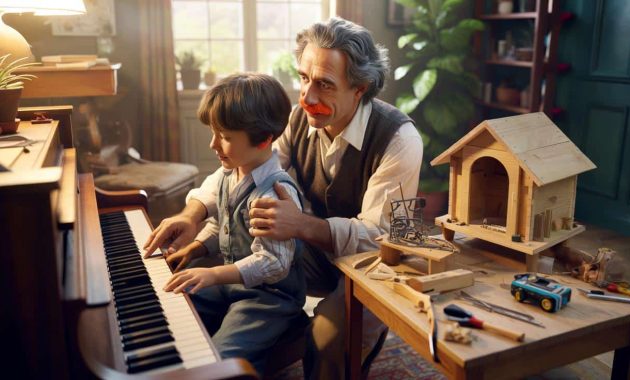
That tension sits at the heart of a little note from Albert Einstein to his son. It reads like a memo from yesterday. It points to joy as the driver of durable learning. It asks adults to back curiosity with time, tools, and trust.
A father’s note with a modern punch
In 1915, Einstein wrote to his 11-year-old son, Hans Albert, who lived apart from him during a turbulent family chapter. He cheered two humble pursuits: music at the piano and building with wood. He nudged daily practice, not as a duty, but as a door. He knew that self-chosen work sticks.
Curiosity beats curriculum when a child cares about the task and returns to it on their own.
He did not trash school. He reframed it. He placed enthusiasm first, then technique, then results. That order often flips in classrooms and kitchens. His note reads like a lean blueprint for motivation that leaders in child-centered education later refined.
Why joy outperforms drills
What science says about motivation
Brain research now maps what many parents feel. Interest nudges dopamine. Dopamine sharpens attention. Attention locks new patterns in memory. Choice also lights up control networks that support persistence. Repetition grows skill only when the mind stays engaged. Forced grind often yields short bursts of performance and fast forgetting.
Joy fuels focus, and focus turns practice into growth that lasts.
Hands-on tasks add another layer. Music trains timing and working memory. Woodwork trains spatial reasoning and planning. Both teach patience and error recovery. Those habits travel into math, writing, and social life.
From living room to classroom
You can wire this approach into small routines without flipping your life. Start by giving protected time. Add a little structure around the child’s choice. Track progress through reflection rather than points.
- Set a daily 20-minute block for a self-chosen skill, free of phones and grades.
- Rotate maker stations at home or school: music, carpentry, robotics, cooking, gardening.
- Use a one-line journal: Today I tried… I noticed… Next time I will…
- Swap some quizzes for a monthly showcase with demos, short notes, and photos.
The Montessori overlap, without the labels
Maria Montessori built an approach around guided freedom. She designed rooms where children move, choose, and finish. Adults set clear boundaries and then step back. Responsibility grows because ownership grows. Einstein’s letter lands on the same path: let interest lead, support the craft, and watch stamina rise.
➡️ “I feel overwhelmed by emotional closeness”: psychology explains fear of imbalance
➡️ What walking with your hands in your pockets means, according to psychology
➡️ The cleaning habit that keeps mess from piling up silently
➡️ A tiny behavioral change can restore mental balance
| Activity | Skills strengthened | Bonus effects |
|---|---|---|
| Piano or guitar | Working memory, rhythm, attention control | Mood regulation, auditory discrimination |
| Carpentry | Spatial reasoning, measurement, planning | Hand strength, patience with iteration |
| Cooking | Sequencing, fractions, timing | Sensory integration, hygiene routines |
| Robotics or coding | Systems thinking, logic, debugging | Resilience after failure, teamwork |
| Gardening | Observation, data logging, care cycles | Stress reduction, responsibility |
The phrase parents can borrow today
Einstein’s note can fit the world of homework apps and busy evenings if we give it a simple line that you can repeat, calmly and often.
Do more of what lights you up each day, because that practice teaches you more than a worksheet ever could.
Say it before homework. Say it after practice. Say it when a project stalls. The line sets a compass without lecturing. It respects the child’s drive while honoring craft and repetition.
Make it fit your house
- “Pick a project for this week. I will help set the space and gather tools.”
- “Show me the hardest part you met today. Let’s plan one tiny tweak.”
- “Your riff sounds tighter. What changed in your practice time?”
- “When you feel bored, switch to a different step, not to a different screen.”
Where uneven paths beat straight lines
Einstein did not glide through childhood. He disliked rote drills. He read slowly by some accounts. He still learned ferociously when a topic grabbed him. That pattern shows up in many children. Uneven does not mean unready. It means the entry point differs, and the pace varies.
Risks and how to balance them
- Too much freedom can sink into drift. Set short, clear goals for each session.
- Performance pressure can crush interest. Cap test prep and protect hobby time.
- Screens can hijack attention. Add friction to passive scrolling and keep tools in sight.
- Gear can get pricey. Start with scrap wood, borrowed instruments, or free apps.
What this means for schools now
Schools can widen space for choice without losing rigor. A weekly passion block invites depth. Maker corners convert idle rooms into learning labs. Portfolio defenses replace some high-stakes tests. Teachers act as coaches who set constraints and ask better questions. Students bring evidence of effort, not just right answers.
When students own the goal, practice becomes voluntary, and voluntary practice builds mastery.
Districts that add arts and hands-on projects often report fewer behavior issues and steadier attendance. Families notice calmer evenings. Young people talk more about process and less about points. Those shifts build grit without cynicism.
Try a simple 7-day plan
- Day 1: Choose a project and define a tiny finish line for Friday.
- Day 2–4: Practice 20–30 minutes, log one sentence, snap one photo.
- Day 5: Share a mini-demo with a peer or parent and ask for one question.
- Day 6: Fix one flaw you noticed during the demo.
- Day 7: Rest or switch domains to keep energy fresh.
Extra context that helps parents act
The phrase “do what lights you up” does not ignore discipline. It shapes it. Children stick with hard parts when they care, then they learn to tolerate frustration. You can raise the challenge slowly: more complex pieces, tighter joints, longer code. The curve stays steep and satisfying.
Cross-pollination also matters. Music supports math through pattern sense. Carpentry supports geometry through angles and length. Gardening supports science through cycles and measurement. You can stack passions during the year: fall for building, winter for music, spring for plants. That rhythm keeps curiosity warm while skills compound.