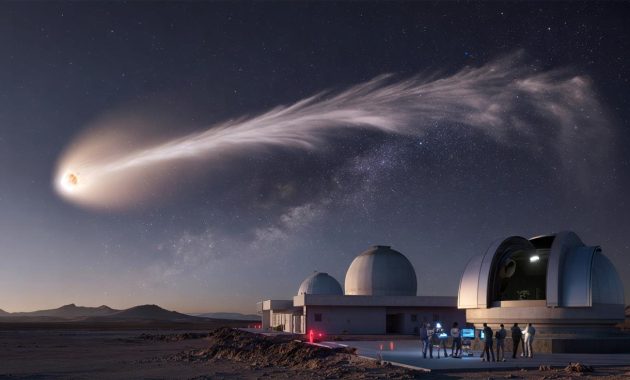
On a windless winter evening in Chile’s Atacama Desert, a group of astronomers stood in the bluish glow of their monitors, eyes fixed on a barely-there smudge of light. On screen, the smudge sharpened, pixel by pixel, into a curling, ghostly tail. Someone swore softly in disbelief. Another burst out laughing.
The object drifting into focus wasn’t just any comet. It was 3I ATLAS, only the third confirmed interstellar comet ever spotted passing through our Solar System, freshly revealed in unprecedented detail by a worldwide network of observatories.
For a brief moment, the control room was completely silent.
Then they realized what they were looking at.
When an interstellar visitor suddenly sharpens into view
The first new images of 3I ATLAS look like something out of a high-budget sci‑fi movie, except they’re real and arrive as raw data on tired astronomers’ screens at three in the morning. From the European Southern Observatory’s Very Large Telescope to the Subaru Telescope in Hawaii, teams coordinated like an international relay race, each catching the comet as Earth spun it into view.
On the finished composites, 3I ATLAS doesn’t look like a tiny dot. It looks alive. A thin, strangely kinked tail, a fuzzy, asymmetric coma, subtle jets fanning out as if the comet is exhaling after a billion‑year journey between the stars.
What makes these images so striking isn’t just the beauty. It’s the level of structure that shows up once you stack dozens of high‑resolution exposures from multiple telescopes. One sequence from the Gemini North telescope shows the coma changing shape over a single night, as sunlight cooks volatile ices and sends plumes of material into space.
Another set, captured in near‑infrared from the VLT, reveals clumps of dust locked into the tail like beads on a string. These are the kind of details older generations could only dream of. Now, they’re being shared on social media feeds, right between a cat video and a recipe reel.
Astronomers are treating 3I ATLAS like a forensic time capsule that fell into our backyard. This comet didn’t form with our Sun; it grew up around another star, in another planetary nursery, and then was flung into deep space. By splitting the light in these new images into spectra, researchers can map out its chemistry, comparing it to home‑grown comets like 67P or Halley.
The early verdict: 3I ATLAS seems both familiar and alien. Similar water and carbon compounds, yes, but ratios that don’t quite match what we know. In plain terms, it’s like opening your neighbor’s fridge and realizing their idea of “basic groceries” is just slightly off from yours.
➡️ The hidden nutritional deficiencies that cause fatigue, depression, and poor immune function
➡️ Car windshield frozen on the inside: What you can do and what isn’t a good idea
➡️ The reason some plants recover quickly after storms while others never do
➡️ Hairdresser reveals hard truth about short hair for women over 50 that many won’t want to hear
➡️ Germany Negotiates With Israel For New Arrow 3 Systems
➡️ I make this raclette toastie in a pan when it’s freezing: 4 ingredients, 15 minutes, total pleasure
How a worldwide telescope network “chased” 3I ATLAS
Catching an interstellar comet in detail is less like a single heroic snapshot and more like a carefully choreographed dance. 3I ATLAS is moving fast on a steep, hyperbolic path, which means every hour counts. Astronomers built a kind of follow‑the‑sun schedule: as dusk fell in Chile, the Atacama facilities got their turn; a few hours later, Hawaii’s night began; then instruments in the Canary Islands, then smaller European observatories, and on it went.
Each site grabbed its slice of time, then passed the baton to the next. The comet never really left their watch.
One researcher in Hawaii described receiving a Slack ping at 02:37: “Clouds breaking. Go now.” Within minutes, the Subaru Telescope was tracking 3I ATLAS, its adaptive optics ironing out the atmospheric shimmer to reveal the nucleus with stunning sharpness. That night, the team caught a sudden brightening, most likely a mini‑outburst of gas and dust as a fresh patch of ice rotated into sunlight.
A few hours later, in Spain’s Canary Islands, another team picked up that same outburst in a slightly different wavelength, watching the cloud expand like smoke in slow motion. These overlapping observations are gold, allowing scientists to link cause and effect instead of guessing.
Behind the scenes, what looks effortless in the final pictures is built on spreadsheets, sleepless nights, and a constant fear of missing the moment. Observing time on big telescopes is fiercely competitive; turning them all toward one fleeting comet means other projects wait.
Yet the science payoff is huge. By stitching together observations from different instruments — some optimized for visible light, others for infrared or even radio — astronomers can build a layered portrait of 3I ATLAS: its dust grains, its gases, its temperature, the way sunlight strips material from its surface. Let’s be honest: nobody really does this every single day. These are the rare nights when the global astronomy community drops everything and points the whole sky toward a single visitor.
What 3I ATLAS quietly reveals about other star systems
For anyone curious about other worlds, 3I ATLAS is a tiny, icy spy from beyond our Sun’s influence. Think of it as a gravel sample flung out of another star’s construction site. By analyzing its dust and gas, researchers get a rare peek into the raw materials that shaped planets in a different system.
This is not theory on a slide. It’s physical stuff, flying through our cosmic neighborhood right now, dropping clues like breadcrumbs.
There’s a catch: interstellar comets don’t stick around. Their paths cut through our Solar System once, then they’re gone, never to return. We’ve all been there, that moment when you realize the special thing you’re witnessing is about to end, and you have to decide how intensely you’re going to experience it. For astronomers, that means throwing every instrument they have at the target before it fades past the reach of their best cameras.
Miss a window of clear sky and a whole puzzle piece about another star’s history simply never gets recorded.
The early chemical analysis of 3I ATLAS hints that planet formation may be more universal than we once thought. Ratios of elements like carbon, oxygen, and nitrogen aren’t wildly off from comets born with our Sun. That suggests that the basic recipe for building planets — rock, ice, organics — repeats itself across the galaxy.
At the same time, subtle differences in its composition whisper that each star system spices that recipe in its own way. *If you’re wondering whether this nudges the odds of life elsewhere upward, a lot of scientists quietly think it does.* No big declaration, just a growing sense that we’re seeing a familiar story play out on countless other stages.
How you can actually see 3I ATLAS — and not just scroll past it
You don’t need a giant observatory to feel part of this story. If 3I ATLAS gets bright enough, even a modest backyard telescope might reveal it as a small, fuzzy patch sliding against the background stars. The real trick is timing and location. Amateur astronomy networks and apps like Stellarium or SkySafari regularly update the comet’s position, telling you exactly where to point.
The practical move is simple: pick one night, set a specific time, and give yourself a real chance to look up, not just “someday soon.”
Many people buy a telescope, use it twice, then let it gather dust in a closet. The expectations are too high — razor‑sharp tails, neon‑bright comas — and reality feels underwhelming. That’s where a bit of gentle reframing helps. **You’re not looking for a Hollywood effect; you’re trying to catch light that left an alien world’s outskirts thousands or millions of years ago.**
The glow will be subtle, especially under city skies, so finding a darker spot, even a short drive away, can transform the experience. Bring a friend, a thermos, and a printed star map, not just a phone screen that keeps wrecking your night vision.
Astronomers themselves are surprisingly sentimental about moments like these, even when they’re buried in data. One researcher studying 3I ATLAS told me:
“Every time I zoom in on this comet, I have to remind myself: this rock doesn’t belong here. It came from somewhere else entirely, and yet the physics shaping it are the same ones shaping us.”
Then there’s what you can do without a single lens. The new observatory images are already circulating online in high resolution, and they’re more than wallpaper. You can:
- Download the raw data some observatories release and try basic image stacking at home.
- Join online citizen‑science platforms that help classify comet structures.
- Compare 3I ATLAS shots with past comets like 2I/Borisov or ‘Oumuamua.
- Use the images as a springboard to learn about spectroscopy and exoplanet chemistry.
- Share a single image with someone who never looks up, and tell them what they’re really seeing.
These small actions turn a distant headline into a lived experience, even if you never step into an observatory dome.
A brief visitor, a long echo
In a few months, 3I ATLAS will already be fading, racing back into the deep dark between the stars. The telescopes will move on. Proposals for the next big target will crowd the inboxes, and the nightly data streams will return to their normal rhythms. Yet the images captured during this brief passage will sit quietly on servers and laptops, ready to be reanalyzed with future tools we haven’t invented yet.
The comet will be gone. The questions it raised will stay.
There’s something strangely grounding about that. This icy fragment traveled untold trillions of kilometers just to brush past our Sun once, and in that blink of time we pointed our most precise machines at it and said: show us who you are, and by reflection, who we might be. **No single picture answers that.** But each new frame — each sharper view of the tail, each spectral line on a graph — chips away at the feeling that our Solar System is some isolated accident in a quiet corner of space.
Maybe the real legacy of 3I ATLAS won’t be one “stunning” image but the slow shift in how we picture our place in the galaxy, as just one stop on a road that wandering comets have been traveling for ages.
| Key point | Detail | Value for the reader |
|---|---|---|
| Unprecedented images | Multiple observatories combined high‑resolution data of 3I ATLAS | Understand why this comet suddenly dominates astronomy headlines |
| Interstellar origin | 3I ATLAS formed around another star, then was ejected into space | Grasp what this says about other planetary systems and possible life |
| Personal connection | Practical ways to see or engage with the comet and its data | Turn a distant cosmic event into a concrete, shared experience |
FAQ:
- Question 1What exactly is 3I ATLAS, and why is it called “interstellar”?
- Question 2Can I see 3I ATLAS with the naked eye or a small telescope?
- Question 3How do astronomers know 3I ATLAS came from outside our Solar System?
- Question 4What new science could come from these high‑resolution images?
- Question 5Where can I find and download the latest photos of 3I ATLAS?