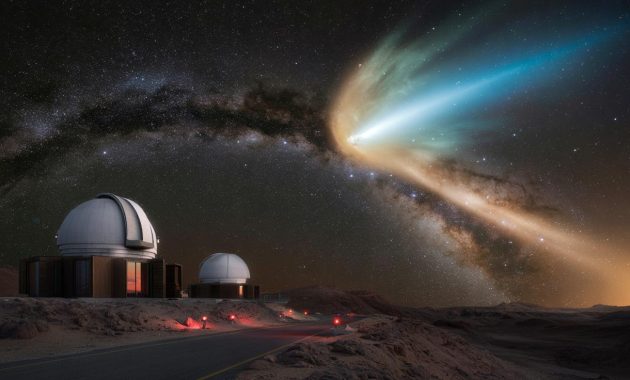
Telescopes turned. Forums lit up. Then NASA stepped in with a cool-headed update that trimmed rumor and sharpened the facts.
What we know so far
NASA has confirmed that the object now catalogued as 3I/ATLAS is moving through our planetary neighborhood. It is not bound to the Sun. It entered from interstellar space and will leave again on a one-time swing. The agency stresses there is no danger to Earth based on current tracking.
NASA: 3I/ATLAS poses no threat to Earth, and will stay well away while it arcs through the inner solar system.
The object was spotted on 1 July 2025 by the ATLAS survey operating from Chile. That early detection triggered follow-up from major facilities, including teams at the Instituto de Astrofísica de Canarias and the Vera C. Rubin Observatory. Data points pulled from multiple nights allowed a firm orbit solution and the “3I” designation: the third confirmed interstellar object after ‘Oumuamua (2017) and Borisov (2019).
Size, speed, and path
Early measurements suggest a nucleus roughly 10 to 30 kilometers across. That places 3I/ATLAS in the heavyweight class compared with known interstellar visitors. The comet is moving at about 68 kilometers per second. That is more than 130,000 miles per hour. It carries a visible coma and a tail, which signals active ices and dust being shed as it warms.
Researchers say 3I/ATLAS could be the largest interstellar visitor detected so far, with a bright, active coma and a clean hyperbolic escape path.
| Key fact | Current estimate |
|---|---|
| Discovery date | 1 July 2025 (ATLAS, Chile) |
| Object type | Interstellar comet (active) |
| Nucleus size | ~10–30 km |
| Speed | ~68 km/s |
| Closest solar approach | ~130 million miles from the Sun, expected October 2025 |
| Earth risk | None expected from current trajectory |
How scientists are reading the clues
Interstellar comets arrive with chemical fingerprints baked in during their birth around distant stars. As sunlight heats the nucleus, ices vaporize and carry dust into the coma. Spectrographs then dissect that light. Teams are already parsing ratios of water, carbon monoxide, and complex organics. The signals help reconstruct the comet’s origin environment: cold, calm outskirts like a distant analogue of our own Oort cloud, or a more turbulent nursery that left distinct chemical scars.
Multiple instruments are contributing. Wide-field cameras refine the orbit and activity curve. High-resolution spectrographs look for isotopes such as deuterium, which trace temperature conditions during formation. Polarimetry examines dust grain sizes. Each method adds a layer to the picture.
- Composition: water, CO, CO₂, and organic molecules mapped over time
- Dust physics: grain size distribution and jet structures across the coma
- Rotation: spin rate and any tumbling state of the nucleus
- Aging: how fast the activity rises and fades with solar heating
- Origin clues: isotope ratios that hint at the comet’s birth zone
Is it alien tech? The debate, without the noise
Speculative takes surfaced fast, as they always do. A few voices floated the idea of artificial origin. The broad scientific view does not support that claim. Observers report textbook comet behavior: sublimating ices, dust jets, a growing tail, and a hyperbolic track that fits gravity and heating. That does not need exotic explanations. Lessons from ‘Oumuamua and Borisov inform this cautious stance: start with the simplest model that fits all the data.
➡️ Why you keep rehashing old arguments in your mind and the closure technique that stops the loop
➡️ Gardeners who stopped watering at this specific time saw healthier plants within weeks
➡️ Eclipse of the century: six full minutes of darkness, when it happens and where to watch
➡️ A giant find under the desert could upend the global nuclear race
Current observations match an active comet moving on a one-pass interstellar course. No evidence points to anything else.
What you can try at home
Amateur astronomers with medium to large telescopes can chase 3I/ATLAS as conditions allow. The comet may remain a faint, diffuse smudge for most backyard setups. Dedicated imagers using stacked long exposures will do better. Follow updated finder charts from observatories and plan for dark, clear nights with steady air. A sensitive camera and patient tracking will reveal the tail structure long before it pops to the naked eye.
- Use at least a 150–200 mm aperture for visual attempts.
- Favor low magnification first to catch the diffuse glow.
- Stack short exposures to tame trailing at high speed.
- Try narrowband filters tuned to CN or C₂ for coma contrast.
What comes next
Tracking will continue for months as 3I/ATLAS brightens and then fades. Engineers are studying a daring option: a trajectory tweak that could bring NASA’s Juno spacecraft near the dust environment in 2026. Fuel margins, radiation limits, and geometry would all have to align. No decision has been announced. Ground-based campaigns will carry most of the load, with radar unlikely given the distance.
Why this one matters
Only two interstellar objects had been confirmed before now. Borisov gave us a clear, gassy comet. ‘Oumuamua stayed stubbornly odd, with a peanut shape and non-gravitational forces that still spark arguments. 3I/ATLAS looks more cooperative. It behaves like a classic comet, only faster and older, and probably larger. That makes it a clean laboratory for testing how other planetary systems seed space with icy leftovers.
How scientists tell an interstellar visitor from a local
Two flags give the game away. First, the orbit is hyperbolic, with an eccentricity above 1, which means it will not be captured. Second, the inbound speed is too high for a body nudged out of our own Oort cloud. Combine those with spectral data that resemble fresh ices, and the interstellar badge sticks.
Extra context you can use
Interstellar comets help calibrate life’s raw materials. Detecting simple organics, and how they change with sunlight, feeds models of chemical delivery to young worlds. If 3I/ATLAS carries complex molecules in unusual ratios, that could hint at colder or warmer birth conditions than those common around Sun-like stars.
For students and clubs, simple simulations can add insight. Use free orbital tools to model a hyperbolic pass and compare it with a bound comet’s ellipse. Vary the velocity and watch how the deflection near the Sun changes. Then add a sublimation model to see how jets can nudge the path. Those small forces matter for precise predictions, especially when gas release is patchy.
Risk questions always arise with comets. This pass does not threaten Earth. The larger value here is knowledge. A big, active interstellar comet lets researchers refine exposure times, calibrate instruments, and test coordination between surveys. That practical experience pays off when a fainter, trickier object shows up next time.