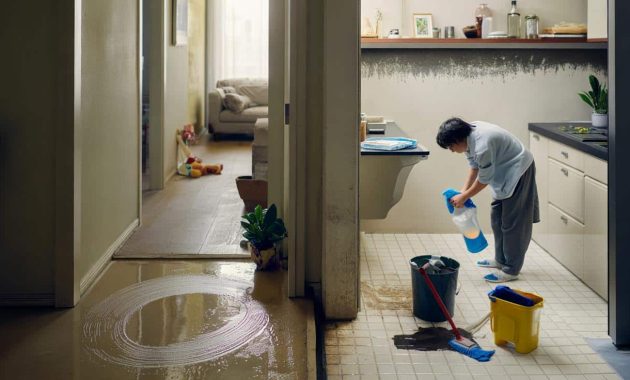
Saturday morning, 9:07 a.m. You grab the same blue cloth, the same lemon-scented spray, and you start your weekly loop. Kitchen counters. Coffee table. Bathroom sink. You follow the exact same route your body now knows by heart, almost without you.
Then one day, you move a plant “just to see”. Under the pot: a sticky ring, dust baked into the varnish, a tiny army of crumbs that somehow escaped your routine for months.
Your home looks clean at a glance. Smells clean. Yet the closer you look, the more tiny blind spots appear.
Something in this picture doesn’t quite add up.
When “clean enough” quietly stops being clean at all
Every home has a choreography. You start with the big surfaces, swipe the dust that shows, vacuum the visible bits of the rug. Same gestures, same tools, same order. It’s comforting, almost ritual.
The problem is that rituals age. Your life changes, dust patterns change, humidity shifts, objects move, kids or pets arrive. Your weekly routine stays frozen in time while your home keeps evolving.
That’s how slowly, silently, a “good” cleaning routine can start working against you.
Think of the bathroom shelf where your skincare lives. You always wipe the front edge, the part you see in the mirror. One day, you finally pull everything off. Under the bottles: a gray film of product residue, hair, and microscopic soap splashes that formed a sticky layer over months.
Or take the hallway. You vacuum straight down the middle every Sunday. The sides, near the baseboards, get a quick pass at best. Six months later, the edges are visibly darker than the center. Not dirty enough to shock you. Just… dull.
That’s how dust wins: not in big dramatic piles, but in thin, persistent layers at the margins of what we touch.
On a microscopic level, repetitive cleaning in the exact same spots pushes dirt elsewhere. The same mop strokes move dirty water into grout lines. The same feather duster flicks particles from shelves onto radiators and behind furniture. Your eyes register the immediate “clean” signal, your brain relaxes, and the slow build-up in hidden spots continues.
There’s also a psychological trap. Once you have a routine, you trust it. You stop questioning whether the products still fit your surfaces, whether your vacuum filter is clogged, whether your habits match your current lifestyle. **Repetition becomes a comfort blanket that quietly hides reality.**
➡️ This rich chocolate cake recipe stays incredibly moist for days, even without any frosting
➡️ Almost one in two people will develop cancer in their lifetime, says Robert Koch Institute
➡️ If your dog follows you everywhere, here’s what it means
➡️ Snow for every corner of the UK? 2.8 inches an hour, 10 days out: will your street be hit
➡️ Japanese Defense Ministry Claims Spotting Aircraft Carrier Liaoning Near Japan
➡️ Psychology reveals why your mood shifts after certain interactions without obvious reasons
That’s when a home can look “fine” while indoor air quality, allergen levels, or mold risks creep upward.
The tiny shifts that change everything in your cleaning routine
The simplest way to break this pattern is not to clean more. It’s to clean different. Start by rotating your focus. One week, give five extra minutes to “high but forgotten” spots: top of fridge, tops of doors, lampshades. Another week, go “low and hidden”: under sofas, behind bathroom trash cans, under the washing machine drawer.
Change your tools too. If you always use the same all-purpose spray, pick one area to treat differently: vinegar and water on glass, a microfiber cloth slightly damp on screens, a degreaser once a month on kitchen cabinets. Small shifts reveal neglected residue you stopped seeing.
One useful trick: adopt a “zone of the week”. It could be “entryway and shoes”, “kitchen cabinets”, or “bedroom textiles”. You keep your normal routine, but you add one rotating mini-mission, no more than 15 minutes. It doesn’t sound like much, yet over a month you’ve touched four forgotten areas.
Be gentle with yourself about gaps. Maybe you never wash your trash can lid, or you’ve never vacuumed your mattress. You’re not alone. Let’s be honest: nobody really does this every single day.
The aim isn’t a showroom home. It’s to break the autopilot long enough to see where your current habits stop being useful.
We’ve all been there, that moment when you move a piece of furniture and suddenly feel like you’re uncovering an archaeological layer of your own dust.
- Change your path: Start cleaning in a different room or from the opposite side of the same room once a month.
- Change your angle: Look under furniture with your phone flashlight, or take a photo of a shelf and zoom in. The camera catches what the eye filters out.
- Change your rhythm: One week focus on “wet” cleaning (mopping, wiping), the next on “dry” (dusting, vacuuming, shaking textiles).
- Change your target: Instead of “clean the kitchen”, pick “handles and switches” or “door frames and baseboards”. Very specific, very fast.
- Change your tools: Wash or replace cloths and sponges regularly so you’re not spreading yesterday’s grime into today’s corners.
When cleaning becomes a conversation with your home
If you pay attention, your home talks back. A faint smell near the sink that returns three days after you scrub. Dust that seems to settle faster in one room than another. A window that fogs up every shower, no matter how often you wipe it. These are signals, not failures.
The moment you stop cleaning on autopilot and start noticing these patterns, your routine shifts from “fight against dirt” to “collaboration with reality”. *You’re not just repeating moves, you’re responding to what your space is telling you this week, in this season of your life.*
| Key point | Detail | Value for the reader |
|---|---|---|
| Rotate your focus | Zones of the week and different height levels | Keeps hidden build-up from turning into big cleaning jobs |
| Question your tools | Adapt products and cloths to surfaces and age of dirt | Less scrubbing, better results, fewer damaged materials |
| Break autopilot | Change order, angle, and small weekly missions | Makes cleaning more efficient and less mentally draining |
FAQ:
- Question 1How often should I change my cleaning routine so it doesn’t backfire?
- Answer 1Every 3–4 months, take 20 minutes to review what’s working and what’s not. Walk through your home with a fresh eye, look up and down, and adjust one or two habits: where you start, which tools you use, or which “zone of the week” you rotate.
- Question 2Is it bad to use the same all-purpose cleaner everywhere?
- Answer 2Using one product for everything can lead to residue build-up or damaged surfaces over time. Glass, natural stone, wood, and textiles each react differently. **Switching products for at least a few key areas** (like stone countertops or screens) usually gives better results and protects materials.
- Question 3Why does my home still feel dusty even though I clean weekly?
- Answer 3Often the issue isn’t frequency, it’s strategy. If you always dust after vacuuming, or use a feather duster that just moves particles into the air, dust keeps circulating. Try vacuuming first, then wiping with a slightly damp microfiber, and don’t forget textiles like curtains and cushions.
- Question 4How can I avoid spreading germs with the same cloth?
- Answer 4Use color-coded cloths for different zones (bathroom, kitchen, living areas) and wash them hot after one or two uses. Fold the cloth in four and use a fresh side for each surface, instead of rubbing everything with the same dirty patch.
- Question 5What’s one small change that makes the biggest difference?
- Answer 5Many people see a big shift when they start cleaning “touch points” weekly: door handles, light switches, remote controls, phone screens, appliance buttons. They don’t look dramatic, yet they carry a lot of invisible grime and bacteria, and refreshing them changes how clean a home feels.